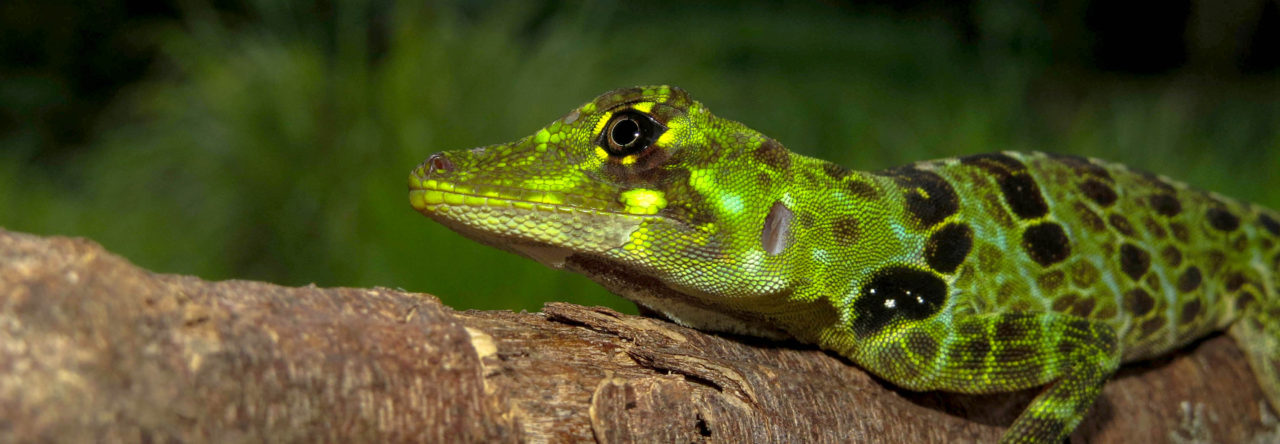
I received a copy of Steven Poe’s “guide” to the mainland anoles. The book includes summaries of 240 species, copious photographs, range maps, and chapters on anole biology and identifying and catching anoles. The 400+ page tome is not entirely devoid of value. Many of the photos are excellent, the maps are useful, and the book’s thickness encourages functionality as a step stool (although its heft precludes frequent usage in this capacity). Unfortunately, the self-satisfied prose of the author fails to distract sufficiently from the book’s considerable inadequacies, an exhaustive list of which might exceed the length of Poe’s long-winded exposition itself. Settling on the most salient among the myriad deficiencies in Poe’s treatment is a challenge akin to finding a live Anolis roosevelti during daytime while jacked on Bufotenin (Figure 1). Herewith I make my attempt.
First of all, who made Poe judge and jury of Anolis taxonomy? Just because Anolis osa has no diagnostic characters save for continuously varying hemipenial traits, freely interbreeds with A. polylepis, appears externally identical to A. polylepis, is mitochondrially nonmonophyletic relative to A. polylepis, and is found syntopically with A. polylepis, doesn’t mean we shouldn’t recognize A. osa as valid. Even though A. ibague, described from external characters, looks exactly like A. sulcifrons doesn’t mean it might not be an Ibague-area endemic. And no, Poe’s addition of an appendix with detailed point-by-point refutation of each of the species names he fails to recognize does not absolve such cavalier taxonomic behavior. Somebody must do the work before we make such rash decisions! Somebody needs to examine Type specimens!
 Second, do we really need the tone of a wannabe cross between Bill Simmons and Hunter S. Thompson in the text of a field guide? Seriously: A reference to Land of the Lost? (P. 367; does anyone under age 70 know what this is?); telling us Linnaeus was “cool” with herps? (P. 367); describing one’s difficulty to identify a specimen as being “screwed”? (P. 37); mocking E. O. Wilson’s ineptitude in identifying anoles? (P. 369; OK, upon rereading maybe Wilson deserved that). Author Poe, drop the cheekiness and just tell us how to identify the anoles, please. Realize, dear Poe: not everybody enjoys your writing as much as you do.
Third, what’s with the imperialist gall of offering a guide to all mainland anoles (Figure 2) ? Señor Poe, have you traveled to all of the neotropics and seen all the pertinent anoles in life? Have you caught mirus, proboscis, fungosus, lamari, brooksi, alvarezdeltoroi? Have you visited Adrian Nieto’s anole collection in Mexico or James Aparicio’s in La Paz? I’ll trust Ayala-Varela in Ecuador; Velasco and Moreno-Arias and Daza and Calderon and Castro-Herrera in Colombia; Rivas and Barros in Venezuela; Chaves and Köhler (R.I.P.) in Costa Rica; Ibañez in Panama; Yañez-Miranda and Venegas in Peru; Rodrigues and Prates in Brazil; Nieto Montes de Oca in Mexico; thank you. Newsflash to Poe: We. Don’t. Need. You. Go back to your adobe tower at UNM, drop the toploftical anole schtick, and stick to phylogenetic computer games and data cooption. You want another anole named after you? How about Anolis whiteprivilegei?

And finally, ahem, the photos and the maps? Oh, you know, those subtly credited triflings that constitute essentially ALL THAT IS OF VALUE IN THE BOOK? How about making Tom Kennedy, Chris Anderson, and Joseph Barnett coauthors? Do you think you could have produced this book without Torres-Carvajal’s PUCE website? Without the maps by Barnett? Without iNaturalist anole leader Kennedy’s photos? Without Savage (2002), McCranie and Kohler (2015), Arteaga et al. (2023), Moreno-Arias et al. (2021), Castro-Herrera and Ayala (unpublished Saurios de Colombia), and Ernest Williams’ unpublished notes? It is one thing to produce an arrogantly broad taxonomic treatise. But to do so as the sole author? Child, please. Ernest Williams could have written this book, except good. You, Senhor Poe, are no Ernest Williams.
I could go on and on and on and on and on describing the countless and multifaceted defects in Poe’s treatment, but the time commitment required for even a tally of such failings strains the credible limits of scientific service. The retraction of this book in its entirety from Princeton University Press is warranted and should be advocated on grounds that the book fails to reach even the most base standards of scholarship. The thing reads like a children’s joke book that is not funny even to children.
However. If you can tolerate the author’s smug tone, his authoritarian taxonomic tendencies, his bumptious claim to be an expert on all mainland anoles, and his anti-conservationist approach to conservation; if you are comfortable with pop-culture references in a field guide, an overwritten chapter that presents guidelines for finding and catching anoles in nauseating detail, and natural history accounts that focus on sleeping behavior (of all things); if you can stomach footnotes upon footnotes that offer little beyond exemplary demonstration of the author’s singular talent for herpetological inanity; well, you might find some serviceableness in Poe’s treatment of mainland anoles.
But I doubt it.
Pete Snove
Adjunct Assistant Administrative Faculty, Eastern New Mexico State Seminary College of the Southwest, Clovis Satellite Branch at Yerba, New Mexico, USA.