
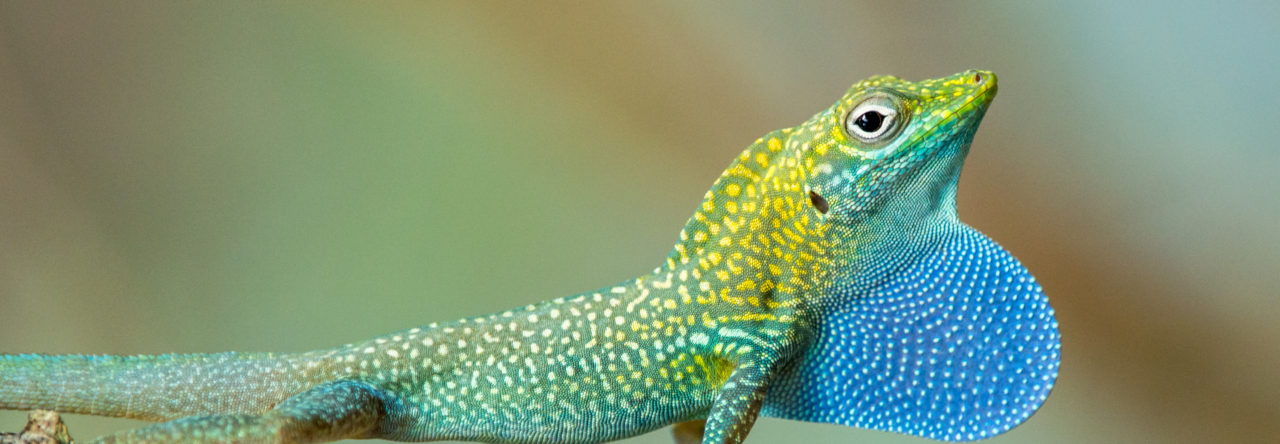
 What better adornment for an arm than a lovely knight anole? Thanks to Chuck Horne, the proud bearer of this lovely crown giant. We’ve featured anole tattoos before, but there must be others out there? Anyone want to share?
Author: Jonathan Losos Page 62 of 133
Professor of Biology and Director of the Living Earth Collaborative at Washington University in Saint Louis. I've spent my entire professional career studying anoles and have discovered that the more I learn about anoles, the more I realize I don't know.

Everyone loves a good photo of an anole eating something, and here’s a fine one of an anole chomping down on a dragonfly (or maybe a damselfly). It’s from the Facebook page of Tigertail Airboat Tours located on the Tamiami Trail in Florida. No details on what happened, but looks like a happy ending for one festive anole.


Lyriocephalus scutatus. Photograph by Ruchira Somaweera, National Geographic
We at Anole Annals love horned lizards, and so were delighted to read about new research on Sri Lankan hornies, reported on the National Geographic Society’s webpage. Check out the article, which details recent research by Ruchira Somaweera of Sydney University.

Certatophora stoddartii. Photograph by Ruchira Somaweera, National Geographic
There was a lot of discussion last month about the fabulous anole goings-on at the SICB meetings. However, there were other conferences sporting important anole work over the holidays. One of them was International Plant and Animal Genome XXII, described as “the largest AG-genomics meeting in the world” and held in San Diego in early January. Perhaps not a venue at which you’d expect anole work to be discussed, but there was Poster #720:
Mining the Most Species-Rich Amniote Genus: de novo Sequencing of Three Anole Lizards for Comparative Genomic Analysis #P720
Date: Monday, January 13
10:00 am – 11:30 am
Description:
Presenters: Marc Tollis Arizona State University, Elizabeth D. Hutchins Arizona State University, Walter L. Eckalbar Arizona State University, Michael R. Crusoe Arizona State University, Catherine M. May Arizona State University, Jessica Stapley Smithsonian Tropical Research Institute, Elise Kulik Arizona State University, Matt J. Huentelman Translational Genomics Research Institute, Rebecca E. Fisher University of Arizona, Kenro Kusumi Arizona State University
P720 – Mining the Most Species-Rich Amniote Genus: de novo Sequencing of Three Anole Lizards for Comparative Genomic Analysis
The repeated evolution of morphological adaptations to specific ecological niches makes Anolis lizards a spectacular example of adaptive radiation in vertebrates, and an ideal model for comparative genomics. The complete genome of the green anole (A. carolinensis) has already provided insights to the evolution of genomic and phenotypic variation in vertebrates. A multi-species comparison within the Anolis genus would increase the power of studies seeking to understand the genomic bases of species diversification. We carried out de novo whole genome sequencing and draft assembly of three species, the grass anole (A. auratus), the bridled anole (A. frenatus), and the slender anole (A. apletophallus). Here we report some of our preliminary comparative genomic findings. Analysis of the abundance and diversity of transposable elements within these genomes has revealed repetitive landscapes typical of non-mammalian vertebrates, yet variation between Anolis species is greater than what is observed across most mammals. This may have provided a genomic environment amenable to key adaptations during the Anolis radiation. Using well-defined models such as mouse and chicken, we identified orthologous genes integral to myogenesis and limb development, and are beginning to catalogue interspecific variation in protein-coding genes and cis-regulatory motifs. Functional anatomical and histological studies are being performed to quantify the tail and hindlimb muscle groups of these species compared to A. carolinensis. Our ultimate goal is to identify the divergent alleles associated with ecological speciation, thus bridging the genotype-phenotype gap.

Read all about it in this post on Deadspin.
Update March 13, 2014: Here’s a less happy story on the same theme.

All’s well that ends well
A couple of days ago, we had a post about a poor anole frozen to death in wintry Texas. Today comes a report on Dust Tracks on the Web of another green anole incapacitated by unseasonable chill, but with a happier ending.

Photo from http://www.frogtown.org/
For more than three decades, since the seminal work of Ray Huey, Al Bennett, and Steve Arnold, biologists have measured whole animal performance–how fast they run, how far they jump, how well they can swim–to understand how species are adapted to their environment. Work on anoles has been a prime example of how we can study differences among individuals and species to understand how natural selection works and why species living in different environments possess different morphologies (several AA posts have discussed this sort of work [e.g., 1, 2, 3]).
But a critical assumption of all of this research is that we can get animals to perform maximally. Otherwise, it’s tough to study what causes variation in maximal capabilities if animals aren’t performing maximally. The catch is: how do you tell if an animal is going all out? Sure, it’s easy to weed out the slackers, but distinguishing a lizard giving it his all from one going at, say, 90% of max…hard to tell.
In an important and entertaining paper, Henry Astley and colleagues provide some sobering information. The short story goes as follows, and you really should watch the video below for more details and some great images: biomechanicians have studied frog jumping for decades to understand how muscles work. Bullfrogs are known not to jump very well. The maximum jump ever recorded in the lab was only 1.3 m, whereas the much smaller Cuban treefrog can bound 1.7 m. The proffered explanation was that bullfrogs live on land and in the water, and so their morphology must be a compromise.
But…the Guinness Book of World Records claims that a bullfrog–Rosie the Ribeter, to be exact–once jumped 2.18 meters at the Calaveras County Fair. That’s 68% farther than any scientist had ever recorded in the lab. Sounds like a bunch of hooey, right? Well, just to debunk this nonsense, a bunch of Brown University biologists headed to sunny California to visit the County Fair, eat some cotton candy, and check out the frogs. And, lo and behold, it’s true–bullfrogs there regularly far exceed the lab record.
The story’s a lot more complicated–it turns out that there are “pro” frog jumpers–and I won’t go into the details; the paper is well worth a read, very entertaining and sobering for lab performance types (abstract here). But the short story is this: it seems that lab studies had massively underestimated how far bullfrogs can jump, calling into question many of the conclusions that had been reached about their physiology. Moreover, records for the maximum jump distance at the fair showed a steady increase for the first 50 years before levelling off for the last 30. This suggests that the people who jump the frogs (and some families have been doing this for generations) have only gradually learned exactly what conditions and behaviors maximally stimulate the frogs. And this suggests that lab scientists, who just guess at what may work best and tinker a little bit, may not have much of a chance of hitting on the right stimuli.
There’s been lots of great press coverage, too–just google “calaveras frog astley” or something like that. But, first, watch the video and go read the paper (I can email you a copy if you can’t access it online).
httpv://www.youtube.com/watch?v=QKFpvoez7_M

Two days ago, the Boston Globe had an article online,
Winter storm causes havoc in US South
“A winter storm that hit the southern United States yesterday all but paralyzed the city of Atlanta, stranding people in cars at stores and children at their schools. The storm only brought a few inches across the region but with the ice caused major problems in America’s southern region.”
Accompanying the article were 28 photos. The one above was #22, with the following caption: “Snow covers a dead lizard in Springville, Ala., on Jan. 28. (Mark Almond/Associated Press)”
 Until now, Anolis omiltemanus was the only Mexican anole restricted to pine forests. However, in a new paper in Zootaxa, Gunther Köhler and colleagues have described a new species, A. peucephilis, from the southern Sierra Madre del Sur in southern Oaxaca, nearly 300 km from A. omiltemanus. The new species differs morphologically in a number of respects, most notably in its extremely short legs. It is also is divergent in mitochondrial DNA. All specimens were collected at night in pine trees at heights ranging from 2-10 meters. No specimens could be located during the day, suggesting that they are very cryptic, a common trait with short-legged anoles.
Wondering what the name means? Here’s what the paper says in its etymology section: “The name peucephilus is a compound adjective derived from peuke (Greek for pine) and philios (Greek for loving) referring to the obvious habitat preference of this species.”
