
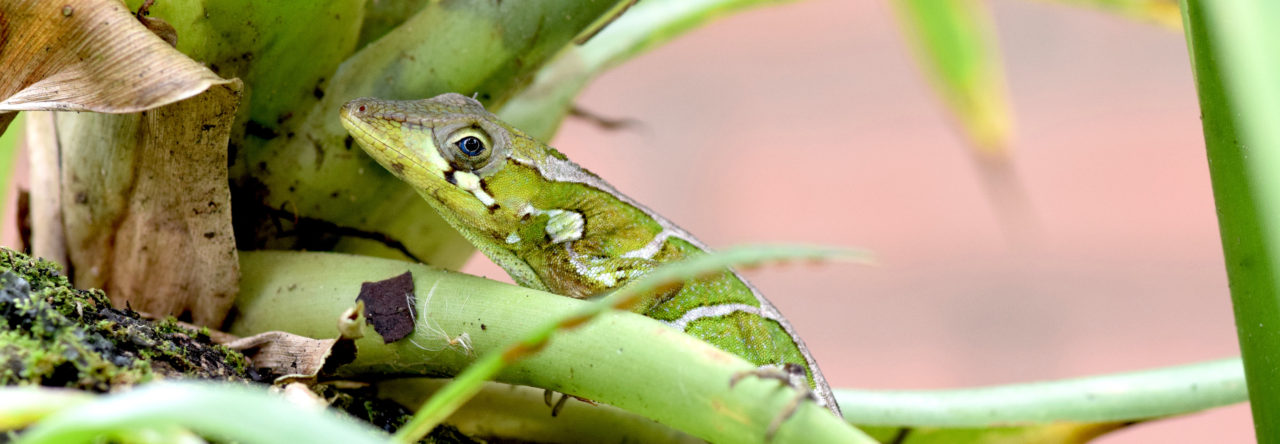
 We’ve reported on bird predation on anoles many times before [e.g., 1, 2, 3, 4], but here’s another. The paper just out in Herpetological Notes has also the gory details of what went down in Veracruz, Mexico.
Author: Jonathan Losos Page 48 of 133
Professor of Biology and Director of the Living Earth Collaborative at Washington University in Saint Louis. I've spent my entire professional career studying anoles and have discovered that the more I learn about anoles, the more I realize I don't know.
In a recent post on the newly described Anolis triumphalis, I stated that the Reptile Database listed 400 anole species. It turns out I was mistaken. Fortunately, Claus Petesen and Peter Uetz have set the record straight in the comments: A. triumphalis makes 396. Four to go! Everyone get out there and find some new ones!

The march of Anolis to 400 species continues with a paper by Kirsten Nicholson and Gunter Köhler describing a new species from Panama.Actually, according to the Reptile Database, there are already exactly 400 species! So this makes 401.
Previously, ten members of the pentaprion group were known, seven from Central America, three from South America.
 The new species, A. triumphalis (described under the name Norops triumphalis) has a large orange dewlap, thus distinguishing it from all other members of the group, which have a reddish-purple dewlap.*
Anolis triumphalis is described from a single male that was captured crossing the road between pastures with tall grass and a fence composed of wooden fenceposts and living trees. As the authors note, pentaprion group anoles are very similar to West Indian twig anoles. This story is reminiscent of the rediscovery of another mainland twig anole, A. proboscis, found after forty years by a group of birdwatchers when a male was observed crossing a road in front of a mini-van. Why the twig anole crossed the road is clearly a question that will puzzle philosophers for years to come.
*The authors state that the large, orange dewlap doesn’t distinguish A. triumphalis from A. sulcifrons, but as far as I’m aware, the latter species has a red-purple dewlap like other pentaprion group members.
Here’s the abstract:
We describe the new species Norops triumphalis sp. nov. from Darién, Panama. Norops triumphalis differs from all congeners by having a combination of (1) smooth, bulging, subimbricate ventral scales; (2) a short tail, ratio tail length/SVL 1.54; (3) short hind legs, longest toe of adpressed hind leg reaching to ear opening, ratio shank length/SVL 0.24; (4) a lichenous body pattern; and (5) a very large yellowish orange dewlap in males. In external morphology, N. triumphalis is most similar to the species of the N. pentaprion group. Norops triumphalis differs from the other species in the N. pentaprion group, except N. sulcifrons, by having a very large orange male dewlap (vs. a large red or pink dewlap) and an unpigmented throat lining. Norops triumphalis differs from N. sulcifrons by having the supracaudal scales not forming a serrated crest (vs. a distinct serrated caudal crest present in N. sulcifrons), 4 supracaudal scales per segment (vs. 3 supra-caudal scales per segment in N. sulcifrons), greatly enlarged outer postmental scales, about four times the size of adjacent medial scales (vs. moderately enlarged outer postmental scales, about twice the size of adjacent medial scales, in N. sulcifrons), and no enlarged postcloacal scales in males (vs. a pair of moderately enlarged postcloacal scales present in male N. sulcifrons). We further provide a standardized description and illustrations of the holotype of N. sulcifrons.
![Angie-Les-Christmas-card[1]_1](https://i0.wp.com/www.anoleannals.org/wp-content/uploads/2014/12/Angie-Les-Christmas-card1_1.jpg?ssl=1)

My Backyard Birding posted this video on Youtube, stating: “Five Brown Anole Lizards feeding voraciously on venomous Fire Ants in the backyard. I’m not sure this phenomena has ever been filmed before. Amazingly the common, but invasive, Brown Anole Lizards living in the backyard have evolved to enjoy a treat of invasive fire ants, probably because they have been around together for many years now.”
Can anyone confirm that these are fire ants that the anoles are eating?

This fabulous photo of a blue phase Anolis carolinensis was snapped by Will Talley of the Santa Fe College Teaching Zoo. It appeared in the Association of Zoos and Aquarium’s (AZA) monthly magazine, Connect, which sponsors an annual photo contest, and this photo was celebrated as one of the best entries.
Will kindly gave us the backstory: “I was biking down Hawthorne trail outside of Gainesville Florida and got to the Alachua Lake overlook. That’s where this guy was. I saw him on a section of the platform, got my macro lens out. As soon as I got the camera close he seemed to see his reflection and start displaying. It happens quite often with animals seeing their reflection, it seems.”
Will sent along another fine herpetological photo as well, and you can check out some more of his work on Flickr.

The Biodiversity Heritage Library just tweeted this figure from
Title
Abbildungen zur Naturgeschichte Brasiliens /
Title Variants:
Alternative: Recueil de planches coloriées d’animaux de Brésil
By
Wied, Maximilian, Prinz von, 1782-1867
It’s Plate 44, labelled, as you can see, as Anolis viridis and A. gracilis, but according to the tweet, they are both A. punctatus, male above and female below.

Photo by Eladio Fernandez.
Eladio Fernandez observed this interaction in Pedernales, Dominican Republic. He reports that the little fellow eventually escaped and lived to see another day.

Anolis bartschi. Photo by Shea Lambert. Check out his previous post, with more photos.
The long-running U.S. embargo has failed to topple the Castro regime in Cuba, but has done a good job of stymying research on anoles. Despite its great biodiversity, less is known about the Cuban fauna and flora than other Caribbean islands (despite the great efforts of Cuba’s excellent scientific establishment). I can speak from personal experience in saying that even though scientific research is one of the exemptions in the U.S. embargo law, getting permission from the U.S. and Cuban governments to work there has often been difficult. Recently (and probably still the case, though the U.S. government’s interpretation of the law is constantly changing), graduate researchers, in particular, have troubles because they are not considered “full time professionals” and thus not eligible to travel there under the research exemption.
Let’s hope that all restrictions are lifted soon so that the marvelous biodiversity of Cuba can be observed, studied, and conserved.

Anolis vermiculatus from another Shea Lambert post.