
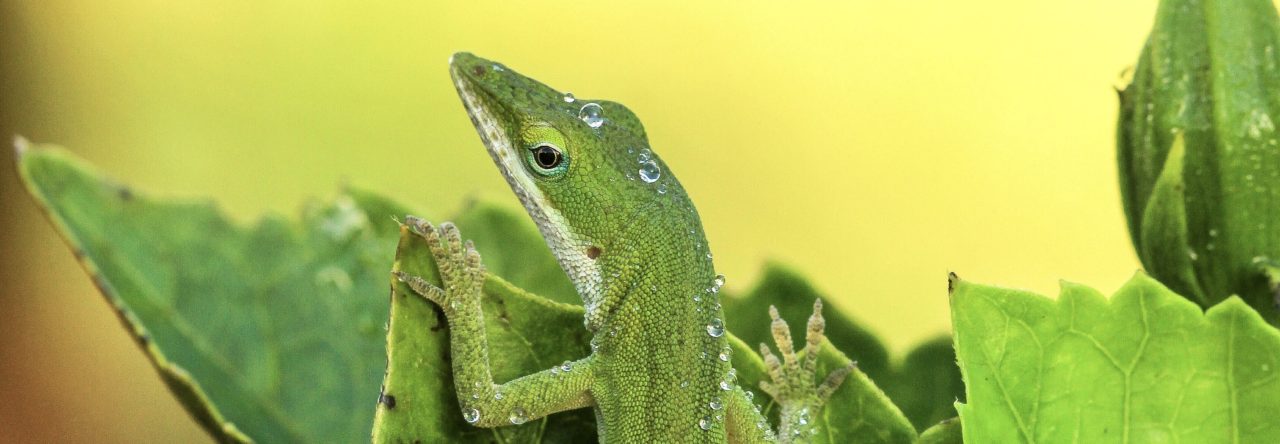
 Florida green anoles appear so loving and peaceful. But perhaps the tranquility of Hawaii brings out the devil in them. Johanna Mercier was on vacation on Kauai with her husband and daughters when she snapped these photos on February 27th. She describes what happened: “These were taken in Kapa’a, Kauai at about 4:30pm. They were on a hibiscus plant and I almost missed them, they blended in so well. I watched them for almost half an hour and finally had to pull myself away to make dinner. NOT being sarcastic, they were fascinating! They would flare out their dewlaps and bob at each other with their mouths open and then latch onto each other. They would stay in this lock for easily 5-10 minutes without moving. Then one would slip and fall; they’d climb back to each other and do it all again.”
Author: Jonathan Losos Page 129 of 133
Professor of Biology and Director of the Living Earth Collaborative at Washington University in Saint Louis. I've spent my entire professional career studying anoles and have discovered that the more I learn about anoles, the more I realize I don't know.

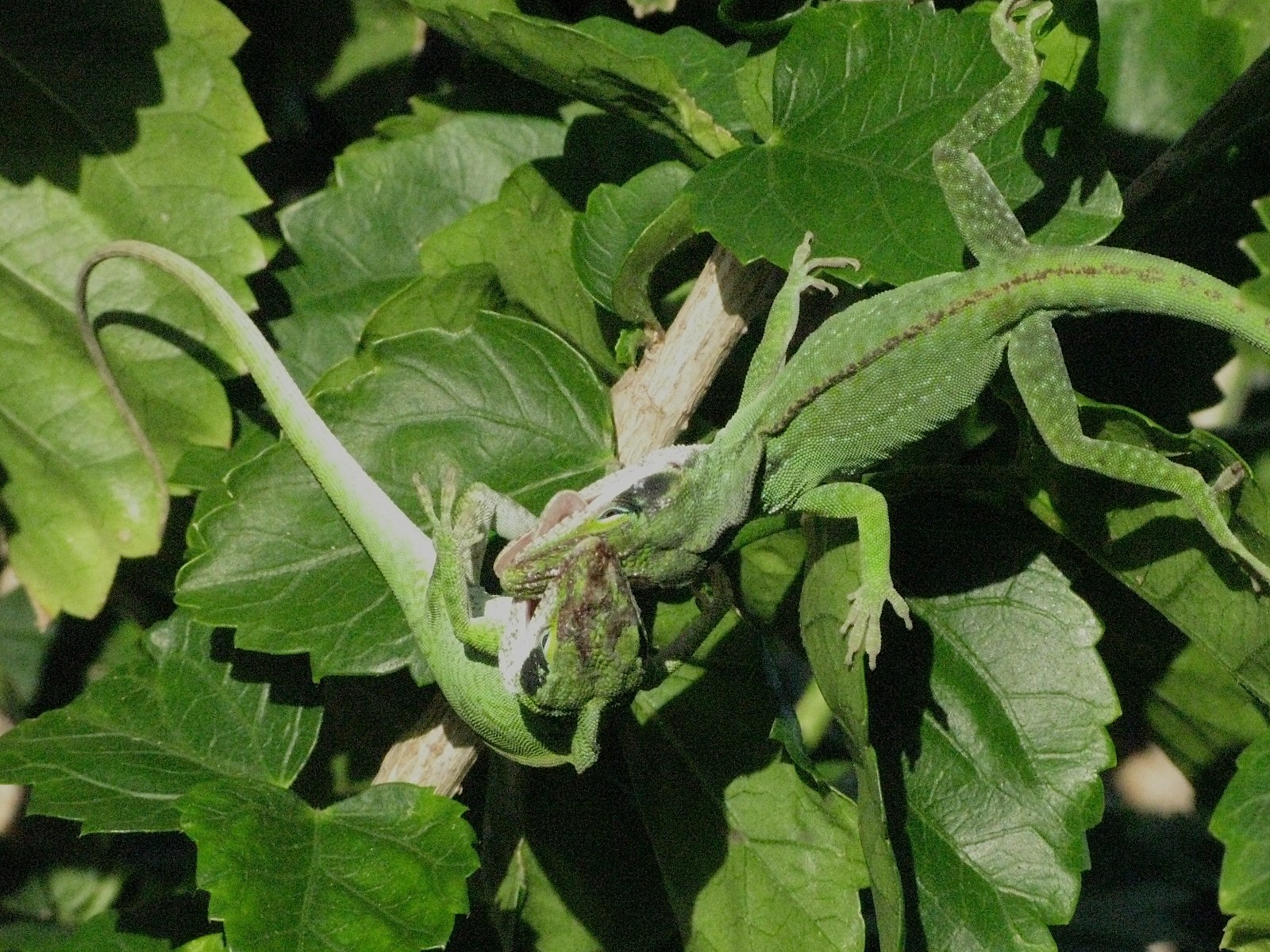
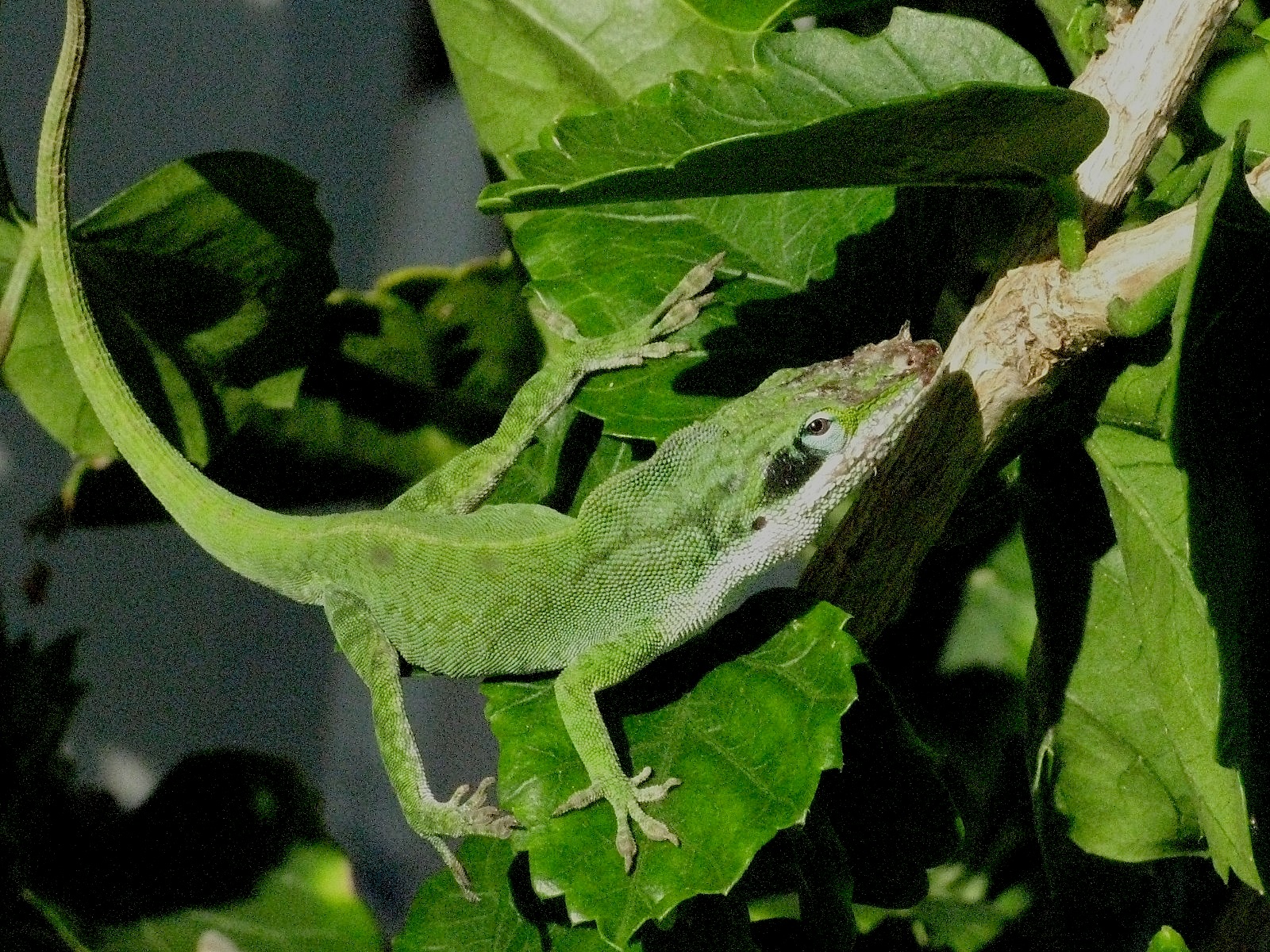

Photo @Alexa Class.
Pictured here is a nestling ocellated antbird with an anole of some sort (A. lemurinus? humilis?) stuffed down its throat (photo taken at La Selva Biological Station in Costa Rica; event described in Ornitologia Neotropical, vol. 20, 2009). Alexa Class and Johel Chaves-Campos several times observed these birds take anoles from army ants. Johel also reported he has “seen bare-necked umbrellabirds grabbing Norops capito anoles from tree trunks covered with mosses at middle elevations (about 1000 m, Caribbean Slope) in Costa Rica. I was truly impressed by how far away the bird was when it detected the lizard; at least 30 feet away in front of me. Actually, I was watching it with binoculars. The lizard was perhaps 7-10 feet away from me, on my side, and the bird flew directly towards where the lizard was and took it in front of my face. By the way, the lizard was so well camouflaged that I couldn’t see it until the bird took it. Great vision!”

Guess what these are
Anolis polylepis is a small and very abundant anole that occurs in southwestern Costa Rica. Recently, Köhler and colleagues divided A. polylepis into two species based on the structure of the hemipenis illustrated above. The vast majority of A. polylepis retains the name, but populations of the lizard on the Osa Peninsula, where the famous Corcovado National Park is located (and hence from where many people know A. polylepis) are now to be known as A. osa.
The species may be distinguished by their man parts. Anolis polylepis, whose hemi-tallywacker is on the top row above, has a bilobed organ, whereas that of A. osa, on the bottom row, is unilobed. What appears to be a narrow hybrid zone occurs at the base of the Osa Peninsula, where lizards exhibit an intermediate hemipenial morphology. Köhler et al. examined a number of other morphological characters, including dewlap color, and found that in all other respects, the two taxa could not be distinguished.

Photo copyright Ben Freeman
Ben Freeman of Cornell University writes: here is a photo of a White-tipped Quetzal with an anole, taken at 1800 m on Santa Marta Mountain, Colombia. While working as a bird guide we found an active quetzal nest and we had the chance to observe the adults on various days (<10 h observation). On three occasions, we saw quetzals bring anoles of the size shown in the photo, while an adult appeared to bring a fruit (Lauraceae) on one occasion. The adult posed for a long time with the lizard before entering the nest, presumably feeding the nestling(s) in the cavity nest.
Anyone know what species of anole this might be?

Anolis sagrei. Photo by Melissa Losos.
Anoles are renowned for their adaptation to different habitats. One particularly well-documented and ubiquitous axis of adaptation involves the length of the hindlimbs. Both among and within species, lizards that use broader surfaces have longer legs. The adaptive explanation for this correlation appears to revolve around a locomotion trade-off: on broad surfaces, longer limbs provide greater sprinting ability, whereas on narrow surfaces, shorter legs provide enhanced nimbleness. Anoles, and particularly A. sagrei, are also known for their ability to adapt rapidly to novel conditions (but see caveat below)—experimental populations introduced to different environments differentiate in hindlimb length in ten years. For these reasons, anoles may be a particularly good organism to examine the extent to which human-caused habitat alterations lead to evolutionary change or, looked at another way, whether a species can adapt to changing conditions in a human-altered world.
In this vein, Erin Marnocha and colleagues studied populations of A. sagrei on four islands in the Bahamas. On each island, she compared two populations, one in natural, forested habitat, the other  in disturbed habitats around houses. These habitats differ both because disturbed areas have fewer trees, but also because disturbed areas have more broad surfaces, such as big trees, walls, and fenceposts, as compared to natural forest, which has lots of narrow diameter vegetation. The prediction is straightforward: A. sagrei in disturbed areas should have relatively longer legs. And that is exactly what they found.

First marketed in Ithaca, NY.

Dewlap variation in Anolis apletophallus (formerly, A. limifrons). Photo courtesy Jessica Stapley.
Jessica Stapley writes:
I am a Marie Curie Postdoctoral fellow co-hosted by the University of Sheffield and the Smithsonian Tropical Research Institute (STRI) in Panama. I have just started a new project aimed at identifying loci underlying Anolis dewlap colour pattern.
Understanding the evolution and maintenance of phenotypic variation is a major goal in evolutionary biology. Addressing this goal ultimately requires linking molecular genetic variation to phenotypic variation, but identifying the genes responsible for important traits has been a major challenge in non-model organisms. Recent advances in DNA sequencing technology however, have revolutionized the development of genomic resources and paved the way for major advances in linking phenotype and genotype in non-model organisms.
The appearance of the paperback version of Lizards in an Evolutionary Tree has provided the opportunity to correct a major error. In the book, Figure 15.10, which was supposed to illustrate how sexual dimorphism declines as the number of species occupying an island increases, is simply wrong. The correct version can be found here, and is included as an insert with copies of the paperback. To make things more complicated, what appears as Figure 15.10 in the book is actually the correct version of Figure 15.9. In turn, what appears as Figure 15.9 is a slightly incorrect version of the figure. So, to recap: ignore Figure 15.9, Figure 15.10 is really Figure 15.9, and the real Figure 15.10 is on a piece of paper tucked into the front of the book, as well as posted here.

Lily Capehart, the Lizard Whisperer (photo from http://lilycapehart.com/site/)
We all remember five years ago when ten-year-old Lily Capehart took the nation by storm, appearing on the David Letterman And Ellen DeGeneres shows, where she hypnotized anoles and dressed them up in little costumes (see her website here).
But what’s happened to the Lizard Whisperer since then? A recent Anole Annals post about playing dead behavior brought Lily to mind, and a quick Google revealed that Lily has a new website, is in high school, and has become an award-winning nature photographer. Anole Annals decided to catch up with Lily and find out what her future plans are and, most importantly, whether anoles have a part in them, and Lily graciously agreed to be interviewed.
Anole Annals: Lily, the anole world has been delighted with your fun photos and the attention you have brought to anoles. Has your life changed much since you became famous five years ago? Do you still love and work with lizards?
Lily: My life has changed a lot since I first started to become “famous.” I do still love lizards, but I do not work with them as often, I’m keeping busy with film and high school. Anoles will always have a special place in my heart.
Dale Hoyt (dhoyt5@charter.net) asks the very reasonable question:
What is the proper pronunciation of “Anole”? Is it Ann-ol, An-ol-ee,or something else?
I get different answers when I consult online pronunciation guides, e.g.,
http://www.howjsay.com/index.php?word=anole&submit=Submit
or
http://www.merriam-webster.com/cgi-bin/audio.pl?anole001.wav=anole
Thoughts, anyone?