
Author: Jonathan Losos Page 1 of 132

Professor of Biology and Director of the Living Earth Collaborative at Washington University in Saint Louis. I've spent my entire professional career studying anoles and have discovered that the more I learn about anoles, the more I realize I don't know.

Knight Anoles Spreading through Florida–Will They Get to Georgia?

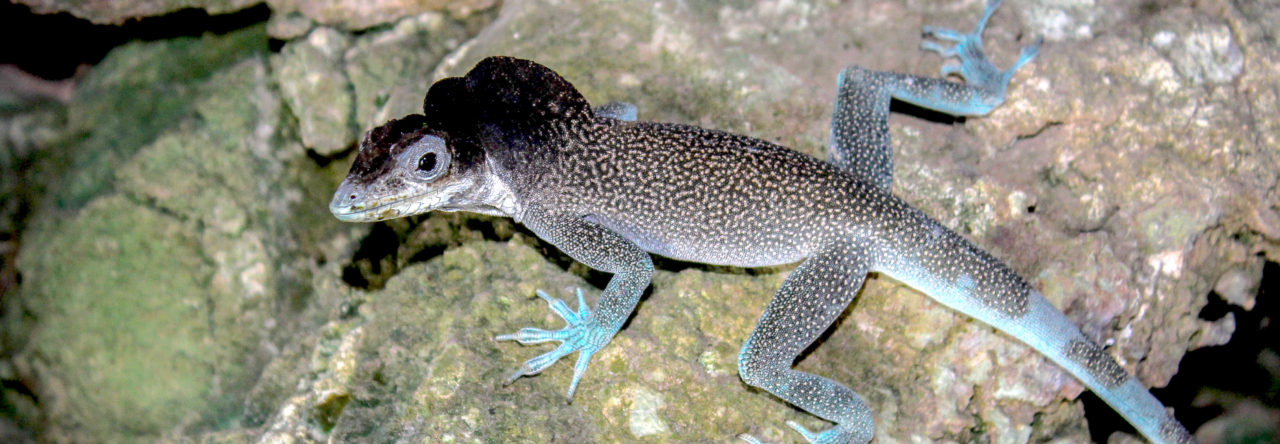
Cuban knight anoles were introduced to Florida in the 1970s. Credit: Alexander Romer

from the Wildlife Society:

Florida towns facilitate spread of knight anoles

Giant Cuban anoles have found footholds in habitats across Florida thanks to expanding human development over the past decades.

But it’s unclear whether the reptiles can push into Georgia or if the introduced reptiles may be near the edge of their potential range.

“Jacksonville might be suitable, even though one might be surprised that they can get so far north,” said Alexander Romer, a quantitative ecologist at the University of Florida’s Fort Lauderdale Research and Education Center who works with the interagency Everglades Invasive Reptile and Amphibian Monitoring Program (EIRAMP).

A biology student was the culprit behind the first introduction of Cuban knight anoles in 1952 to the campus of the University of Miami’s north campus in Coral Gables. They have since spread throughout much of the state—especially in urban areas. These lizards are much larger than most anoles, stretching up to 20 inches long, including their tails. They are striking, with vibrant green bodies, yellow stripes with black speckles and baby-blue mascara-like eye shadowing.

Knight anoles gravitate toward human settlements. Credit: Joshua Rapp Learn

Their ecological impact isn’t completely certain yet, but scientists have observed them eating some imperiled vertebrates, such as Florida tree snails (Liguus fasciatus). They also likely eat federally endangered Florida tiger beetles (Cicindelidia floridana) and Schaus’ swallowtail butterflies (Papilio aristodemus). “We know that they do eat butterflies,” Romer said. “They do eat beetles.”

In a study published recently in Ecology and Evolution, Romer and his colleagues examined the factors that characterized suitable habitat for knight anoles in Florida and compared them to the factors that predicted occupancy in their home range of Cuba.

Citizen scientists track anoles

To conduct the study, the team relied on citizen science reports gathered from the Global Biodiversity Information Facility, a database that corrals information from platforms like iNaturalist together with museum specimen data.

They also used data that EIRAMP collected during reptile surveys in southern Florida in the Everglades Cooperative Invasive Species Management Area.

The models that they developed predicted knight anoles gravitated toward different ecological factors in Florida as opposed to Cuba. In Florida, for example, urbanization was the strongest predictor of knight anole presence, which wasn’t the case in Cuba.

Knight anoles prey on native invertebrate, some of which are imperiled. Credit: Alexander Romer

While their study didn’t examine why Florida knight anoles gravitate more toward human settlement, Romer said it might have to do with the novelty of the environments and the level of disturbance there compared to Cuba. “Disturbed habitats likely have more open niches,” he said. “There are [fewer] predators, less competition.” In Cuba, meanwhile, the ecosystems might function better, with more predators that control the expansion of knight anoles.

So far, knight anoles have been seen in most eastern coastal cities in Florida and some western coastal cities. They are found all the way north to St. Augustine, but the models predicted the heat island impact in Jacksonville has likely made that city warm enough for the lizards, though they haven’t yet spread there, according to records.

Romer still hesitates to call knight anoles invasive rather than just introduced at this point, despite their potentially negative impact on several imperiled invertebrates. But this research shows that developing or disturbing habitat only helps them spread.

“Conserved habitat is precious,” he said. “When you disturb habitat, you’re facilitating invasive species. When you protect it, you’re protecting native species.”

Knight Anole Meets Cat

Photo by Miriam Lipsky

Happy ending: they both lived to see another day thanks to the screen between them! Thanks to Miriam Lipsky for the photo from Miami.

Breaking News: Green Anole Savagely Bites Stephen Colbert

Ok, not actually breaking news–occurred almost eight years ago, but somehow word never reached Anole AnnalsPeople magazine tells the story:


Nearly three years after taking over The Late Show from David LettermanStephen Colbert finally welcomed the first animal expert back on the CBS program, Friday. But… he might regret that decision.

The 53-year-old talk show host sat down with Nathaniel “Coyote” Peterson, the animal expert and adventurer known for his popular YouTube show Brave Wilderness — for which he travels the globe letting animals and insects bite and sting him.

It was only fitting, then, that Peterson brought an animal along to bite Colbert. “I was told you wanted to enter the bite zone,” Peterson said, before pulling out the green anole lizard. “What we have here is…arguably one of the most painful lizards in the world. They can be found all throughout Florida and maybe even here in New York because they often times escape as people’s pets.”

He then asked Colbert, “If you’re brave enough, and I know you are, you’re actually going to be bitten by one of these anoles.”

StephenColbertLizard

Colbert was game, though he was nervous. “I wanted to do something that wasn’t very painful,” he said. “Lizards don’t really bother me but is it going to hurt?”

“That’s yet to be determined,” Peterson said. “How are you going to endure the pain. It’s all on you. You have to mentally prepare yourself. When I do this and I’m bit and stung by things, I kind of walk and pace behind the cameras before I actually go through with it.”

The former Colbert Report host didn’t do that. Instead, he stayed seated — looking directly into the camera before saying, “I’m Stephen Colbert and I’m about to enter the bite zone with the green anole.”

That’s when Peterson put the lizard up to Colbert’s ear — because “the ear is the best place to be bit by this thing, then it just kind of hangs there like an earring,” according to Peterson.

As for the bite, Colbert handled it well. “Well done. Well done,” Peterson said.

Invasive Brown Anoles More Aggressive to Native Greens at Higher Temperatures

Tulane University reports:

Study: Invasive lizards’ tempers flare with the heat

Turns out those New Orleans lizards with record levels of lead in their blood are also picking more fights — but heat, not heavy metal, may be driving their aggression.A new Tulane University study published in the Journal of Thermal Biology finds that invasive brown anoles become more aggressive toward native green anoles as temperatures rise, suggesting that warming conditions could tip the competitive balance between the two species.

Earlier Tulane research revealed record-high levels of lead in brown anoles collected in New Orleans, prompting questions about whether lead exposure could explain their feisty tendencies. While the team can’t rule out a connection, the evidence so far points elsewhere, said senior study author Alex Gunderson, assistant professor of ecology and evolutionary biology in Tulane’s School of Science and Engineering 

“We don’t yet know whether lead contributes to the brown anoles’ aggressive behavior,” Gunderson said. “But since we haven’t seen lead affecting them in other ways, my guess is that it’s probably not the cause. What we can say for certain is that their aggression increases with warmer temperatures.”

The research, led by Gunderson and PhD student Julie Rej, examined how temperature influences aggression between the two species, which compete for the same habitat in the southeastern United States. The invasive brown anoles displace the native green anoles from their preferred habitats in the wild, and behavioral aggression is one potential reason.

“Invasive species cause a lot of ecological and economic damage, so biologists are really interested in understanding what makes these species so successful,” Rej said.

The team found that brown anoles are consistently more aggressive than green anoles, and that their aggression increases as temperatures rise.

To measure aggression, Rej placed pairs of brown and green anoles together in controlled enclosures set to simulate different seasonal temperature ranges – from cool spring days to hotter summer conditions expected in the future. Across all tests, brown anoles displayed higher levels of aggression, and while rising temperature increased the aggression of green anoles somewhat, the gap between the two species’ aggression widened as the temperature increased.

The findings suggest that as the climate continues to warm, invasive brown anoles may become even more dominant competitors, further displacing native green anoles from their preferred habitats.

“Climate change can make invasive species more potent, and this study shows that heat-driven aggression could help explain why in some cases,” Gunderson said.

The study contributes to growing evidence that behavioral responses to temperature are an important, and often overlooked, factor in how species will interact and compete as global temperatures rise.

The research was supported by Tulane University and conducted at the Gunderson Lab, which studies how animals respond and adapt to environmental stressors such as temperature changes.

Hurricanes as a Source of Episodic Natural Selection on Lizards

from the pages of Rhody Today:

URI’s Jason Kolbe studying hurricanes as a source of episodic natural selection

Storm study shows adaptive selection in southeast lizards

A new study led by URI’s Jason Kolbe examines adaptive selection in Anolis lizards in the southeastern U.S. (Photos / J. Kolbe)

KINGSTON, R.I. – Dec. 11, 2025 – How do intermittent events like hurricanes impact natural selection? How do animals adapt to challenging weather? A University of Rhode Island professor has set out to track natural selection in the Anolis lizard over time to see how the species has weathered hurricanes in the southeastern United States.

A new paper by Jason Kolbe and colleagues published in the Proceedings of the National Academy of Sciences finds hurricane-induced selection and responses to hurricanes in Anolis lizards. Chair of URI’s Department of Biological Sciences, Kolbe studies how human-mediated global change phenomena drive evolutionary change in the natural world.

High winds associated with hurricanes can result in natural selection on traits related to clinging performance in anole lizards.

If species’ mortality depends on specific traits, then hurricanes — extreme and intermittent in nature — provide a source of episodic natural selection on affected populations. The predicted increase in hurricane activity and strength in the North Atlantic has the potential to alter patterns of selection and evolution for populations, especially in coastal areas and islands.

The paper’s focus brought Kolbe back to the start of his professional research career. He has studied lizards for 25 years and used genetic markers to reconstruct the invasion histories of Anolis lizards introduced to Florida from the Caribbean for his dissertation.

As part of his Ph.D. research, Kolbe studied the ecology and evolution of anole populations on islands in the Bahamas. When Hurricane Sandy hit their study site there in 2012, he decided to use the devastating storm’s impact to compare lizards before and after impact.

The invasion of Anolis sagrei in the southeastern U.S. provided a rare opportunity to put a timestamp on the start of adaptive evolution for populations in this region, Kolbe says. Over 100 hurricanes have hit Florida since the start of the A. sagrei invasion.

Their results affirmed that hurricanes are a source of episodic selection with lasting evolutionary effects on lizard traits connected to weathering storms. Kolbe’s team’s preliminary analysis found lizards with longer limbs survived better during the hurricane and that lizards with longer limbs possessed greater clinging ability, supporting hurricanes as a source of natural selection for lizard populations.

“Our studies of the brown anole in Florida provided an excellent opportunity to test whether hurricane-induced selection could shape the morphology of lizards over the course of their invasion, around 100 years,” he says. “Because we have a good estimate of the time each brown anole population in our study was established and hurricane records go back to 1851, we were able to estimate the number of hurricanes impacting each population and test for an association with traits that increase clinging performance.”

Introduced lizard

The Anolis sagrei was introduced in Florida and Georgia beginning in 1887 in the Florida Keys. It showed up on the peninsula a half-century later. Kolbe’s team reconstructed a chronology of the A. sagrei invasion in Florida and Georgia using dates from published observations and museum specimen records.

Brown anoles were introduced to the U.S. from at least eight geographically and genetically distinct source populations in their native range, mostly from Cuba. These introductions likely occurred accidentally via shipping or intentional introductions (release of pets into the wild).

Kolbe and his colleagues found that brown anole populations experiencing more hurricanes had longer limbs and larger toepads, traits that help them hold on — both in the immediate sense of a single storm and in the long-term as well, in terms of natural selection. Their results confirm hurricanes as a major force shaping variation in Anolis lizards and highlight how the evolutionary trajectories of animal populations will be altered as climate change modifies historical patterns of natural selection, he says.

An evolutionary ecologist, Kolbe studies the evolutionary response of species adapting to rapid environmental shifts and says that biological invasions are useful scenarios to study rapid evolution.

Although there aren’t many good studies on the ecological impacts of this species, its high densities, rapid spread and generalist nature suggest potential impacts on other species, Kolbe says, noting that other species could be studied, as well.

“Lizards are surely not the only species potentially experiencing selection during hurricanes,” says Kolbe. “Our understanding of episodic selection may be enhanced by studies on the evolutionary effects of hurricanes on other species, not only lizards.”

Pointy Snouted Green Anole Has a Thing for Star Fruit

Photo by Miriam Lipsky

And who could blame the little green lady–star fruit are delicious!

Miriam Lipsky of Miami explains:

Photo by Miriam Lipsky

“The star fruits (carambola) are indeed from my yard!  I was picking them to give to a friend, since no one in my family really likes them (Editor’s note: hard as that is to believe!), and when I reached for one of them, this cute anole came with it, then refused to leave the basket.”


Miriam also demonstrated her anole photography chops with this lovely backyard brown anole:

Photo by Miriam Lipsky

See How They Run: Observing Lizards Helps Researchers Aim for Innovation

From the Pages of Syracuse University Today:

See How They Run: Observing Lizards Helps Researchers Aim for Innovation

A Tokay gecko (Photo by Austin Garner)

Diane Stirling Nov. 21, 2025

How geckos and anoles use sticky toepads and claws to run, climb and jump is providing clues for innovations to help humans, and is also aiding in efforts to conserve the animals’ species.

Through millions of years of evolution, geckos and anoles have developed curved claws and sticky toepads that make them expert climbers.

A team of researchers in the College of Arts and Sciences has been examining how those physical traits could inspire innovations such as new super adhesives and robotic climbing technologies, research that has the potential to not only help humans, but also contribute to the conservation of the lizard species.

Postdoctoral scholar Benjamin Wasiljew and a group of biology student research assistants have been putting a group of anoles and geckos through their paces—having the animals run, jump and climb on various surfaces and at differing inclines.

The group has included doctoral student Aaliyah Roberts ’29;  former research assistant Sierra Weill ’24; former undergraduate student researcher Natalie Robinson ’25; and Maya Philips ’26, who is currently using the research to write her undergraduate thesis.

Extreme close-up of a gecko's toe pads showing the detailed layered structure of adhesive lamellae.

Foot structure, Tokay gecko (Photo by Austin Garner)

Impressive Climbers

“We are testing their clinging ability on various surfaces and inclines, which helps explain what combination of toepads and claws work best on different surfaces,” Wasiljew says. “We believe adhesive toepads are more effective on smooth surfaces like leaves or glass windows, whereas claws perform better on rough surfaces like tree bark or concrete walls. Anoles and geckos encounter all those types of surfaces depending on whether they live in urban or natural settings. Combining the abilities that both claws and toepads provide is likely what makes geckos and anoles such impressive climbers,” he says.

Portrait of a young person in a blue patterned shirt smiling at the camera, with museum exhibits in the background.

Benjamin Wasiljew

The research provides a better understanding of how clinging and climbing are handled in nature. Wasiljew believes that knowledge could be used to build physical models based on gecko and anole feet that could lead to new types of climbing equipment, robotic climbing technologies or other innovations.

These new developments could provide better access to hard-to-explore terrains and assist search and rescue efforts when people are trapped in challenging or remote geographic locations or stranded during hurricanes and earthquakes, he says.

Wasiljew and the Garner Lab team work with Syracuse University engineers to discuss ways to implement their biological findings into bio-inspired adhesives and robots. They also collaborate  with biology professor Susan Parks and researchers at her Bioacoustics and Behavioral Ecology Lab. Her group is studying how to build better biologging tags that adhere to the skin of endangered whales to improve tracking and protection.

A Role in Conservation

Understanding how geckos and anoles function in their various habitats is crucial to their conservation, Wasiljew says, because urbanization can threaten their existence. Urban habitats can cause some species to be unfamiliar with how to dwell and move in natural settings that have flexible twigs and branches, versus the concrete and glass materials they encounter in urban areas. Some species don’t adapt well to  habitat changes, which could lead to their eventual extinction, Wasiljew explains. Other species may adapt so well to urban settings that they can come to be regarded as pests.

“Our findings are important because they show how different surfaces affect tree-dwelling lizards and how urban environments can change how lizards behave and how their surroundings can shape their bodies and abilities. It’s research that can both help protect endangered species and limit their negative impacts in urban locations. Understanding how animals respond to human influence or habitat disturbance is crucial to their conservation.”

Jumping Experiments

The researchers discovered that all groups of anoles are negatively affected by having a flexible springboard from which to jump. Urban brown anoles are better jumpers than the naturally-dwelling green anoles and jump further and faster than the brown anole species.

That difference is largest when jumps are made from a stiff springboard and smallest when jumps are made from a very flexible springboard. Surface flexibility affects brown anoles more than the green anoles because the brown urban anoles are more accustomed to the rigid surfaces of urban life than the green species.

Side view of an anole lizard with gray, white, and yellow-green patterning standing on a reflective black surface that mirrors its image.

From a stiff springboard, brown anoles (like the one pictured) jumped 9 to 10 centimeters further and went 50% faster on average than green anoles. The longer hind legs (averaging 1.5 millimeters more) of brown anoles make them better jumpers. (Photo by Austin Garner)

Watch: Lizards in Action

The first video shows a flexible surface jump of a brown anole. When a highly flexible springboard was used, jump distance and velocity for both brown and green anole species were almost the same.

The second video demonstrates a rigid surface jump of a brown anole. When jumping from a rigid surface, tests showed that brown anoles take off faster but move at a lower angle than green anoles do.

(Videos by Sierra Weill)

Top view of a pale crested gecko with a long tail and spotted skin, positioned against a solid black background.

(Crested gecko photo by Austin Garner)

Urban habitats differ in temperature, humidity, lighting and structural materials (concrete walls, metal fences, glass windows) versus the tree trunks, branches, twigs and leaves of natural habitats. Testing showed that surface flexibility affected urban-dwelling anoles more than lizards who live in natural habitats, presumably because the urban animals had less overall experience with natural surfaces.

Jamaican Crown-Giant Anole Weathers Hurricane Melissa

Anolis garmani in a mango tree post-Hurricane Melissa. Photo by Kathryn Miller.

Inbar Maayan writes:

Kathryn Miller.

As you know, Jamaica was very badly hit by Hurricane Melissa. It made landfall in the southwest part of the island and cut across through to the north central coast before continuing northward. Images and videos are circulating that just begin to show the extent of the damage, but everyone says it’s just unfathomable.

Kathryn Miller, one of the excellent Jamaican students who has been on my field team and contributed meaningfully to anole research in Jamaica, was finally able to travel out to help her mother in Santa Cruz, in the parish of St. Elizabeth. This is near Black River, and as you might imagine, sadly the hurricane pretty much flattened this whole area. Kathryn shared with me an anole observation, and I’m submitting it in case folks would like to see a glimmer of the anoles in Jamaica post hurricane.
The photo and video (at bottom) are of an adult male Anolis garmani. Kathryn says “Found him in a fallen mango tree. All the trees in that area were actually either snapped it two or completely uprooted. He’s making the best out of a bad situation I guess. He can’t necessarily go up high anymore. Poor guy:pensive:Anolis garmani is a Jamaican endemic, and like a true Jamaican, this guy is making the best of his situation.”
Kathryn is especially fond of the garmani. She is also a geologist and outstanding artist.I would like to take this opportunity to encourage people to use the official Jamaican government website for hurricane relief to learn more about the impacts of Melissa and donate what they might be able to.

Brown Anoles as a Backyard Ecosystem Menace

Galveston reader A.J. Watkins writes in:

I am in Galveston Texas, and I am literally in tears. Being a Port city, we have been invaded by the Cuban anoles that have obviously come in off the shipping boats. All I can say is they have caused complete devastation to SO MANY native species here on the island. Where once I had assassin bugs calore in my yard, as I never use pesticides, I also hardly ever had any issues with plant pest bugs, as the assassin bugs ( I called them my garden army) would take care of the aphids, white flies, mealy bugs, etc.

Now, since the invasion ( and I do mean INVASION) of the Cuban brown anoles, they have decimated the assassin bug population. I haven’t seen a single assassin bug for at least 3 years now. They also eat all the Pipevine Swallowtail Caterpillars, the Monarch caterpillars, and the Giant Swallowtail Caterpillars. They do kill and eat all the baby green anoles, the green anole eggs, and will outcompetes and fight with the larger Green anole males. As of this year, my back yard is over run with Cuban anoles, and I am talking HUNDREDS of them.

I try to keep the Cuban anoles away from my front porch area, as I did have 3 green anoles that hung out on the plants on my front porch. That was earlier this summer. Since then, I had one baby green anole hatch out, but then disappeared ( she was SO TINY) I am assuming she got eaten by a Cuban anole. In the past couple of weeks, the one large green anole male I had, has disappeared, as well as the adult female I had hanging out up here on my porch too.

Second Invasion of Africa by the Festive Anole

Yes, the brown (aka, festive) anole is at it again. Now it’s turned up on the island of Bioko in the Gulf of Guinea. As Malanza et al. report in Herpetological Notes, this is the second introduction of the species to Africa, the first occurring in Angola.

Page 1 of 132

Powered by WordPress & Theme by Anders Norén