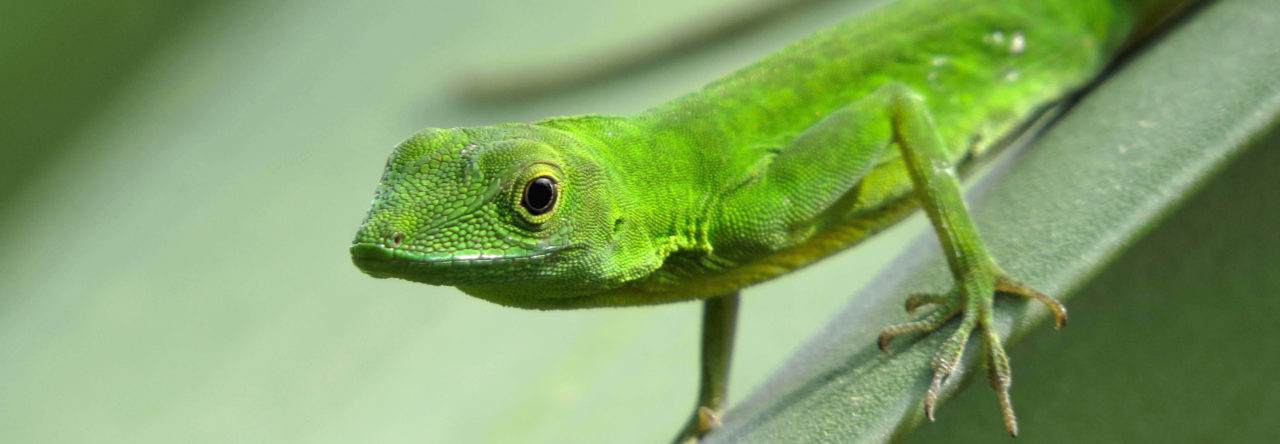

Male green anole (Anolis carolinensis) positioned in front of a black-jack flower (Bidens pilosa)
Species invasions are usually studied one at a time, but ecosystems rarely have that luxury. This project began with a simple frustration: while reading about invasive predators, invasive competitors, and pollinator declines, I kept noticing that these processes were usually treated separately—even though accelerating global trade is increasingly causing ecosystems to experience multiple invasions simultaneously. This is especially true on islands, which are highly connected through the constant movement of goods and supplies. Species rarely arrive alone. That raised a bigger question for me: what happens when multiple invaders arrive together and begin reshaping ecological networks at the same time? Do their effects simply add up, or can they fundamentally reorganize pollination systems in ways we have been overlooking?
The Ogasawara Islands are one of those places that make you feel you are exactly where you should be. Their natural beauty is breathtaking, and the local people live in remarkable harmony with the island. You instantly want to become part of that network of connections among species, to blend into it and stay.
Yet what stayed with me most was not what I saw—it was what I did not see.
Walking through the forest, you begin to notice what is missing, and what has been added. At first, everything appears intact. Then, gradually, the details emerge. Honey bees buzz among non-native flowers. Introduced green anoles wait patiently on blossoms for unsuspecting prey. And slowly you realize that something else should be there. The native bees that once pollinated these forests have disappeared from two of the islands. Younger generations may never have the chance to encounter them. What remains is an ecological network that still functions, but not in the same way as before.
That realization became the emotional starting point for this study. The urgency to respond to pollinator declines led many people to point directly at the green anole as the culprit, triggering eradication efforts before any quantitative, community-level assessment had been carried out.
Perhaps it is simply because I am a community ecologist and tend to view ecosystems as interconnected wholes, but I kept asking myself: could the impact really be driven by a single species? That is when co-invasion became the central question. If we wanted to understand changes in the pollination network, it was impossible to focus only on the predator of pollinators. We also needed to consider competitors such as the honey bee and the role of non-native flowering plants. To investigate this, we conducted three field campaigns in 2021, sampling pollination networks through direct observations with binoculars across four islands. Two islands had already been invaded and had lost their native bees, while two remained uninvaded and still supported native bee populations. We also surveyed the other invasive species that could potentially alter pollination networks, such as plant and pollinators competitors, and their associated ecological interactions.
Even after collecting the data, one of the biggest challenges was resisting the temptation to simplify invasions into isolated events. Modelling simultaneous invasions quickly became complicated because predator introductions, competitive interactions, and pollination rewiring can all interact in unexpected ways. Yet this complexity turned out to be one of the most fascinating aspects of the study. We found that the role of honey bees changed depending on the status of native pollinators on each island. In places where native bees had disappeared, honey bees often became the primary pollinators of many plant species. At the same time, their preference for non-native plants suggests that these invaders may facilitate each other’s spread and establishment. One of the most surprising findings was how consistently top-down effects cascaded through trophic networks. The green anole’s impact did not stop with pollinators; it ultimately reached plants by altering pollinator communities and their interactions, effectively crossing trophic levels and influencing plant reproduction. However, the final impacts were a complex combination that depends on all species involved.
What this project ultimately taught me is that invasions are not just about which species arrive, but about how multiple newcomers interact with one another once they do. Co-invasions can affect ecological communities far beyond what single-species approaches predict, particularly on islands where ecological balances are already fragile. That realization makes prevention feel even more urgent: by the time eradication becomes politically or ethically feasible, much of the ecological rewiring may already be underway. For me, this work reinforced the idea that biosecurity is not simply about stopping invaders and protecting threatened species—it is about preserving the invisible interactions that hold biodiversity together.

James
Interesting how the green anole and black-jack flower example illustrates that invaders often facilitate each other’s establishment, rather than acting in isolation.