
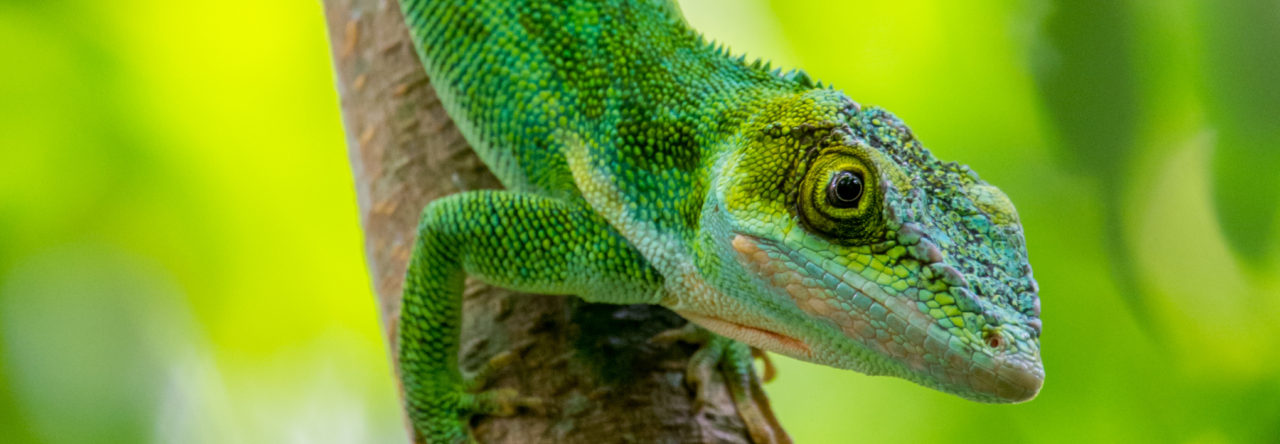
Study: Invasive lizards’ tempers flare with the heat


Earlier Tulane research revealed record-high levels of lead in brown anoles collected in New Orleans, prompting questions about whether lead exposure could explain their feisty tendencies. While the team can’t rule out a connection, the evidence so far points elsewhere, said senior study author Alex Gunderson, assistant professor of ecology and evolutionary biology in Tulane’s School of Science and Engineering.
“We don’t yet know whether lead contributes to the brown anoles’ aggressive behavior,” Gunderson said. “But since we haven’t seen lead affecting them in other ways, my guess is that it’s probably not the cause. What we can say for certain is that their aggression increases with warmer temperatures.”
The research, led by Gunderson and PhD student Julie Rej, examined how temperature influences aggression between the two species, which compete for the same habitat in the southeastern United States. The invasive brown anoles displace the native green anoles from their preferred habitats in the wild, and behavioral aggression is one potential reason.
“Invasive species cause a lot of ecological and economic damage, so biologists are really interested in understanding what makes these species so successful,” Rej said.
The team found that brown anoles are consistently more aggressive than green anoles, and that their aggression increases as temperatures rise.
To measure aggression, Rej placed pairs of brown and green anoles together in controlled enclosures set to simulate different seasonal temperature ranges – from cool spring days to hotter summer conditions expected in the future. Across all tests, brown anoles displayed higher levels of aggression, and while rising temperature increased the aggression of green anoles somewhat, the gap between the two species’ aggression widened as the temperature increased.
The findings suggest that as the climate continues to warm, invasive brown anoles may become even more dominant competitors, further displacing native green anoles from their preferred habitats.
“Climate change can make invasive species more potent, and this study shows that heat-driven aggression could help explain why in some cases,” Gunderson said.
The study contributes to growing evidence that behavioral responses to temperature are an important, and often overlooked, factor in how species will interact and compete as global temperatures rise.
The research was supported by Tulane University and conducted at the Gunderson Lab, which studies how animals respond and adapt to environmental stressors such as temperature changes.

- Knight Anoles Spreading through Florida–Will They Get to Georgia? - March 4, 2026
- Knight Anole Meets Cat - February 1, 2026
- Breaking News: Green Anole Savagely Bites Stephen Colbert - January 29, 2026
Leave a Reply