
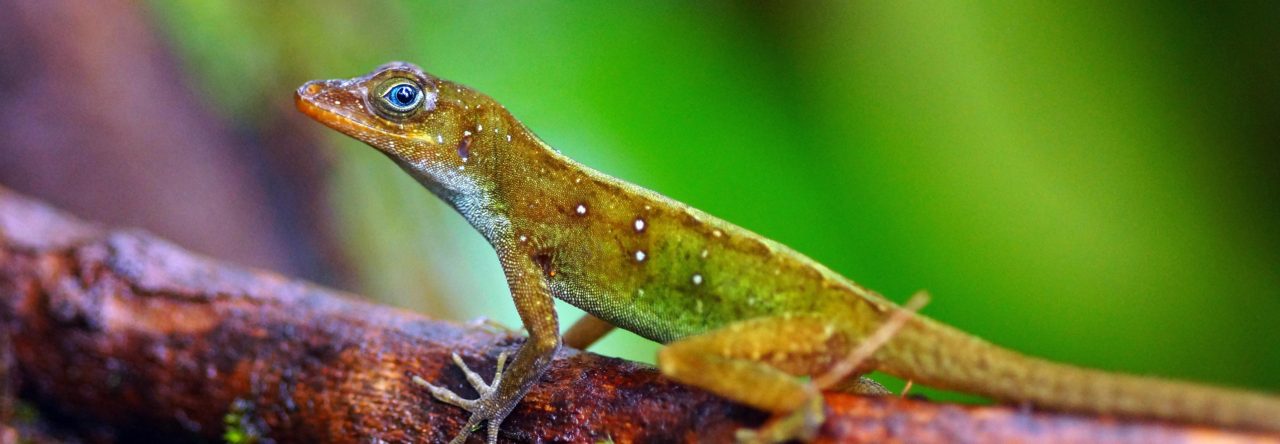

photo from San Angelo Standard-Times
Galveston reader A.J. Watkins writes in:
I am in Galveston Texas, and I am literally in tears. Being a Port city, we have been invaded by the Cuban anoles that have obviously come in off the shipping boats. All I can say is they have caused complete devastation to SO MANY native species here on the island. Where once I had assassin bugs calore in my yard, as I never use pesticides, I also hardly ever had any issues with plant pest bugs, as the assassin bugs ( I called them my garden army) would take care of the aphids, white flies, mealy bugs, etc.
Now, since the invasion ( and I do mean INVASION) of the Cuban brown anoles, they have decimated the assassin bug population. I haven’t seen a single assassin bug for at least 3 years now. They also eat all the Pipevine Swallowtail Caterpillars, the Monarch caterpillars, and the Giant Swallowtail Caterpillars. They do kill and eat all the baby green anoles, the green anole eggs, and will outcompetes and fight with the larger Green anole males. As of this year, my back yard is over run with Cuban anoles, and I am talking HUNDREDS of them.
I try to keep the Cuban anoles away from my front porch area, as I did have 3 green anoles that hung out on the plants on my front porch. That was earlier this summer. Since then, I had one baby green anole hatch out, but then disappeared ( she was SO TINY) I am assuming she got eaten by a Cuban anole. In the past couple of weeks, the one large green anole male I had, has disappeared, as well as the adult female I had hanging out up here on my porch too.
At this point, I only have one juvenile green anole left, which I painstakingly try to help along by catching flies and feeding them to her ( I am assuming a female). The Cuban anoles are so much faster, and they eat EVERYTHING, so all my green anoles were looking very skinny, but I was trying to help them ( the green anoles) all out by providing extra food for them. The juvenile I have left, has become very friendly with me, and will sit out here on my handrail with me as long as I am present. I think it knows that I will run off the Cuban anoles if they try to come up here, so she feels safe as long as I am around. When I go inside, though, she disappears and goes to her hiding place (which I don’t know where that is).
The Cuban anoles have completely disrupted the balance of things in my yard and garden, and I have even try to do some “population control”. Invasive species, whether animal or plant, always outcompete native species. TPWD encourages the control of non-native species, so that is what I am trying to do, but at this point, I think it is too late, and the City of Galveston has done nothing about it.
I am so disappointed and disheartened. Where once I had a thriving garden with butterflies that grew out from caterpillars, tree frogs, house geckos, and so many other beautiful native species in my back yard, now all I see are Cuban anoles EVERYWHERE. I rarely see a house gecko, and there are no more frogs. I do have a few Gulf Coast toads, but that is it. The Pipevine swallowtails still lay their eggs, but the Cuban anoles eat all the eggs before they get a chance to hatch. I don’t even plant milkweed anymore. What’s the point??!!! The Cuban anoles just eat the eggs or kill and eat the few caterpillars that make it long enough to hatch out of the eggs. Where green anoles only lay 1 egg at a time, Cuban anoles lay several at a time. I have never seen such a devastating species of animal in all my life. It makes gardening on this island much less enjoyable, and I literally despise these Cuban anoles. I love nature, and would never kill any living thing in my yard… Until now.
So if you are noticing a decline of green anoles in your area, you might want to start watching for Cuban anoles. I know they have made it to Houston, as I have seen posts from Houston gardners complaining about them as well. They are always brown, or even black colored, never green. Females have a cream colored stripe down their back, with black lines on either side of the cream stripe. The males have a checkered like pattern on them. They have a smaller head, stubby like head, and they are super fast. I know the grackles catch lizards in the spring to provide protein for their hatchling babies, but I don’t even think the grackles can catch the Cuban anoles. They are just too fast for them to catch them.
The only advice I can give, is if you do start to seeing them in your yard, start swatting them HARD with a very heavy duty fly swatter… If you can catch up to them. Look up the pictures though, and make sure you aren’t mistaking a green anole for the Cuban anoles. Female green anoles can have a white or cream stripe down their back too, and turn a tannish brown color more than the male green anoles do. Make sure you aren’t killing green anoles. I hate to say it, but I think the days are numbered for our native green anoles (as I said, all but 1 are gone out of my yard) , unless we can figure out a way to control the Cuban anole population, but not harm the green anoles. I think that feat is impossible though.


- Knight Anoles Spreading through Florida–Will They Get to Georgia? - March 4, 2026
- Knight Anole Meets Cat - February 1, 2026
- Breaking News: Green Anole Savagely Bites Stephen Colbert - January 29, 2026
Nathalia Assaad
Get yourself a Pekín duck, maybe two. We have seen them eat the brown anoles at our house and we have a healthy population of green anoles (knock on wood) that is staying stable. We are in Central Florida. Make sure to provide water in a shallow container like a plant clay saucer for example and give them what I call a “lizard forest” meaning native ground cover that provides a safe haven (check what is native and pretty dense in your area).
Then cross your fingers and wait.
I hope this helps!
AsaBee
I had the same problem with the brownies myself it took about 6 years of my lawn exploding with them and the greenies being all but absent still eventually we achieved a balance of about 50/50 tween the two of them.
Claudio
You can also catch them with a green minnow trap. All you do is expand it, fill it with crickets that you can get at the pet store or online in bulk, leave it for about 30 min at a time. I usually leave mine under a tree or bush, or where ever you see them hand out. Once you check, you can remove the green anoles and other native species and then take care of the invasive ones. I tried this on both brown anoles and the Agamas and have had good success. I recently stopped for about 2 months , and those Agamas started to come back. So its a continual upkeep (like gardening lol). When getting them out of the trap, I would recommend using gloves. Also make sure you check with you local wild like rules to make sure it’s ok. Agamas and curly have made a huge invasion here in South Florida and I have recently seen a handful of the “Jesus” Lizards here and there. My local park used to have many invasive Brown Anoles about 4-5 years ago, but now then are also becoming rare as the Agamas and Curly tails have started taking over.
Michael Childs
I have both Cuban and Green anoles. I spend a lot of time with them out side. I’ve noticed they really aren’t bothered or interested in each other. Even when the males become territorial and looking for females, they just ignore each other. Just on my patio I normally have about 14 to 16 Cuban and about 4 green. Both populations have been growing in the entire backyard area. All of a sudden, I’ve noticed some of the large males missing. I installed a camera on my patio. It seems a group of Raccoons, one adult and three juveniles come at night and forage for the anoles. My point is, even with the young green juveniles and more adult Cubans, I’ve never seen a Cuban chase or try to eat a green. Maybe you have a new neighbor feeding on them. Black racers and rat snake eat them and raccoons are very proficient in hunting them at night.
Gary Brauckman
Here in the Houston area the Cubans took over and very few greens. Geckos disappeared and then we had the mother of all freezes in 2020 and a hard freeze every winter after that and the Cubans couldn’t survive the cold. I now have greens all over the place and geckos are making a return. Well spoke too soon and saw my first Cuban in years. Not sure if I can handle those freezes
Armando F Pou
I have heard this same story recounted since the 1960s. I suggest a different hypothesis or theory, what is happening in your area is the result of first contact. The same thing that happened to the Native Americans when the first Spanish boots hit the sands of the Caribbean. The plagues of the Old World devastated the endemic population. Estimates of the die off of Native Americans are as high as 80%. Many before ever setting eyes on the first European. The green anolis population in the late sixties and early seventies in Southern Florida nearly disapeared. As a child I remember hardly ever seen a green anole. Many were undoubtedly forced up into the canopy due to the fierce competition from the prolific brown anolis. However something more impactful was going on, and I believe that it was diseases or pathogens harboured by the brown anolis. Both species basically eat the same insects. I have never observed either species of anolis eating eggs although I have seen adult males of both species feeding on hatchlings of their competitors and of their own species. Interestingly enough, something has happened over the last couple of decades. The green anolis has made a remarkable comeback in south Florida. At this time I would say that it has been my observation that the green anolis has become nearly as common as the brown anolis. And these green anolis are exremely robust and healthy. Additionally they are no longer relagated to the tree tops, I see them on bushes, walls and fences, just as I remembered as a child. The new invaders down here are curly tailed lizards, basilisks, ameivas and red headed agamas. Unfortunately they all do feed on all the anolis species that are now found in south Florida. The red headed or rock agama (Agama agama) will eventually work it’s way north perhaps as far as many of the southern states as it is more cold tolerant than the others.
TL Williams
TL reporting in from Galveston Island and can confirm, the green anoles are fewer in number compared to just a few weeks ago. Our garden appears to be an anole factory and lately its always baby brown anoles scurrying away when when we approach. The green anoles seem to stay near the Bougainvillea (as it matches their color quite well), but haven’t spotted one in weeks.
Nancy Rhoads
I found a little male green Anole under a landscape rock that I picked up, which I thought was dead, but not. So into my mesh net container he went and it’s been 3 days now, he is a down to earth fellow in all ways! Not interested in climbing too high nor my purple heart plant to climb on. Admiring his reflection in the window. 🙂 He is a cutie alright. I read males don’t have a stripe down their back which he doesn’t. I can purchase a female at one of the pet stores when available. Might do that or let him loose in my community garden where there are 2 others that I have seen near my garden spot. Adorable and I will probably keep if he is happy to stay