
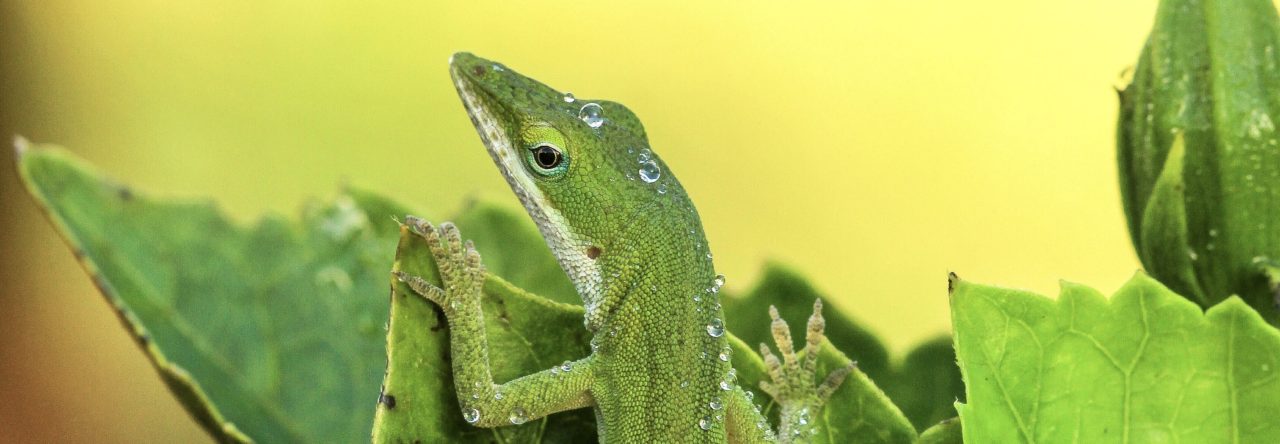

Photo by Christopher Brown in Field Notes.
Christopher Brown on his blog Field Notes writes:
“We may never acquire the gift evidenced by this anole I saw on our retaining wall last weekend: the ability to regenerate large portions of one’s own body after an accident or an encounter with a predator.
I was grilling dinner when I saw it, and had to raise my glass in admiration. Long live the new flesh. May your descendants grow large, and lord over the rewilded ruins we leave behind.”
I’ve seen anoles like this before. Is skin regeneration the explanation?

Professor of Biology and Director of the Living Earth Collaborative at Washington University in Saint Louis. I've spent my entire professional career studying anoles and have discovered that the more I learn about anoles, the more I realize I don't know.
Latest posts by Jonathan Losos (see all)
- Knight Anoles Spreading through Florida–Will They Get to Georgia? - March 4, 2026
- Knight Anole Meets Cat - February 1, 2026
- Breaking News: Green Anole Savagely Bites Stephen Colbert - January 29, 2026
Allison DeVan, PhD
Very interesting. I saw something similar on an A. carolinensis in Austin, TX many years ago. In that case, it was a botfly larvae infestation.
Jonathan Losos
Could the black spot on the side of the lizard be a botfly exit hole?
jacque Masters
Absolutely amazing post. Have never seen this (and I live in Florida). Thank you.
Peter
I wonder if this is regeneration or rather something else. In addition to the botfly (or other) infection Allison suggested, it could be a case of aberrant gene expression, similar to other patches of color in animals or even some kind of immune reaction, as in vitiligo.