
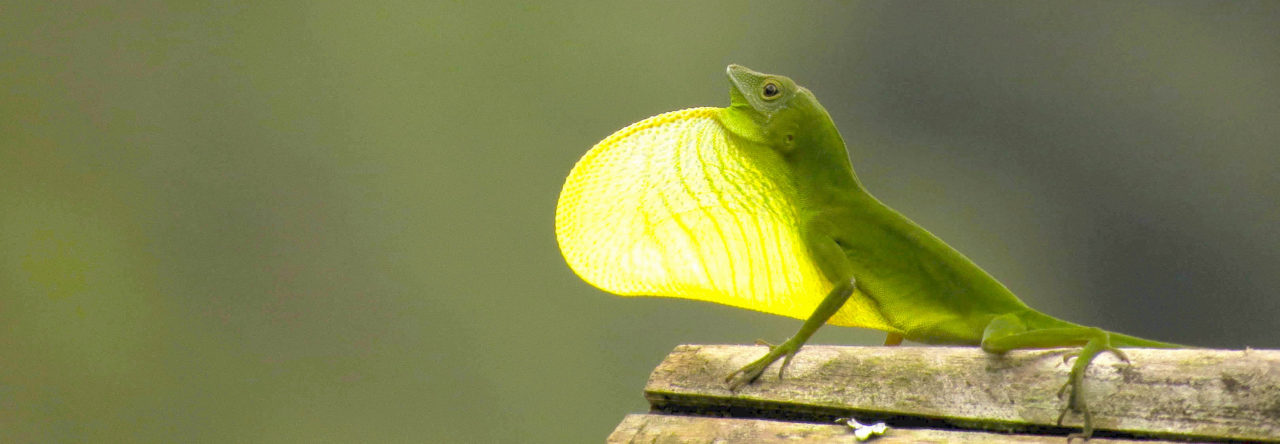
The legume forest in the arroyo on the north side of Graffiti Hill on the U.S. Naval Station, Guantánamo Bay, Cuba is an anole-rich environment, including Anolis smallwoodi. But it is also has high densities of the Cuban boa, Epicrates angulifer. Smaller Cuban boas can often be seen in the canopy, looking for- smallwoodi? While radio-tracking Cuban boas in the aforementioned arroyo I came upon the entwined skeletons of a juvenile Cuban boa and an Anolis smallwoodi, the result of an encounter that was lethal for both participants.

Latest posts by PeterTolson (see all)
- Sharing A Cold One On St. John, U.S. Virgin Islands - February 13, 2013
- Battle To The Death In The Graffiti Hill Arroyo: Cuban Anole And Boa Fight To The End - November 22, 2012
Pat Shipman
Oh my!