
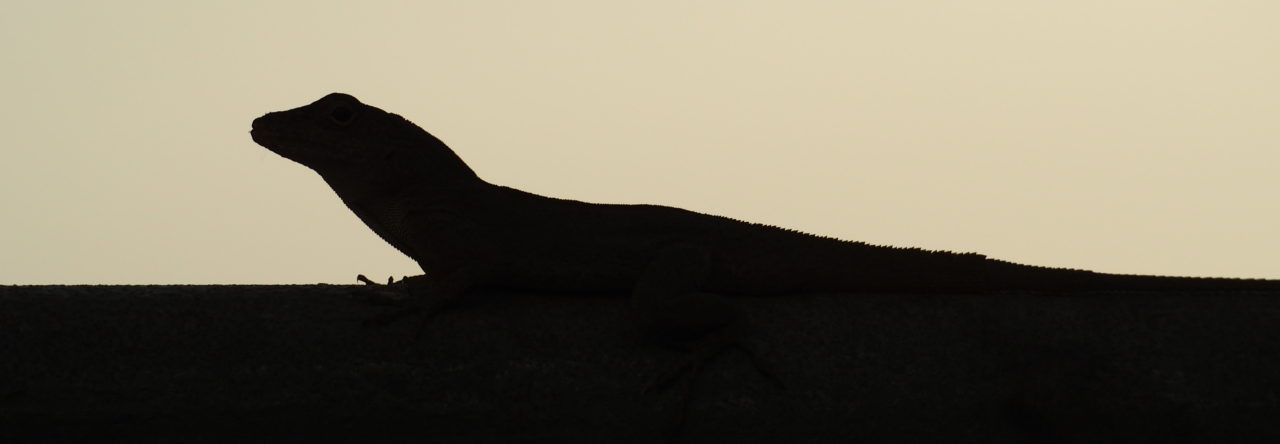
 The Cuban knight anole (Anolis equestris) was intentionally introduced to South Florida in the 1950s. Since then, they have spread along the Atlantic Coastal Ridge, into southwest Florida, and into the Florida Keys. Currently, these anoles have been documented in 23 Florida counties, including Central Florida and along the Space Coast. In fact, the northernmost observations for this species occur in St. Augustine in Northeast Florida. This seems at odds with the natural history of A. equestris given the tropical climate of its home range, Cuba. However, if one examines the distribution of A. equestris in Florida, they’ll notice that outside of urbanized areas, knight anoles are scarce. Could different factors influence habitat suitability for this species between their native and invasive range?

Figure 1. Suitable habitat concentrates along Florida’s urban corridors
To answer this, we used species distribution models (SDMs) to predict habitat suitability for knight anoles across Florida and Cuba. This involved gathering hundreds of species records from a citizen science database (GBIF) which each carried the GPS coordinates of where the observation occurred. We then extracted environmental values for each point that describe the climate, vegetation, and urbanization at that location. We repeated this process for a set of randomly chosen points where the species did not occur (“pseudoabsences”), giving us an understanding of the baseline environment. We tested several modeling approaches and selected the best performing model using an independent validation set. We also examined which factors were most influential on model predictions and if these factors changed between the native and invasive range. Finally, we examined if there was potential for overlap between knight anoles and several species of threatened invertebrates.

Figure 2. Urbanization drives suitability in Florida while vegetation and precipitation dominate in Cuba.
Our models of habitat suitability showed that, as suspected, many developed areas of Florida had especially high suitability for A. equestris (Fig. 1). When we look at our analysis of how the model made its predictions, we see that different factors drive suitability for each region. In Florida, variables related to urbanization and development had a greater impact on where these lizards are found (Fig. 2). By contrast, vegetation and precipitation had a greater influence on the occurrence of knight anoles. Thus, A. equestris is more reliant on modified habitats in its invasive range whereas in its native range its niche is better defined by intrinsic ecological factors like climate and forest structure. Additionally, we found evidence for potential overlap between knight anoles and three species of threatened native invertebrates (Fig. 3).

Figure 3. Knight anole suitability overlaps habitats of three threatened invertebrates.
These results have implications for our understanding of invasion ecology and management. In their native range, knight anoles are tolerant of human modified landscapes, inhabiting plantations and urban gardens, but they also occur widely in natural habitats. However, in their invasion range, the most suitable environments are urban and suburban areas. This suggests that human development may facilitate the establishment and spread of non-native species. Additionally, urbanization creates an interface at which natural and modified habitats interact, which can have negative consequences for biodiversity. We found potential overlap between knight anoles and threatened invertebrates, such as the Florida tree snail (Liguus fasciatus), which could generate predation pressure on species that are already experiencing declines. Thus, while A. equestris has not historically been considered a harmful invasive species, these results suggest closer monitoring, particularly in high-value conservation areas, and targeted interventions may be warranted.
Ultimately, our study shows that some invasive species benefit from urbanization, underscoring how land use influences invasion dynamics.
If you’d like to learn more about our analysis and results, the open access paper is available from Ecology and Evolution.


![Anolis alutaceus [image] | EurekAlert! Science News](https://i0.wp.com/www.eurekalert.org/multimedia/pub/web/23297_web.jpg?resize=400%2C600&ssl=1)


