
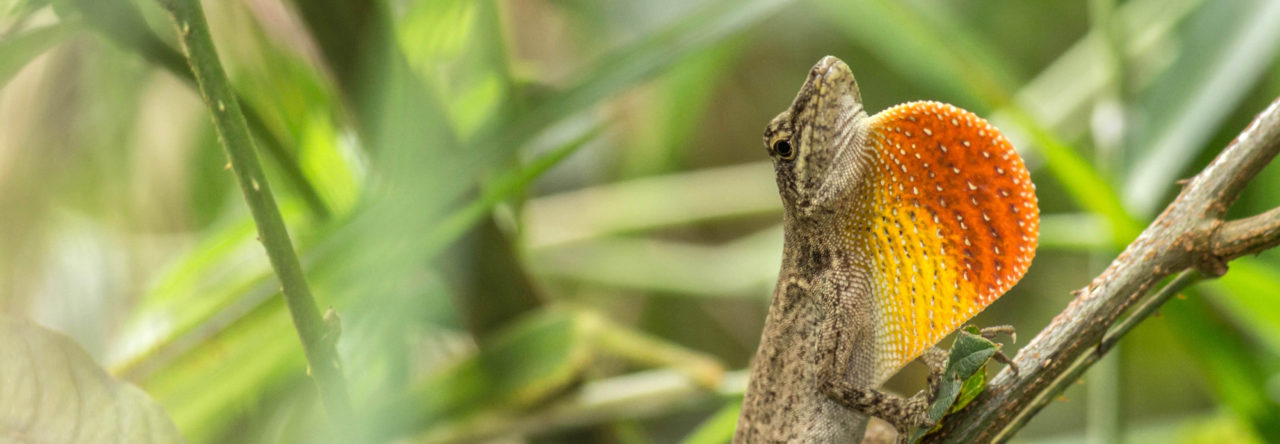
Evolution 2017: Urban Lizards Are Larger but Show No Consistent Trend in Dewlap Area or Injury Rate

P1228627_edited

At last night’s poster session, undergraduate Derek Briggs (U. Mass. Boston) presented findings from his senior capstone project in which he looked at several traits related to dominance and health. Using a dataset of x-rays and dewlap photos collected over a 4 year period from various urban and forest sites across Puerto Rico (by Kristin Winchell), Derek looked at body size, body condition, dewlap size, and injury rates (broken bones and missing digits) to see if there was a difference in frequency between urban and forest habitats.

Derek and his co-authors chose these traits because they thought they might be impacted by shifts in lizard density and distribution in the urban habitat which may lead to increased male-male competition. Specifically, in urban habitats, lizards tend to perch closer to one another because the potential perches are more clustered. This increase in local density could lead to increased encounter rates and fights over optimal perch sites, food resources, or mates. Derek hypothesized that this shift in distribution should lead to shifts in these traits, although he did not have a prediction about the direction of these shifts.

Derek Briggs with his poster.

Derek found that urban lizards were consistently larger than forest lizards in terms of snout-vent-length (SVL) but that body condition (mass~SVL) did not consistently differ between sites. Although all paired populations had significant differences in body condition, in some municipalities lizards were fatter in urban habitats and in some they were fatter in forests. In terms of dewlap size, Derek did not find any significant trends, although he still has quite a few dewlap photos to analyze still, so stay tuned!

In terms of injuries, Derek did not find significant differences between forest and urban animals for bone breaks or missing digits. However, these are rare events to begin with, so it is possible that a much larger sample size is needed to detect a difference. His findings do suggest a trend of more bone breaks in urban populations, and more missing digits in forest populations. He attributes this trend to either elevated male-male competition in urban habitats or differences in predator communities.

We look forward to seeing the full results from Derek’s honors thesis.

Evolution 2017: Urban Anoles Sprint Faster on Smooth Substrates

Kristin Winchell gives her talk on urban anoles at Evolution 2017.

Kristin Winchell gives her talk on urban anoles at Evolution 2017.

When I think of Puerto Rico, the first thoughts that come to mind are of sunny beaches and lush rainforests. There are, however, also lots of urban habitats in Puerto Rico. San Juan, for example, has two million human residents, and also lots and lots of anoles. Doctoral candidate Kristin Winchell has been studying adaptation in urban anoles for several years. Last year, she published1 her work showing that Anolis cristatellus in urban habitats have longer hindlimbs, bigger toe pads, and more lamellae than lizards in rural habitats.

A connection that was missing, however, was how the morphological shifts she documented related to performance differences in urban versus rural habitats. To get at this question, she conducted sprinting trials with different substrates to see how limb and toe characteristics affect sprinting capacity. Lizards in urban habitats use much smoother perches, such as fences and posts, and so the hypothesis was that the longer limbs and toe pad differences she detected improved sprinting performance on smoother substrates. She used three different substrates for sprinting trials – bark (rough surface), metal (smooth surface), and painted concrete (very smooth surface). She found that, overall, lizards sprinted more slowly on more slippery substrates. On average, lizards sprinted at 60% of their maximum capacity, indicating a strong performance hit when using slippery substrates.

Kristin confirmed that the urban anoles were better at sprinting on all substrates – including the slippery ones – than rural anoles. When she explored the results in greater detail, she found that only lamella number explained variation in sprint performance, with no appreciable effects of limb length or toe pad area. Kristin’s elegant study demonstrate how we can document evolution on recent timescales, and shows how urban environments provide strong selective pressures for the animals that live in them.

1. KM Winchell, RG Reynolds, SR Prado‐Irwin, AR Puente‐Rolón, LJ Revell. 2016. Phenotypic shifts in urban areas in the tropical lizard Anolis cristatellus. Evolution 70:1009-1022

Evolution 2017: Genetic Constraints in the Anolis Adaptive Radiation

As a lineage splits and diversifies, species’ traits diverge in different ways.  For example, as anoles diversified in the Caribbean, trunk-ground anoles’ bodies become muscular and stocky, trunk-crown anoles’ heads become long and thin, and grass anoles’ tails become long and slender. This process of adaptation to different environments seems simple and intuitive, but the evolution of traits is not so simple.

Most traits don’t evolve independently – changes in one trait are often correlated with changes in another trait, which can constrain a species’ response to selection. This correlation between traits is represented by the genetic variance-covariance matrix (G matrix). The size, shape, and orientation of the G matrix determine the speed and direction of morphological change, and defines the “line of least genetic resistance” along which a species can evolve. But of course, as species diverge and their traits shift, the correlations between these traits themselves may not stay constant – that is to say, the G-matrix itself can evolve. Which means that G represents both a constraint on evolutionary change, as well as a product of evolution itself. So does the G matrix evolve along with species divergence, or does it limit morphological evolution?

IMG_1866

In his talk at Evolution 2017, Joel McGlothlin (Virginia Tech) described his efforts to address these question in anoles. As a poster child of adaptive radiation, Anolis provides an excellent opportunity to explore the dynamics of G matrix evolution and evolutionary constraint. To that end, McGlothlin and colleagues estimated G matrices for seven anole species (no easy task), including representatives from three ecomorph categories. He laid out the following question: has the G matrix evolved as Anolis diversified? Or do we see a signature of constraint conserved across anoles?

First, McGlothlin and colleagues found that the G matrix has indeed evolved in the course of Anolis diversification: the shape, orientation, and size of the G matrix was different for each species studied. More closely related species had more similar G matrices, and there was a weak link between ecomorph and G matrix structure, but overall, G was clearly different across the seven anole species. This suggests that trait correlations (and therefore species’ potential responses to selection) are not necessarily constant across the anole radation.

However, despite this overall divergence, one important aspect of the G matrix – its orientation – was similar across all anole species sampled. This suggests that the line of least genetic resistance has remained constant throughout the diversification of anole ecomorphs, and is deeply conserved. So even though individual species’ trait correlations have changed as anoles have diverged, the signature of morphological constraint has persisted. The study provides a fascinating illustration of the complexity of morphological evolution, and provides a fresh new link between micro- and macro- evolutionary processes in Anolis lizards.

Evolution 2017: Speciation and the Anolis Dewlap

When, why, and how does speciation take place? Travis Ingram, professor at the University of Otago in New Zealand, tackled this question in his talk at Evolution 2017 (and in this paper) by examining Anolis speciation in the context of anoles’ most enigmatic trait–the dewlap.

Anolis sagrei with its dewlap extended. Photo by Bonnie Kircher.

Anolis sagrei with its dewlap extended. Photo by Bonnie Kircher.

Ingram posited that we can think of relationships between speciation rates and the value of particular traits in two ways. One possibility is that the value of a particular trait in a lineage influences the probability that that lineage speciates, trait evolution facilitating speciation. Conversely, particular traits may be especially likely to diversify at speciation events, in response to speciation.  Ingram tested these two hypotheses in Anolis, crowd-sourcing photographs of outstretched anole dewlaps  to quantify dewlap size and ending up with analyze-able dewlap size information for 184 species from across the whole clade.

Ingram detected no relationship between speciation rates and dewlap size,  indicating no evidence for dewlap-size-dependent speciation in anoles (possibility 1 above). However, probing a bit further, Ingram considered why bigger dewlaps may be related to speciation rates–what if a bigger dewlap allows for greater pattern complexity, allowing more species to coexist by accessing more axes along which their dewlaps can diverge? Quantifying dewlap complexity as the number of colours on a dewlap, Ingram did find a relationship between size and complexity, but curiously, more complex dewlaps were linked to lower, and not higher, speciation rates. Why remains a mystery. Suggesting evidence for speciational evolution (possibility 2 above), 34% of dewlap size evolution was associated with speciation events. Intriguingly, this pattern was driven almost entirely by mainland and not island anoles.

In sum, though the precise processes linking speciation and dewlap evolution remain rather enigmatic, it seems to me that Ingram’s macroevolutionary approach has given us a number of directions in which to take microevolutionary and behavioral ecological studies to understand why dewlaps vary in the ways that they do!

Evolution 2017: Sexual Dimorphism in Anolis sagrei

Sexual dimorphism, or phenotypic differences between the sexes, is characteristic of nearly all animal species. Males and females often differ in size, shape, color, and many other morphological and behavioral phenotypes. This dimorphism can often make it difficult to study selection on various phenotypic traits – how do you measure selection on a trait accurately when that trait may be expressed differently in each sex?

Anolis sagrei exhibits sexual dimorphism. (Photo by Bob Reed)

In a talk at the annual Evolution meeting, Robert Cox and Joel McGlothlin help us answer this question. Using dewlap and skeletal measurements – which differ widely between males and females – and data from breeding experiments on Anolis sagrei, they examine the quantitative genetic architecture of these sexually dimorphic traits. Using a matrix-based model, which accounts for genetic correlations between and within sexes, Cox and McGlothlin are also able to see how these sexually dimorphic traits react to a variety of selection regimes, including selection that acts in opposite directions in males and females. In addition, using these simulations, they are able to estimate how different traits can be evolutionarily constrained: genetic correlations between the sexes appear to constrain selection on skeletal phenotypes, but not dewlap-related phenotypes.

These methods are likely to be extremely useful to anyone hoping to measure selection in natural population of anoles, or any other sexually dimorphic species. Sex differences often play an important role in how an organism can evolve in the wild, and introducing them into the way we quantify selection and its response is a key contribution to understand this process. I encourage anyone interested in the details of this method to check out the recent paper by the authors below for more details!

Cox, R. M., Costello, R. A., Camber, B. E., & McGlothlin, J. W. (2017). Multivariate genetic architecture of the Anolis dewlap reveals both shared and sex‐specific features of a sexually dimorphic ornament. Journal of Evolutionary Biology.

Evolution 2017: The Evolution of Anolis Adenovirus

We all wish anoles were invincible, but, sadly, they aren’t. Sofia Prado-Irwin’s poster at the Evolution 2017 meeting discussed one of anoles’ putative foes–the adenovirus. Adenoviruses infect a wide diversity of hosts, from amphibians to mammals, and though they are well characterized in captive and domesticated populations, we know very little about their evolution in the wild.

FullSizeRender

Sampling opportunistically from deceased animals in a breeding colony of Anolis sagrei as well as from one fecal sample, Prado-Irwin (Harvard University) was able to examine the prevalence of adenovirus in lizards caught on six different Bahamian islands. In particular, she was curious about three questions:

  • Was the mortality of animals in the breeding colony associated with adenovirus?
  • Is adenovirus present in anoles in the wild?
  • Does adenovirus coevolve with its hosts? In other words, does the phylogeny of A. sagrei from these 6 islands match the phylogeny of those animals’ viruses? Or perhaps, instead, the geographic distance between hosts’ islands explain how strains of adenovirus are related to one another?

Extracting genomic DNA and then amplifying virus-specific genomic regions, Prado-Irwin was able to show that adenovirus was certainly found in wild as well as lab-housed animals. However, mortality was unlikely to be due solely to the virus–only 23% of the deceased animals were infected. Finally, there was no evidence for for the adenovirus phylogeny matching either the lizard hosts’ phylogeny or tracking their geographic distribution. Instead, adenoviruses seem to shift hosts readily, with some A. sagrei adenovirus protein sequences being more closely related to mammalian adenovirus strains than to other anole strains! In a nutshell, virus evolution is complicated, and much remains to be learned about these submicroscopic maybe-destroyers of our favourite lizards.


Evolution 2017: Are We Wrong about Territoriality in Anolis Lizards?

Anolis lizards have long been thought to be territorially polygynous reptiles, meaning specifically that males maintain and defend a small area in which they sire all (or the vast majority) of the offspring produced by females residing in said area. Ambika Kamath (UCSB) challenged that long held belief today in her presentation at this year’s Evolution meeting.

A conventional model of territoriality: a male defends a territory containing multiple females (from https://ambikamath.wordpress.com/, photos by Rachel Moon)

When Ambika looked at the historical basis of the initial assertion that anoles are territorial she found that this claim  was made with little to no empirical evidence and that there are several studies documenting  females residing within a male’s territory producing offspring sired by multiple males. This made her wonder if the species she works on (Anolis sagrei) are, in fact, territorially polygynous. She did so with an extensive empirical study of 253 lizards over an area of 7100m2. Her results clearly indicate that male A. sagrei do not maintain the assumed small territory, rather, they regularly travel outside of their projected 10m diameter range throughout the breeding season (photo below). Additionally, the majority of females in the study both encounter and produce offspring sired by multiple males.

Dark circles = static territory, small circles = observed sightings of A. sagrei males over the breeding season

Ambika concludes that  A. sagrei does not fit the definition of a territorially polygynous species. Males do not maintain the expected territories and there is significant polyandry. Importantly, Ambika points out that the assumption of territoriality influences study design by limiting sampling area and duration and that such limitations simply reinforce the territoriality assumption. Her findings call for the potential re-tooling of study designs and empirical investigation into the mating systems of other species long considered territorially polygynous.

For more on this research, check out the recent publication on this work:
Kamath A, and JB Losos. 2017. The erratic and contingent progression of research on territoriality in Anolis lizards. Behavioral Ecology and Sociobiology 71:89.

Fabulous Video on Amazing Homing Ability of Anolis Lizards: English and Spanish Versions

The Day’s Edge team combined with lizard behavior guru Manuel Leal–what could be better? Turns out that anoles have amazing navigation abilities, able to make incredible journeys over vast distances. Check it out, in either English (above) or en español (below).

Knight Anoles Eat Fruit and Pass Viable Seeds

knight anole

Figure 1. Knight anoles (Anolis equestris) are large, arboreal, and highly frugivorous lizards native to Cuba and introduced to Miami, Florida in the mid-20th century. This adult female was found perched on the trunk of a strangler fig (Ficus aurea) in Miami, Florida, a common sight in south Florida. Strong jaws and a large gape enable knight anoles to consume a range of large food items including snails, locusts, small vertebrates (occasionally), and some moderate-sized fruit. Photo by S. Giery.

I remember the first knight anole (Anolis equestris) I ever caught. Details about how I caught it are gone, but I certainly remember the resulting bloody thumb. I was impressed and intrigued by the force and stamina of its bite – I needed to study this critter (fig. 1). Motivated by the recent publication of a short paper on knight anole  diets, below, I break down a few years of research into the trophic ecology of the knight anole into a brief recount of what my collaborators and I have found.

Preliminary observations on knight anole trophic ecology
Following that first encounter I conducted a simple study of anole diet and habitat use around the Florida International University (FIU) campus in North Miami. In general, the findings showed some sensible results: Cuban brown anoles (A. sagrei; trunk-ground) perched low and ate a wide variety of terrestrial insects, Hispaniolan bark anoles (A. distichus; trunk) skittered up and down the trunk and ate – almost exclusively – ants, and Cuban knight anoles (A. equestris; crown-giant) ate larger food items than the other two species and tended to stay in the canopy (Giery et al. 2013). Again, this pattern of diet and habitat use was expected except for one thing – the composition of knight anole diet. Prior to embarking on the study, I had expected, based on their large size, strong bite force, the abundance of smaller anoles, and a few anecdotal accounts, that these powerful lizards would be eating lots of anoles. Surely these were the T-Rex of the trees and their direct interaction with other anoles was a predatory one. Yet in all the knight anoles that I dissected in this first study (n =21), not a single one contained vertebrate remains. Instead, nearly half of the diet (by volume) was fruit, specifically strangler figs (Ficus aurea; look to Supplemental table 1 for summary diet data). Our stable isotope data corroborate these observations – rather than the enriched 15N signature we‘d expect from an anole predator, the isotope data suggested similar trophic levels for brown, bark, and knight anoles. So what gives? Where was the evidence for a swaggering, arboreal meat-a-saurus?

Years later, James Stroud and I assessed the stomach contents of more knight anoles (n = 10) from a different site in Miami (Fairchild Tropical Botanic Gardens. James had directly observed knight anoles eating three different species of anoles there (1,2,3,4) and so we thought another look at their diet would be interesting. Once again, the majority of gut contents consisted of fruit, this time from royal palm trees (Roystonea regia). In fact the only evidence for vertebrate prey in this population was a 1 cm section of green anole tail. These data supported earlier observations (Brach 1976; Dalrymple 1980, Giery et al. 2013) demonstrating that fruit is a major component of knight anole diet, and vertebrates aren’t. It seemed that the canopy superpredator role I’d imagined for knight anoles was increasingly less likely. In fact, in all three previous examinations of knight anole diet, few instances of vertebrate predation by knight anoles are observed (table 1). The evidence spoke, knight anoles were sharp-toothed, veggie-sauruses with a deliberate, powerful bite.

Table 1. Knight anole (Anolis equestris) diet summaries (number of individuals assessed, ‘n’, are included below each study reference). Data presented in columns are the proportion of individual knight anoles with prey taxa in their stomach, P(n). For this study we also present the proportion of total stomach contents by volume, P(vol).

An opportunity presents itself
Understanding the trophic ecology of anoles has been an ongoing project of mine for some time, the paper that we’ve just published in Food Webs (Giery et al. 2017) would not have come without the serendipitous post-capture … deposition … of a few seeds. An adult male passed two royal palm seeds which were planted post-haste in the greenhouse at FIU. It took a few months but the seeds eventually geminated, demonstrating that seeds consumed by knight anoles are viable and suggesting a role as seed dispersers (fig 2).

seed dispersal in knight anole

Figure 2. Adult knight anoles (Anolis equestris) often inhabit the crowns of royal palms (Roystonea regia) in Florida and Cuba. Note the numerous ripe fruits above this displaying male photographed at our study site in Coral Gables, Florida (A). Roystonea regia seedlings resulting from seeds passed naturally by a wild-caught A. equestris. Both seeds were planted at the same time, but germinated nearly 130 days apart (B). Adult royal palms can reach 30m high and are an ecologically and economically important plant throughout their range (C). Photos by J. Stroud (A & B) and S. Zona (C).

We felt that these data filled an important gap in our understanding of how anoles interact with other species. Certainly, the literature (e.g., Herrel et al. 2004; Losos 2009) and our data from Florida (Giery et al. 2013, 2017), Bermuda (Stroud, unpublished), and The Bahamas (Giery, unpublished) show that frugivory is widespread and sometimes quite common in anoles. Yet, the fact that seeds remain viable after passing through the guts of anoles presents a new facet to their interactions with plants. For more about what we know about lizard-plant interactions go ahead and check out the references in our paper (there’s good stuff from Europe, and recently, the Galapagos).

Whether the interaction we illustrate in our paper is ecologically important (i.e., increasing germination rates via ingestion and/or dispersal) requires substantially more study. Yet, the relationship between knight anoles and royal palms has been noted for nearly a century in Cuba suggesting their interaction is more widespread than just Florida. For example, Barbour and Ramsden (1919) remarked on the frequent coexistence of royal palm and knight anoles in Cuba. Interestingly, these early works often focused on the potential consumption of vertebrate prey, despite reports from Cubans that knight anoles often ate fruit – a bias matching my own preconceptions about the nature of this great anole:

As to the food of the great Anolis [equestris] we know but little; it is surely insectivorous and Gündlach records that he once heard the shrill scream of a tree frog Hyla and found that it had been caught by one of these lizards. The country people all declare that they feed largely upon fruit, especially the mango; it is not improbable that this idea arises from the fact that they are frequently found in mango trees. We have always imagined that this circumstance was due in part at least to the excellent cover offered by the splendid growth of rich green foliage of the Cuban mango trees; it, however, has been seen eating berries (Ramsden). With good luck one may occasionally see two males of this fine species chasing one another about, making short rushes and charges at each other, accompanied by much tossing of heads and display of brilliant dewlaps When this mimic battle takes place about the smooth green top of the trunk of a stately Royal Palm, it is a sight not easily forgotten.” from Barbour and Ramsden 1919.

Anyways, we hope our short paper does two things. First, we hope that our summary of knight anole diet in Florida accurately illustrates their trophic ecology. Second, seed dispersal of native trees (royal palm and strangler fig) by an introduced vertebrate represents an interesting contrast to the negative effects usually attributed to introduced species (e.g., brown anole). We hope our observations highlight the diverse relationships between anoles and plants in the Caribbean region. Finally, we realize that our data are merely suggestive and effective seed dispersal by anoles has yet to be demonstrated. Nevertheless, we’re excited by the potential for new research directions stimulated by our observations.

Giery, S.T., Vezzani, E., Zona, S., Stroud, J.T. 2017. Frugivory and seed dispersal by the invasive knight anole (Anolis equestris) in Florida, USA. Food Webs 11: 13-16.

Lizards On The Loose: Middle School Students Help Track Invasive Anoles in Miami, FL

As you have heard before on Anole Annals, the Lizards On The Loose project involves middle school students conducting anole surveys in their back yards, school grounds, and local parks throughout South Florida. You can read more about the background and early results of this project in an earlier AA post which summarizes my talk at the Ecological Society of America’s (ESA) 2016 annual meeting.

Well, now we have updated results! Chris Thawley, a postdoc in Jason Kolbe’s lab and new member of the Lizards On The Loose team, has produced this video which explains what we have learned from the new data collected by students during their 2016-17 surveys. One species that we are particularly interested in is the Puerto Rican crested anole (Anolis cristatellus), whose distribution in Miami has been closely monitored since their introduction in the 1970s (see Kolbe et al. 2016 for a review of this species’ range dynamics in Miami). To our amazement, middle school students identified populations of crested anoles that were brand new to us! Watch below for more information:

Page 87 of 305

Powered by WordPress & Theme by Anders Norén