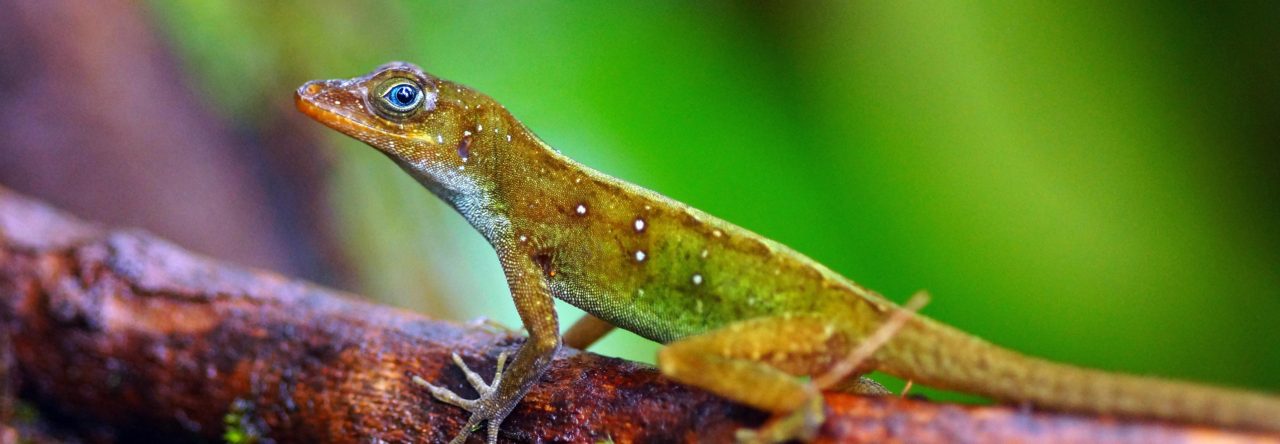
Category: Notes from the Field Page 7 of 22

Finding the “Rare” Anolis duellmani

Like many quests to find rare herps, this is a story of courage, persistence, and strength. Just kidding; it was a piece of cake.

Anolis duellmani was described by Fitch and Henderson (1973) based on four specimens from the southern slope of the Volcán San Martín Tuxtla, Veracruz, Mexico. Even though the phylogenetic position of A. duellmani is uncertain, no additional morphological variation had been described for the species. As part of a major effort led by Dr. Adrián Nieto-Montes de Oca and Dr. Steven Poe to untangle the systematics of Mesoamerican anoles, Israel Solano-Zavaleta, Levi N. Gray, and I went to Los Tuxtlas to search for the elusive species.

More Morphological Oddities in Anolis sagrei

A few months ago, I shared with you some of the odder morphological variations my field assistants and I encountered while measuring Anolis sagrei in Gainesville, FL. We went on to measure quite a few more lizards, and saw quite a few more oddities, as well as some fairly gruesome injuries. Here are some of my favourite examples:

1. A far better picture of a doubly-regenerated tail.

double regeneration

2. A jaw injury that resulted in the left and right sides of the jaws being dissociated from each other.

jaw injury

3. A cut hyoid. I imagine this lizard was no longer able to extend his dewlap.

hyoid

4. A nasty head injury. We saw this lizard three or four more times after we measured him, and his wound seemed to have healed up completely.

head injury

5. A brutal leg injury.

IMG_0430

6. A male with not only an impressive tail crest but also some nice red tail coloration.

tail crest


The Dewlap of Cophosaurus texanus

_1070960

Here at Anole Annals, we can appreciate a good dewlap. In particular, a pair of agamid clades, namely the genera Draco and Sitana + Otocryptis, arguably do extensible throat fans even better than Anolis. But dewlaps are actually found in many other iguanian lizards, covered by AA posts here and here.

Today I thought I’d share a lesser-known dewlap, that of Cophosaurus texanus, known as the greater (greatest?) earless lizard, and a legitimate candidate for best lizard coloration if you ask me. In my experience, these lizards don’t often dewlap, but will occasionally hit you with a few push-ups, and reliably wag their striped tails at you before darting away — though they are upstaged in this latter respect by Callisaurus draconoides. On a recent walk in the Rincon mountains near Tucson, Arizona, I encountered a particularly saucy individual, and thought I would share.

Here’s a series of photos showing a pushup/dewlap combo being delivered. By the way, Cophosaurus texanus are known to display at potential predators (see Dial 1986, American Naturalist 127:1).

_1070980
_1070979
_1070978

Another shot, the dewlap is being retracted here:

_1070973-2

As far as dewlaps go, its not the most impressive, but there certainly looks to be some cartilaginous rod action involved, as in Anolis. But wait – notice anything unusual in the above photos? Yes, there looks to be a parasite peeking out through the lizard’s nostril. Here’s a closer look:

_1070972

Pretty gnarly. I’m not sure what the parasite is, it looks to me like it could be a maggot (hey, speaking of maggots, remember anole throat maggots?). Hope I didn’t just ruin anyone’s lunch!

Anyway, if you’re interested in learning more about Cophosaurus, here is an excellent write-up written by Robert Bezy and provided by the Tucson Herp Society.

A Doubly Regenerated Tail and Other Morphological Oddities

I’m doing fieldwork with Anolis sagrei in Gainesville, FL, this summer. We now have about 125 lizards  measured and marked, and have come across a number of interesting morphological oddities in these lizards. Most interesting so far is this doubly regenerated tail, i.e. there appear to be two spots at which the tail has regenerated, which means a regenerated tail must have broken and regenerated again.

A doubly regenerated tail in a male Anolis sagrei in Gainesville, FL.

A doubly regenerated tail in a male Anolis sagrei in Gainesville, FL.

Approximately three minutes before we noticed this tail, my field assistant Christian Perez asked me if double regenerations were possible, and I confidently said “no.” As Jonathan Losos puts it in Lizards in an Evolutionary Tree, “when a tail regenerates, the new portion of is made of a rod of cartilage and thus lacks the intravertebral breakage planes that enable an unregenerated tail to autotomize.” So how did this double regeneration happen? Anyone seen this before?

The next oddity is this male with a mysteriously shortened upper jaw:

A shortened upper jaw in a male Anolis sagrei in Gainesville, FL.

A shortened upper jaw in a male Anolis sagrei in Gainesville, FL.

Third, we have a partially discoloured dewlap:


A discoloured dewlap in Gainesville, FL

A discoloured dewlap in Gainesville, FL

And finally, here’s an addition to our collection (1, 2) of multiply tailed lizards:

A double tail in an Anolis sagrei in Gainesville, FL.

A double tail in an Anolis sagrei in Gainesville, FL.


When You Can Not Get The Results You Expected, Use What You Can Get!

An adult Anolis sagrei male specimen from Santzepu, Sheishan District, Chiayi County, southwestern Taiwan.

An adult Anolis sagrei male specimen from Santzepu, Sheishan District, Chiayi County, southwestern Taiwan.

Field research does not always go the way we plan. My research partners and I were reminded of that in 2004, when we tried to use a mark-and-recapture method to determine the population sizes of brown anoles (Anolis sagrei) in a small betelnut palm (Areca catecha L) plantation in Santzepu, Sheishan District, Chiayi County, southwestern Taiwan. We ended up with too low recapture rates for our estimates. Still all was not lost! Of the lizards we did recapture, we were able to calculate monthly growth rates and monthly growth percentages. The results indicated that at least some individuals experienced active growth throughout the year. Our results also supported the findings of Schoener and Schoener (1978) and Cox et al. (2009) that smaller individuals of both sexes grew faster than larger conspecifics of the same gender, and that males grew faster than females. We also determined that growth rates of both sexes decreased during the peak reproductive period, suggesting that available energy is directed primarily to reproduction and the associated to behavior, and that energy is only directed towards growth once the requirements for reproduction are met.

The experience from this study convinced me again that it is important to collect as much data as possible when conducting field studies – it is hard to predict where it may come in handy at a later stage.

Crown-giant habitat overlap

Spring is the season for spotting crown-giant anoles in Miami!

I was hosting (recently graduated Lacertid-ophile, although closet anologist) Dr. Robert Heathcote for a few days this week, and after his failed attempt at catching a Cuban knight anole (A. equestris) a fortnight previous, I had promised to deliver him another! Now, I imagine many AA readers may chuckle at someone foolish enough to promise a crown-giant observation (myself included). Much to my relief luck was on our side and we managed to spot not one, but TWO species practically on top of each other!

test 2

A Cuban knight anole (A. equestris) and Jamaican giant anole (A. garmani) perched within 1-2m of each other in Miami FL – April 2nd 2014, JStroud

Cuban knight anoles (A. equestris) and Jamaican giant anoles (A. garmani) are both non-native introduced species to south Florida.

test 1

A. equestris (left) and A. garmani (right) – habitat overlap in Miami FL, JStroud

Anoles have it tough in south Florida!

A common concept in ecology is that predators have a strong influence on the behaviour of prey species. Anolis lizards have been used as a classic model system to investigate the effect of predator presence on the behavioural response of prey species. On small experimental islands in the Bahamas the manipulated introduction of curly-tailed lizards (Leiocephalus carinatus), a large terrestrial anole-predator, has resulted in brown anoles (Anolis sagrei) shifting higher up in the vegetation, presumably in an understandable effort to avoid being eaten (1, 2, 3). However, predator-prey interactions such as these which may shape community structure are often difficult to observe.

Here in Miami FL we have a rich and diverse, although largely non-native, lizard community. There are two species of “crown-giant” anoles, the Cuban knight anole (A. equestris) and the Jamaican giant anole (A. garmani), that could be potential predators of smaller anoles in the canopy of trees and upper half of tree trunks (although see Giery et al. 2013 for an empirical analysis that suggests this may not be the case). Additionally, there are several large, terrestrial lizards present which may be filling a similar role to curly-tails in the Bahamas.

Potential lizard predators in south Florida:

– *Red-headed agama (Agama agama)
– *Cuban knight anole (Anolis equestris)
– Jamaican giant anole (Anolis garmani)
– *Brown basilisk (Basiliscus vittatus)
– Spiny tailed iguana (Ctenosaura similis)
– Curly-tail lizard (Leiocephalus carinatus)
– Giant day gecko (Phelsuma grandis)
– Black and white tegu (Tupinambis merianae)

*Present at Fairchild Tropical Botanical Gardens

Earlier this afternoon, while taking a break from my office at Fairchild Tropical Botanical Gardens (a hot spot for any anologist visiting Miami; 1, 2, 3, 4) in a typical graduate student effort to put off work that I should be doing instead, fellow lab member Evan Rehm and I noticed some scuffling in a nearby bush. At around 2.5m, and admittedly on relatively precarious branches by this stage, sat an adult female African red-headed agama (A. agama) around 30cm from an adamantly motionless adult male Cuban brown anole (A. sagrei)! As we moved towards the bush the agama was quick to ungraciously thump itself to the floor, while the brown anole remained still. On closer inspection, it soon became apparent why both lizards were so high.

text2

Adult male Cuban brown anole (A. sagrei) found ~2.5m high in Miami FL, supposedly following a predation attempt from an African red-headed agama (A. agama) – JStroud

The significance of tail loss/damage in a population is still debated. The classical view argues that high proportions of tail damage indicates high predation pressure, therefore prey populations are under high predation stress (1). Alternatively, high proportions of tail damage could indicate low predator efficiency, which would suggest prey populations are experiencing low predation stress (1, 2). But the debate doesn’t stop there! Having already lost a tail, a lizard may experience either a resulting increase or decrease in predation depending on the predator species and its associated foraging tactic (1).

text2

The extent of tail damage is clearer in this photo. The lizard had autotomised the lower half of it’s tail however a secondary half-completed break is also evident – JStroud

African red-headed agamas (A. agama) are similar morphologically to curly-tailed lizards (L. carinatus), although are taxonomically distinct (Agamidae and Leiocephalidae, respectively). Predation of anoles by agamas in Miami has not previously been officially recorded, and the impact of these large predators remains unclear. Unlike in the Bahamas, there are multiple predators in the same geographic vicinity that anoles need to be aware of. For example, at Fairchild, brown anoles (A. sagrei) could be eaten from below by agamas, eaten at intermediate levels by basilisks and eaten from above by knight anoles!

South Florida is a tough place to be an anole!

agama

Adult male African red-headed agama (A. agama) at Fairchild Tropical Botanical Gardens, Miami FL. The population of agamas is localised to the botanical gardens; the source remains unclear but is likely an introduction from the pet trade – JStroud

Turks and Caicos Anole: Anolis scriptus

Much of my research has been conducted on the herpetofauna of the Turks and Caicos Islands (TCI). Known to a chunk of the lay public in North America as a sweet honeymoon spot, the Turks and Caicos boast a wonderful assemblage of terrestrial reptiles, like these IUCN critically endangered TCI iguanas (Cyclura carinata):

IMG_4541

Of course, we on AA prefer the smaller saurians, so I will draw your attention to the TCI anole (A. scriptus scriptus), a member of the Southern Bahamas Anole complex (A. scriptus).

Anolis s. scriptus, Big Ambergris Cay, TCI

Anolis s. scriptus, Big Ambergris Cay, TCI

Also known as the Silver Cay Anole, A. scriptus can be found across the southern Bahamas banks, including the Inaguas, Samana, Plana Cays, Mayaguana, and the Turks and Caicos Islands. I have previously posted about this understudied species (1,2), but spent a good bit of time observing them on my last research trip. They occur throughout the TCI archipelago, from the dense tropical dry forest of North Caicos, to the pine savannas of Middle Caicos and xeric outposts like the Ambergris Cays. They can also be found on nearly every vegetated rock cay.


DSC_0981

Male, Big Ambergris Cay


The males have an attractive yellow wash on the underside, with an orange-yellow dewlap that is really striking in the bright sun. The males display from elevated perches, but are wary when approached by nosy researchers.


The females are more cryptic, both in coloration and in behavior. They often have a light stripe down the back, or occasionally darker crossbars perpendicular to the light stripe.DSC_0977

On Big Ambergris Cay, on the southeastern edge of the Caicos Bank, the anoles especially favor an irrigated area near a decorative plant nursery. They are voracious, taking down large prey like this cicada (Ollanata caicosensis) on the right. Hopefully this voraciousness extends to interspecific interactions, as the “Festive” anole (A. sagrei) has now firmly invaded at least one island on the Caicos Bank (1; more on this in a future post).

Phylogenetically, Anolis scriptus is nested firmly within the radiation of Puerto Rican Anoles (most recently). Most closely related to a trunk-ground clade containing A. cristatellus, A. desechensis, and A. ernestwilliamsi, the TCI Anole exhibits a curious distribution, although they really do resemble A. cristatellus. Much of the terrestrial herpetofauna of the TCI is likely derived from Hispaniola (See TOC on this post), so what did A. scriptus do to get to the TCI? Our recent research on the A. cristatellus clade suggests that A. scriptus most likely dispersed from Puerto Rico around the start of the Pliocene. This could have been accomplished completely over-water, as currents and hurricanes push flotsam in a northwesterly direction from Puerto Rico. Alternatively, the species could have island-hopped on the formerly emergent Silver, Mouchoir, and Navidad banks, now a famous calving ground for the Humpback Whale.

Although I have not visited, the Crooked-Acklins Bank is a curious intersection of Bahamian and southern Bahamian herpetofauna, where the range of the southern A. scriptus (nearby Plana Cays) meets the range of the northern A. sagrei (Crooked Island). Furthermore, the bank is the northern limit of the Southern Bahamas Boa (Chilabothrus chrysogaster), which is replaced just a few kilometers northwest on the Great Bahama Bank by C. strigilatus. Finally, the handsome endemic A. brunneus (1,2,3) occurs there.


Wet Prairie Anolis carolinensis in Two Parcels in Broward County, Florida: Historical Populations?

IMGP0471

Hi Anole Folks,

So life transported me to South Florida to beat Cancer, and looks like I have made good progress, thank you in advance. 🙂

As a general naturalist, I get out A LOT, each day- up to three hikes in different habitats.

In my area on the border of Broward and Palm Beach Counties, there are several restored Pine-Lands, some from about 1984- most  cordoned off in a way for even longer due to central farm use, cattle grazing, or logging with left over islands near the wetter areas.

I spent a lot of time in the late 70’s in Coral Gables, Florida-  with a two year stint at the U. of M.  At that time, Anolis carolinensis, while not common, could be found on buildings on Ponce de Leon Blvd. and also areas of Bird Road, LeJeune and others behind the U of M arboretum.  I also would find both A. porcatus and A. chlorocyanus at these locations.  Anolis sagrei was always in great numbers no matter what.

Returning NOW, in 2014- with extensive field searching, failed to find Anolis carolinensis. The typical haunts I’d expect–along homes, in bushes, on trees, and in scrub–failed to yield a single animal.  I put in a lot of effort.  I found A. porcatus, A. equestris, what I think is A. cristatellus, and every morph you can think of of A. sagrei.  I also found Curly Tails living sympatrically with A. sagrei in several pockets.  This I found pretty neat and worthy of some work.

Recently, while hiking a Wet Prairie, along a Cypress Marsh near a domed swamp area, I started to see a very thin green lizard perched atop grass stalks–and very often cattail stalks in the center of the wetland, over standing water.  I could not confirm the species–they were far into the swamp and their flushing distance was ASTOUNDING.   They would see me and DROP clear to the grass below.  One time I saw an individual turn brown in seconds, and disappear, not into tree branches, but into the grass on the ground! I watched this behavior 8-9 times before I knew–I had to hike into the swamp.  So I did.

IMGP0391Eventually I was able to see males and females, of what now I was sure was A. carolinensis hunting and using the grass/cattail stalks for feeding and display.  In the attached image, you will see one on cattail, and this is a typical daily encounter.  I could see five or more in a hike, on the tops of grass stalks near the seed heads.  While bushes and peripheral trees were there, they were not using this substrate. I really was seeing a marshland native Green Anole group.   And to my eyes, this group was rather “gracile” in form.  And they worked the stalks in what seemed to be a new fashion.  I even imagine–since I have not done any morphometrics yet–that their hind legs look longer, tibia/fibula and femur, and toes.  They also have  a posture for most of their time on the stalks that is not something I was used to seeing–legs held way back and tight to the body, as if to reduce their profile.  A thin Green Anole, that can hide on a grass blade :-).   The images here represent two separate anoles from two separate days.

Did the pressures of habitat loss, A. sagrei competition, and A. equestris predatory pressure, isolate this group and/or move them to this grassland habitat over water?  Could this be a recently adapted “ecomorph” which we so timely have read about?

I will be vouchering a male and female for work at the MCZ for others that might be interested.  But in the interim, my favorite interest, watching behavior, will continue.

I know all the BUTS about this- as in- are they even remnants of historical Broward animals at all?  Did they come in with the replanted slash pine and pond cypress?  I’m hoping one day by genetic work, and or even some new Xray work, we might be able to answer some of this.  And of course, in their normal historical lives, they almost certainly used this type of habitat in part.  But what about now?

That there are vigorous groups in these Wet Prairies of Broward attests to the tenacity of the species, and that it is surviving here.  And that  puts a smile on my face!!

If anyone would like additional information for research, and or visit the sites with me, please feel free to contact me at naturalist@gmail.com; I’ll be here for at least a few more months.

Would love any ideas, thoughts regarding this as well.  More photos to come as well.

Enjoy the images.

Sincerely,

Kenneth E. Barnett

IMGP0417IMGP0404IMGP0413

Brown Anoles in Tree Islands

A recent trip to the Everglades with Palm botanist Sara Edelman was meant to provide a welcome break from studying for qualifying exams, and give her the opportunity to further educate me on all things palm (which was previously limited to determining which lizards in Miami appear to live on them).

After spending the morning locating individuals of her study species, the native and state-threatened Paurotis palm (Acoelorrhaphe wrightii), we had received very little wildlife luck (which was the true reason for me volunteering to ‘help’). From past visits, I had found brown anoles (Anolis sagrei) at every car park along the Everglades National Park road down to Flamingo, likely hitch-hiking unwittingly on visitors cars, but to my knowledge they had yet to disperse convincingly out from these. On our second to last survey of the day, to this tree island off the main road just south of Mahogany Hammock, while searching for native green anoles (Anolis carolinensis) which I had yet to see, I heard some rustling in the bushes – lo and behold, sitting there as bold as day signalling straight at me was a male brown anole!

Everglades tree island characterised by Paurotis palm (Acoelorrhaphe wrightii), Saw palmetto (Serenoa repens), Buttonwood (Conocarpus sp.) and Pine (Pinus sp.), and inset brown anole (Anolis sagrei) observed inside

Everglades tree island characterised by Paurotis palm (Acoelorrhaphe wrightii), Saw palmetto (Serenoa repens), Buttonwood (Conocarpus sp.) and Pine (Pinus sp.), with [inset] brown anole (Anolis sagrei) observed inside

Now, observing brown anoles here shouldn’t be a surprise, should it? After all they are already in many surrounding places accessible by car, therefore it was only a matter of time before they spread further afield. However, areas like these in the Everglades may represent one of the last refuges of green anoles from introduced non-native species found everywhere else in south Florida (an idea I mentioned here a few months ago). Tree islands are masses of larger vegetation (unsurprisingly characterised by trees) formed gradually as vegetation clumps in the slow moving Everglades flow. Over time, debris from colonising plants raises the ground level just above surrounding water level, meaning they provide important havens for many wildlife species. During the wet season the dispersal potential for brown anoles would be limited. All of the areas surrounding tree islands are generally inundated, meaning landscape movement through the thin-stemmed sawgrass plains may be easier for more nimble footed green anoles, however somewhat less graceful for browns. This, however, is all hypothetical.

So ruling out human-mediated release or dropping by a clumsy predator, we could assume that this chap arrived there all by himself. This would suggest that brown anoles have no problems in traversing through sawgrass, although temporal factors may be important (i.e. dispersing during the dry season when water levels are low or absent).

The implications for the expansion of this species through the Everglades remain unclear, although their relationship with green anoles leads to a predictable outcome (discussed extensively on AA [1, 2, 3). Just how much effect is a highly fecund, hyper-dense, extremely competitive and resilient insectivore going to have on these small ‘island’ ecosystems?

Page 7 of 22

Powered by WordPress & Theme by Anders Norén