
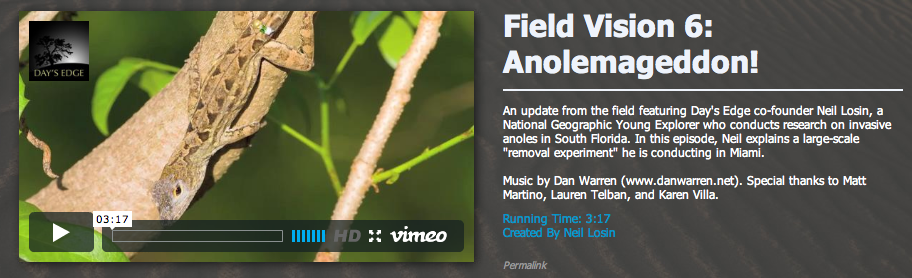
Another video about Anolis research from Day’s Edge Productions. Cool research! Great footage!
Category: Notes from the Field Page 17 of 22

a juvenile Anolis orcesi, in the afternoon of an all-day recording
They wake up, but hit the snooze button before they really get moving. They poop, grab something to eat, and then check out the neighborhood. They take wrong turns, and have to turn around when they reach a dead end. Young boys try to impress each other with their dewlaps. They take naps in the afternoon, and yawn throughout the day. They even sleep in the same bed, most nights.
As Jonathan Losos hinted at in an earlier post, we observed 4 Anolis orcesi individuals from dawn to dusk (12 hours!), and several more individuals for 1 to 6 hours, in the vicinity of Baeza, Ecuador. More to come after several months of video analysis!
I am irreparably fond of anoles, but I must admit that they are not the cuddliest of beasts. In fact, they can be downright unfriendly, especially with each other. The mere sight of another male sends anoles into spasms and, when not mating, males and females seem to barely tolerate each other, at best. It would seem that cuddling is best left to mammals and birds, but recent observations would indicate that even the ornery anole has a soft side.

Anolis shrevei mating pair cuddling in Valle Nuevo, Dominican Republic.
A post by Kat Wollenberg on this blog documented two Anolis etheridgei sleeping with their tails intertwined. A follow-up post by Melissa Woolley shows that Anolis gemmosus mating pairs sleep near each other, even if not touching.
But does an anole have to be asleep to show its softer side? In June 2011 I observed an Anolis shrevei mating pair in Valle Nuevo cuddle as they basked one afternoon. It is chilly at 2500 meters, even in the Dominican Republic. It had been a cold morning, and neither the sun nor the lizards had shown themselves until almost noon. But when the sun did peek out from behind the clouds, there was a mass exodus of anoles, which came out from under their rocks to take advantage of the day’s first rays. This little pair came out from under the same rock and sat together for close to an hour. They were touching each other, despite the fact that there seemed to be enough rock to go around. Whether this was coincidence or another mechanism of behavioral thermoregulation, the anoles of the chilly Cordillera Central know how to keep warm.

Invertebrates associated with Hispaniolan anoles. Scale bar in right panel is in millimeters.
The invertebrates in the image above were photographed yesterday in the Dominican Republic. Today’s trivia is related to these invertebrates and consists of three questions:
1. What are these invertebrates and how do they interact with anoles?
2. How many individuals are in the right panel (note: all of these individuals were associated with a single anole)?
3. How do these invertebrates factor into Dominican folklore?

Photo copyright R. Glor 2011.
Perhaps this is Anole Annals’ first NSFW post, but the mating event depicted in the photo above was such an exciting observation and photographic opportunity that I can’t help but share. Yesterday we discovered a new contact zone between two phenotypically and genetically distinct populations of Anolis distichus along the Rio Bani (this contact zone is along the river’s eastern bank rather than along its well-traversed western bank). Along a narrow zone of contact (~500 m), green bodied, orange dewlapped populations of A. d. ignigularis come into contact with gray-bodied, yellow dewlapped populations of A. d. ravitergum. While sampling this contact zone, we ran across the copulating pair pictured above. The fact that the male is predominantly gray and the female predominantly green may be an indication that this is a hybridization event between A. d. ravitergum and A. d. ignigularis; genetic analyses on tissue samples collected from the pair will soon provide the answer!
If it is a hybrid pair, its likely to be more successful than others reported recently on anole anoles (e.g., A. carolinensis and A. sagrei); although hybrids between A. d. ignigularis and A. d. ravitergum are rare in nature, our captive mating experiments have yielded hundreds of eggs and offspring from matings between A. d. ravitergum and A. d. ignigularis.

Though they are not as flashy as some of their West Indian relatives, Anolis scriptus, the Southern Bahamas Anole, is an ecologically important and interesting component of the herpetofauna of the distal end of the Bahamas Archipelago. Small and brown to brownish green, they seem to be rarely photographed or discussed, so I thought they deserved a post on Anole Annals.  These are individuals from the Turks and Caicos Islands- where they are ubiquitous on most emergent land- from the largest islands at over 290 square km to the smallest rocks with some vegetation. Interestingly, this species has been shown to modify its perch height in response to the presence of predators (more on predation in a later post). When curly-tailed lizards (Leiocephalus psammodromus) are around, the anoles are more arboreal (Smith 1994;1995). However, we have found this to be the case mostly on smaller islands, while on larger islands the anoles will still use the ground and lower tree trunks, even in close proximity to high densities of curly-tailed lizards.


These stills are of an anole fight we saw yesterday along the Rio Bani. This fight happened on a rock between two male Anolis distichus ravitergum. On the left, the two males are facing off. In the middle, one male is charging and biting the other. On the right, the two are tumbling down the boulder. Shea Lambert recorded the video and plans to post a version with slow-motion and music sometime soon; it should be epic.
 In the Dominican Republic, there are few anole hunting localities more famous than the Recodo Road, a road running along the Rio Bani just west of Bani (you can get some background on this locality from several previous blog posts 1, 2, 3). Anthony Geneva, Shea Lambert, and I arrived here on Sunday to continue our studies of speciation in the distichus species group. One feature of this road familiar to anyone who’s visited are the river crossings that are necessitated by the absence of bridges. With a 4×4, these crossings are a piece of cake when the water is low, but completely impossible when the water is high. After a recent tropical storm, both of the two required crossings are on the verge of uncrossability. We made it through the first one (see photos above), but have decided to hold off on attempting the second until the river settles a bit more. Note the beautiful Kapok (Ceiba) tree at the first crossing, which is one of the oldest and most beautiful native trees in the region (it’s also from a genus with rather remarkable transatlantic dispersal capabilities [Dick et al. 2007]). More soon on the lizards we’re seeing so far!
Watch Miguel Landestoy kiss Anolis darlingtoni! (at 1:39 on the video)

Image of Anolis darlingtoni from http://www.philly.com/philly/blogs/evolution/A-Long-Lost-Lizard-is-Found-in-Haiti.html
Last week, Blair Hedges led a team of scientists, journalists and naturalists on a helicopter tour of some of the most remote forested habitats remaining on Haiti’s Tiburon Peninsula. For anole enthusiasts, this expedition’s most remarkable find was the rediscovery of Anolis darlingtoni, an enigmatic species that hasn’t been seen since 1984. As reported by Faye Flam at Philly.com, expedition member Miguel Landestoy spotted a single animal sleeping around 2m up in a tree fern. This seems to have been the only darlingtoni recovered by the expedition, but full trip details are still filtering in.
Even with this rediscovery, Anolis darlingtoni remains the rarest anole on Hispaniola, and the one that is the most immediate danger of extinction. Luke Mahler and I went to a great deal of trouble to search for A. darlingtoni in remnant forests at the western end of the Tiburon Peninsula a few years ago and came up empty, so I know that finding this species is no easy feat. My congratulations to Blair, Miguel, and the rest of the team!