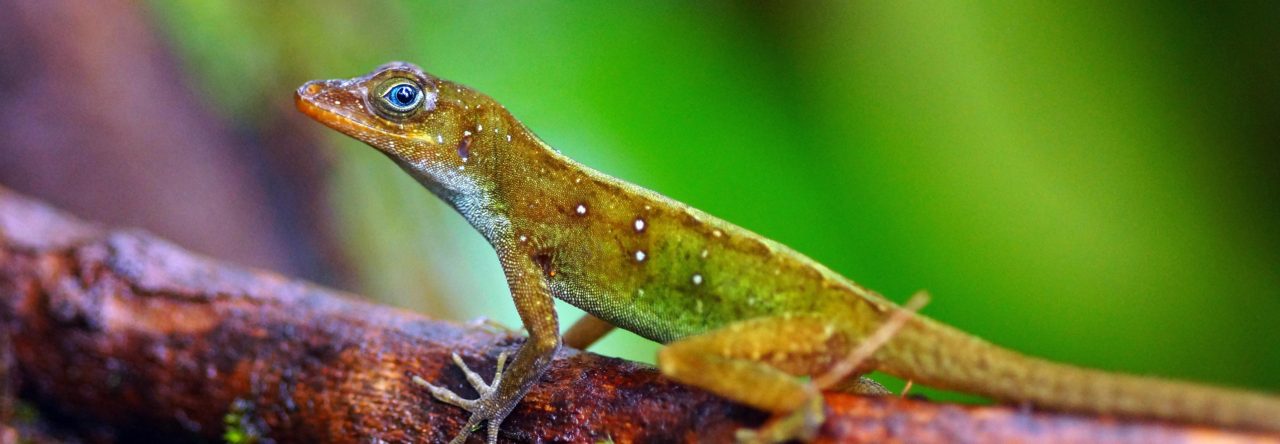
Ecuador is one of the most biodiversity-rich and unique locations in the world – especially for herps. Currently, there are 207 species of lizards there, 41 of which are some of the most spectacular anole species around (Arteaga 2025). As a herp wildlife photographer and an employee of the Khamai Foundation, I have had many chances to encounter and document some of these incredible animals. In this post I will offer some photos, stories, and natural history information about the anole species I witnessed on a ~10 day trip to Ecuador in 2022. The locations we visited included Mindo, at the Septimo Paraiso Lodge; the Choco, at Parque Bosque La Perla; and the Amazon lowlands, at the Yasuni Scientific Station and Yarina Lodge.
The Mindo Cloud Forest is a very unique ecosystem in the Ecuadorian Andes. While it is famous in the birding community, it also supports a variety of colorful and strange anoles. Mindo’s hallmark anole species is, of course, the Pinocchio anole (Peters and Orces, 1956), famously discussed on AA numerous times. The Pinocchio anole’s trademark nose is actually just flesh and scales – it bends when touched, and would clearly be useless in a jousting battle. Some observations of these lizards show that they can actually raise/lower their horn at will – to move it out of the way to eat, for example – despite the seeming lack of muscle. This species is extremely cryptic, as most herpetologists have found after returning disappointed from Mindo, and very little is known about their life cycle and behavior. This can be attributed to the fact that these lizards tend to prefer the canopy of the cloud forest (the individual we found was knocked down from a two-story tree!) and they move at a snail’s pace during the day. Like many other anole species, A. proboscis can turn from bright greens and black to muddy brown colors when stressed. After a stunning photo shoot, the male individual we found was returned to a safe location away from the owls near the lodge
Male Hippie Anoles (Anolis fraseri) have some of the most stunning colors in the nighttime cloud forest. Most males have bright red heads, as this old individual did, with some also having blue and purple colors down their backs – very 70’s indeed! These diurnal lizards are actually uncommon to see, since they perch higher in the forest than most common lizards. We were lucky to see two individuals, a male and a juvenile, who both offered their best poses.
As well exemplified by a significant fraction of anole research, islands can act as natural laboratories of evolution. With limited space, fewer predators, simplified communities, and isolation from the mainland, islands often impose strong and distinctive selective pressures relative to continental habitats. However, although anoles provide some of the most famous examples of evolution on islands, insularity can exert its effects on different types of organisms.
In our recent paper in Reptiles & Amphibians (Zamalloa-Bustinza et al. 2025), we focused on the Peruvian Lava Lizard (Microlophus peruvianus), a conspicuous and widespread species found along the South America’s western coast that was deliberately introduced to several offshore islands in the 1940s. These introductions were intended as a potential biological control for guano-bird ectoparasites. Despite the abundance and broad distribution of Microlophus, this island–mainland system has received surprisingly little attention. Taking advantage of this relatively recent introduction, we explored whether island populations show evidence of rapid morphological divergence from their continental counterparts.
To explore this, we compared adult lizards from a mainland population in northern Peru (San Pedro de Vice) with individuals from an insular population on Lobos de Tierra Island. Rather than focusing on a single trait, we examined a suite of ecologically relevant morphological characters, including body size, head dimensions, and limb proportions, traits known to be tightly linked to feeding and locomotion in lizards.
After less than a century of isolation, island and mainland populations showed clear and consistent morphological differences. Island lizards were larger overall and had relatively longer limb elements and interlimb distances. In contrast, mainland individuals tended to have proportionally larger and taller heads, as well as longer fingers, toes, and femora.
These differences might be pointing to subtle but meaningful shifts in ecomorphology. The evolution of relatively larger heads and longer digits in mainland lizards may reflect the demands of exploiting a more diverse prey base and moving through open habitats where predators and competitors are present. On islands, larger body size may be favored under conditions of reduced predation, while longer forelimbs may be associated with the use of different microhabitats when compared to mainland populations.
Together, our results suggest that morphological differences between island and mainland populations can emerge rapidly following introduction. However, further research is needed to link morphological divergence to ecological causes, if any. Ongoing work is expanding this approach to additional islands along the Peruvian coast and to other aspects of the phenotype, including behavior. These efforts will help determine whether the morphological patterns observed here are consistent across the species’ broad geographic range and how closely they align with ecological differences among localities.
Although I have not been a prolific poster on AA, I have enjoyed contributing articles about the obscure and rarely seen anoles of the Greater Antilles and Lucayan archipelagos, such as Anolis ernestwilliamsi, Anolis fairchildi (1,2,3), and Anolis scripts (1,2,3,4,5).
Here is another post in that series, focused on Anolis altavelensis, the Alto Velo anole. First, a bit of background. I am currently collaborating with Joe Burgess of the National Park Service (USA), Brad Keitt of the American Bird Conservancy (USA), and Jorge Brocca of SOH Conservación (Dominican Republic) on a multi-year project focused on the ecological restoration of Alto Velo Island. This project includes detailed surveys of terrestrial fauna, followed by the removal of invasive species and recovery monitoring.
Alto Velo Island is located about 30 km off the coast of southern Hispaniola, south of the town of Pedernales, Dominican Republic. Part of Jaragua National Park, the island is separated from Isla Beata, and the mainland of Hispaniola, by a deep-water channel. This means that the island contains some endemic reptile species, including A.altavelensis, as well as endemic Leiocephalus and Sphaerodactylus. It also means that not many scientists have visited, as the island is very challenging to reach without either a large boat or a very skilled panga captain. The crossing is dangerous at the best of times, with winds regularly reaching 15–25 kts and waves 1.5–2 m, conditions that are challenging, if not reckless, for open vessels. There are no landing beaches, and a rocky coast surrounded by reefs await those who cross the Beata Channel. As I can now personally attest, this island is not for the faint of heart.
But what awaits is spectacular! Alto Velo Island is very tall, much taller than you might perceive from a satellite view, with a peak of 150 m and a series of dramatic hills that fall precipitously down to the blue sea. A wide, flat plain graces the north end, although a mixture of invasive grasses and African milkweed mars the landscape. The island has historically been heavily impacted by guano mining, an extractive industry that has left numerous islands and islets in the Caribbean in ecologically degraded states, as well as probably contributed to the extinction of some reptile species (such as on Navassa Island). Nevertheless, some endemic reptiles remain on Alto Velo, including the anole.
Anolis altavelensis. Photo by Joseph Burgess.
And what an anole is found there! Anolisaltavelensis is dramatically beautiful, even among a superlative group of the bark anoles (distichus series) that are renowned for their variety and beauty. This species is electric orange, meaning that a sweep of a flashlight over a bush at night resembles a Christmas tree with small orange jeweled ornaments dotting the green leaves. Spectacular!
Happily, the species is relatively common on the island, despite an extremely damaging history of guano mining, burning for goat grazing, and infestation with cats, rats, and many invasive plants. Some native vegetation remains, particularly on the steep slopes, but a goal of the restoration project is to restore the native vegetation as well. Stay tuned for updates on this project as we hope to see Alto Velo restored to its ecological vibrancy and remote beauty.
Yes, the distichus looked that angry when I caught it!
When I was a kid, my favorite thing to do was go outside with my rainbow zebra-stripe notebook and draw any living thing I could find. Often, especially for the animals, I would include little comments and blurbs about the things I observed them doing, or make up stories about them. As the years went by, I slowly forgot about that book, until I was hired as a research assistant last summer to study anoles in the Dominican Republic with the Frishkoff Lab at UTA.
The week before I was scheduled to leave, I went out and bought a new sketchbook, not knowing if I would actually end up doing anything with it. Luckily, I did, and so I’m here to share a couple of my anole sketches that I did on my trip. While not all the information may be completely accurate, it’s just what I noticed about them while I was drawing and studying them. (Note: For the locations, those are specific to the sites that we were studying while we were there and not the complete ranges).
I hope that you enjoy them, and let me know which ones are your favorites! I think mine are the A. barahonae and A. armouri.
While I unfortunately did not get to actually see an A. eladioi, I still drew one in the hopes that I might.
Over the years, there has been a lot of discussion on Anole Annals about the large, conspicuous dewlap. And rightly so because it is arguably the most evocative feature of the anoles. Much of this discussion has focussed on its function, such as its role in species recognition, mate choice, and territorial communication. But is there a cost to having such an audacious visual signal?
We needn’t isolate this question to just Anolis lizards. All socially communicating animals need to produce a signal that will be obvious to conspecifics. There’s little point producing a mating or aggressive signal if females or rivals never detect it. But there is a cost to being conspicuous and it can be a matter of life and death: the unintended attraction of predators.
Generally, the assumption has been that animals just incur the potential risk of predation for the sake of successful communication. But just how risky is it? The dewlap is often large and brightly coloured, but when it’s not being used in display, you’d never know anoles even had one.
There are also at least two other independent origins of the dewlap, including in the gliding lizards of Southeast Asia, the Draco. In these lizards, the dewlap is again large and often conspicuously coloured.
For both Anolis and Draco, one of the best ways to find lizards in the wild is by the quick flash of colour as males rapidly extend and retract the dewlap during their territorial displays. In fact, it is often the only way to find Draco, which are camouflaged and extremely difficult to spot, even when you happen to be staring right at them.
I had this crazy idea a few of years ago… Would it be possible to build an army of robotic Draco lizards with plasticine bodies that could retain impressions of predator attacks and measure the risk of predation from performing a conspicuous dewlap display?
It really was a ridiculous thought, but my long-time collaborator Indraneil Das was game.
Robotic lizards compared to the real thing in (a) morphology and (b) behaviour (robots were modelled on Draco sumatranus from Borneo).
It was an awful experiment to do. Building the robot army turned out to be the easy bit. To be clear, it took months of development and manufacture, all of which I did in my garage (long story). It then took years to run the experiment, with multiple replications across two continents because the data was puzzling. There were bushfires, floods, battles with swarming wasps and kamikaze leafcutter ants, chipped teeth, falls from ladders, bogged car rentals, hammered thumbs, and in the end I only just managed to get it finished before the world turned side-ways in 2020.
Left: fresh-faced and optimistic in June 2018; Right: brave-faced but really a little shellshocked with the retrieval of robot 2,120 in February 2020 (NB: batteries have a habit of failing and parts started to corrode so only 1,566 robots were fully functional in the experiment).
It turns out that prey that can produce a signal intermittently — effectively turning their conspicuous display on and off at strategic moments, like the dewlap — can drastically reduce their risk of predation. In fact, attack rates by predators on dewlapping robotic lizards were no different to robots that remained unmoving and cryptic in the environment. Which means there doesn’t really seem to be a large cost from increased predation for animals that perform bouts of conspicuous behaviour.
But this wasn’t the biggest surprise.
The experiment included robotic lizards that kept the large, conspicuously coloured dewlap permanently extended so it was always visible. Think of peacocks with their massive tail trains or other animals that are spectacularly ornamented. These features are always visible and are not signals that can be turned on and off. My assumption was that these robotic lizards would be the hardest hit by predators.
This wasn’t the case at all. Predators actually avoided these robotic prey and to such an extent that the probability of attack was lower than the robotic lizards that remained cryptic and didn’t perform any conspicuous behaviour.
Photo montage of predator attacks left in the plasticine body of the robotic lizards
At first, I found this to be confusing and replicated the experiment over and over again. I even called in my partner Katrina Blazek who is a biostatistician to blind the data and independently perform the analyses (Katrina is also a skilled tailor and made all the robot dewlaps). I also dragged in my colleague Tom White who is an expert on animal colour discrimination to confirm that the dewlap really was as conspicuous to predators as I thought it was.
The data was robust.
This type of predator phobia actually helps explain the evolution of a completely different type of animal signal in nature: aposematic signals or warning signals that some prey evolve to explicitly advertise their location to predators to warn them against attack, usually because they’re toxic. Conspicuous poison dart frogs are an obvious example, so are ladybirds (or ladybugs).
The paradox is how these warning signals could evolve in the first place given the first individuals that tried to advertise their warning would be quickly eaten by predators that had no idea the signal was meant to advertise unprofitably until after the attack.
One of the key hypotheses that has been proposed to resolve this evolutionary paradox is that predators are highly conservative in the types of prey they go for. That is, they tend to avoid prey that look unusual in some way, even if those prey are more easily detected.
This is exactly what happened in this experiment. The robotic lizard with the permanently extended dewlap was ‘weird’ and so predators instead targeted the robotic lizards that either displayed intermittently or remained cryptic, both of which were more typical of their familiar prey.
The take home message is:
Follow your ridiculous idea and call on your friends to help.
(But don’t hold metal tools between your teeth. Your dentist will be very annoyed with you.)
New natural history note: “Nocturnal foraging and activity by diurnal lizards: Six species of day gecko (Phelsuma spp.) using the night‐light niche”.
A set of observations, recently published in Austral Ecology, noted six different species of day gecko (Phelsuma spp.) using artificial light at night (ALAN) to engage in nocturnal activity (e.g., foraging, courtship, and agonistic behavior). Lizards of this genus are widely believed to be primarily diurnal, however, their propensity to colonize both urban and highly-modified habitats, as well as establish invasive populations within novel landscapes, suggests they are a taxon that is quite flexible and adaptable.
A blue‐tailed day gecko, Phelsuma cepediana, foraging for insects under a fluorescent light in Mauritius. Photo credit J. L. Riley.
Remind you of any other small- to medium-sized adaptable and diverse group of lizards?
Keen readers of the Anole Annals will recall several posts about the effect ALAN can have on anoles, including its impact on physiological stress, metabolism, invasive potential, and reproductive output. With many accounts noting the costs and benefits of shifting diel cycles and daily activity period, but also the general impact light pollution may have. No doubt, there remains a lot of research potential to examine similar questions for the many Phelsuma species across their native and invasive ranges.
Reunion ornate day geckos, Phelsuma inexpectata, engaging in nocturnal activity under a fluorescent light inside a bathroom in Manapany-Les-Bains, Reunion (A,B), including courtship behavior (C). Photos credits C. Baider and F.B.V. Florens.
It is always worth keeping your eyes peeled in the field.
The observations that led to this note came from nine researchers working in various sites, locations, and projects across a number of archipelagos spanning the Indian Ocean and over several years. As with many natural history observations, most of these accounts began with a researcher – who was no doubt occupied with an entirely different task – seeing something out of the ordinary, snapping a picture and jotting down some quick details, and carrying on with their work. A great reminder to never leave home without your trusty notebook; digital or otherwise. Then later on, sometimes much later, this information regarding “something weird you saw” is shared between colleagues, sometimes met with an “oh ya, I saw that too, different species, different location, but the same thing,” and from there, patterns emerge and collaborations bear fruit.
Over the years, Anoles Annals has featured a number of posts related to day geckos, with some keener anolologists expressing the feeling that these colorful, charismatic, and adaptable geckos could be seen as “honorary anoles.” A compliment, surely, the geckos would appreciate and reciprocate toward anoles, if given the chance. Despite their stunning appearance, long history of public awareness, and ability to sell car insurance, there remains a lot of information we do not know about day gecko behavior, biology, and ecology. We hope this natural history note will prompt further research interest into this enigmatic group of lizards.
Upon returning to the first address, I had to search for a long time, 20-30 minutes, before finally stumbling upon one adult male A. Allisoni relaxing on the top of a fence.
I only managed to snap one picture of it in this pose before it hopped onto a palm tree on the other side of the fence. As it slowly made its way up the tree, while cautiously keeping an eye on me, I snapped a few more photos.
After this, I moved on to the next address, about 15 minutes further south in Naples. The area to search was very small, but there were several dense bushes to sift through. After a half-hour spent combing the bushes and peering into the greenery, I finally spotted another adult male A. Allisoni in the underbrush, close to the ground. Unfortunately, he was so deep in the bushes that there was no way to get a clear photo. After an extensive chase, where I scratched myself all over with pointy branches as I tried pursuing the elusive anole through the bushes, he eventually disappeared.
Defeated, I looked up and spotted a small, likely female, A. allisoni hopping from twig to twig much higher in the trees above. This one also completely disappeared as I went to take a picture, unfortunately. However, just as I was about to give up hope and leave, I spotted one final small anole climbing the trunk of a nearby tree at hip level. I crept over and quickly wrapped my arms around the tree where I last saw the anole, and, sure enough, safely snagged it!
Again, at first glance, it appears to be a green anole. But look at the ear cavity. In this observation of a male A. allisoni, the ear cavity is also more of a gash, instead of a hole. And the large scales on the snout would also imply A. allisoni. What do you think?
Join me on Instagram @dailyanole to follow my adventures!
Driven by my quest to find Allison’s anoles (A. Allisoni) in the wild, a few weeks ago I dove into a pit of research papers to look for known sightings and/or colonies of A. Allisoni in Florida. I came upon a few vague notations of a colony in Naples with an address included. So, as part of a herping trip for various anoles and lizards to Miami last week, I stopped in Naples along the way.
I drove to the address and, after parking and entering the area, the first thing I saw was a large male specimen of A. Allisoni perched on the side of a palm tree. Shocked and delighted, I snapped a picture.
To see such a beautiful species of anole in Florida in the wild was breathtaking.
The male allisoni was perched on the palm tree with one large male A. sagrei (brown anole) below him. As I approached the palm to get a clearer picture, the sagrei leaped off the palm onto a smaller scrub, and the allisoni followed right after. The two briefly scuffled, nipping at each other before both went their separate ways and I did not see them again.
Strolling around the area to search for more, I found a very small green juvenile anole. It appeared to be allisoni, but did not give me enough time to properly examine it before scuttling up a tree and into the canopy.
Upon returning to the same spot where the first allisoni was, there was another just a few feet away that I had somehow missed the first time. This one had no hints of blue on its head, but simply from its large size, I took a guess that it was an allisoni. After succeeding at capturing it, I took a picture:
Upon first glance, it seemed to be A. carolinensis. However, on a closer look, both the shape of the ear hole and the large scales on the snout suggested allisoni. Here’s a picture of A. carolinensis for comparison:
For the genetics experts reading this, is there evidence of allisoni interbreeding with carolinensis?
Upon revisiting the address the next day, I searched in the same place I found the first allisoni, and, sure enough, found another one, this time suspected to be a female.
Again, I notice the oddly-shaped ear holes and eyes that seem too large for the head, more characteristic of allisoni than carolinensis.
In total, at this colony, I observed four possible A. allisoni, including two adult males, one adult female, and one juvenile.
I plan to return to check for more allisoni before the warm weather ends and anole activity decreases for the winter.
The following was written by Keeley Peek and Alyssa Vanerelli, two research students in the Reynolds Lab at The University of North Carolina Asheville. Here they document some experiences with a lesser-known anole species- Anolis scriptus– a species our research group has tried to acquaint AA readers with previously (1,2,3,4).
As aspiring tropical herpetologists, adventures aren’t hard to come by. A combination of traveling to new places and the thrill of encountering new species is a constant excitement. From high in the Blue Ridge Mountains, we heard the soft call of crystal blue waters crashing against a distant shore, and importantly, the scurry of little legs across the sand. It was time for an adventure to the Turks and Caicos Islands.
We touched down in a small plane on the long runway of remote Big Ambergris Cay, one of the last strongholds of the Turks Island Boa (Chilabothrus chrysogaster) and Turks and Caicos Rock Iguana (Cyclura carinata). While these two species seem to rule the island during the night and day, respectively, they are not the only ones that think they own the place. Within a mere moment of tumbling out of the 5-seater plane we spotted our target. The Turks and Caicos Anole (Anolis scriptus scriptus) was soon found to dash under every rock, prickly plant, and structure around. We know surprisingly little about these amazing anoles, which are widely distributed in the southern Lucayan Archipelago. Few focused studies on the natural history of this species have been conducted, and each time our Lab visits this region for our ongoing research on boas and iguanas, we often spot Dr. Reynolds imploring us to find a way to fold in some time for anole study.
Female A. scriptus, hidden among the vegetation.
Although our main efforts were on collaborative boa and iguana research with the San Diego Zoo Institute for Conservation Research, most days we would spend our free time in the afternoons in the hot sunlight trying to catch as many anoles as possible. Without any nooses, nets, or know-how, this was not the easiest task. Around the compound where we stayed, the anoles could be found basking in the sun on the concrete building walls or other human structures, reminding us of work done by Kristin Winchell of Washington University in St. Louis (who gave a seminar at UNC Asheville). They also taunted us from tree branches, just out of our reach. The males on Ambergris Cay stood out with a striking yellow underside, yellow extremities, and an orange-yellow dewlap contrasting remarkably with the beige covered their backs. Females sported a less-colorful look, but have a curious pattern consisting of a light stripe running down their back crossed by thin black bars. We were also able to observe, and sometimes catch, anoles as we worked in the evenings catching boas.
After spotting a beautiful male A. scriptus on what may have been a water heater (we weren’t exactly focused on the structure), we silently stalked towards our scaly tailed friend. After discussing the best angles, timing, and speed we should use to capture this anole, we froze ready to strike. One of us raised a hand for distraction, the other sneaking up in the blind spot to… watch as the anole disappear over the side of the heater. We retreated with a stinging defeat, only to return later as the anole had returned to his basking spot. With a few recalculations and adjustments, we crept in for round two, and emerged victorious.
An amazing feature common among all anoles are their dewlaps which they use to attract females and discourage predators as well as other males. Adorned in vibrant colors, the dewlap is a feature that is easiest to observe when a specimen is in-hand. As newcomers to catching A. scriptus, it was a bit of an adjustment to learn to delicately handle these tiny but surprisingly strong creatures. We received some advice from a seasoned A. scriptus catcher (who doubles as our research advisor), Dr. Graham Reynolds, that the best trick is to let them bite us on the finger and then they will gently extend the dewlap. At first, we believed he was pulling our dewlap, and then we realized he was extremely serious. With a quick game of rock-paper-scissors to determine the anole’s victim, we let the creature’s teeth sink a whole nanometer into our skin and extended its sunrise-colored jewel of a dewlap. We embraced the pain and received the reward of observing one of the anole’s best features. Count us among two of the newest fans of the incredible Anolis scriptus.
Learning a new technique.
p.s. Anolis scriptus is going big-time, having featured in recent publications inNature and PNAS. We look forward to the time when they are as popular as A. sagrei!
The Reynolds Lab (www.CaribbeanBoas.org) studies the ecology and evolution of reptiles and amphibians in the Caribbean and the southeastern United States. We are an undergraduate research-centric Lab.
Predation event between a Praying Mantis (Mantodea: sp.) and a sub-adult female of Anolis cusuco. Photo Credit – George Lonsdale
A natural history note published September 2019 in the journal SAURIA details an unusual observation of anolivory by a Praying Mantis. Specifically, it discusses an event involving the predation of a sub-adult female Anolis (Norops) cusuco.
Anolis cusuco owes its name to its type locality in the cloud-forest of Cusuco National Park, Honduras, and is a species endemic to the country. Few publications exist regarding the natural history of this species and much regarding its ecology, including its potential predators, remain unknown. While a small contribution, this observation describes the first, albeit somewhat unsuspecting predator for Anolis cusuco.



 pecies found along the South America’s western coast that was deliberately introduced to several offshore islands in the 1940s. These introductions were intended as a potential biological control for guano-bird ectoparasites. Despite the abundance and broad distribution of Microlophus, this island–mainland system has received surprisingly little attention. Taking advantage of this relatively recent introduction, we explored whether island populations show evidence of rapid morphological divergence from their continental counterparts.


 I hope that you enjoy them, and let me know which ones are your favorites! I think mine are the A. barahonae and A. armouri.


