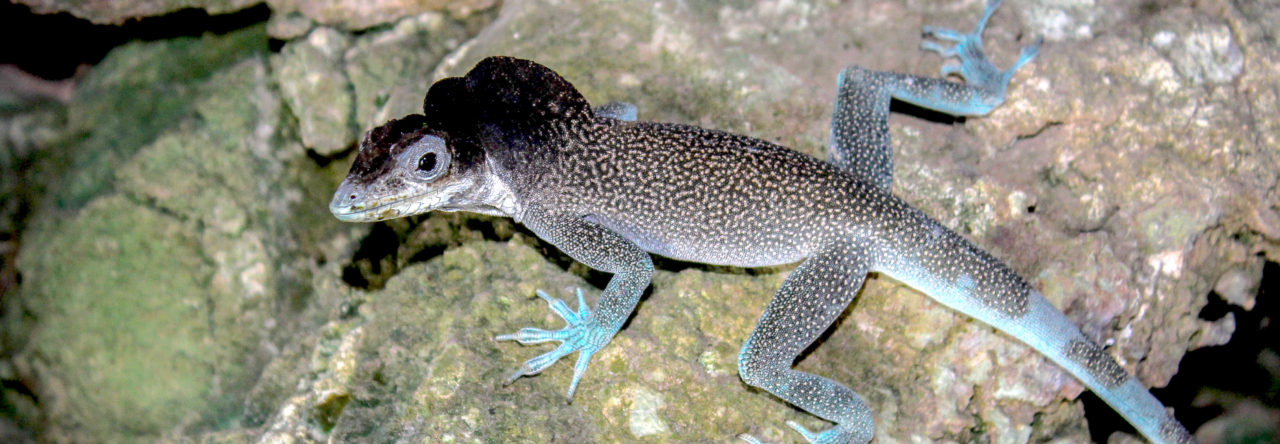
Another star undergrad alert! If you’ve ever followed the work that comes out of Dr. Michele Johnson’s lab at Trinity University, you’ll know that she produces some incredible science and some even-more incredible undergraduate researchers. Isabela Carson is no exception!
Isabela’s poster was focused on studying intraspecific variation in lizard sperm and testis morphology- she described differences in the size and shape of different testis and sperm features for 6 different species of anole. A lot of this work was founded on Dr. Ariel Kahrl’s dissertation work on describing sperm evolution in anole lizards, and her collaborations with Dr. Johnson’s lab and students always produce some awesome talks and posters wherever they are presented. Isabela wanted to know if longer sperm are produced from lizard species that have larger seminiferous tubules- the part of the testis where sperm are produced, matured, and transported. She found an inconsistent pattern across anole lizards where larger tubules don’t always produce longer sperm.
In talking with Isabela, she noted that there are some big inconsistencies between the external morphology of testes and the sperm they produce, and that there might be some larger ecological or evolutionary patterns at work that go into describing how sperm evolve in different species. I would bet that one day we are going to have data on testis shape and size and sperm length for all anolis species, and there are going to be some awesome patterns and studies that come out of that work. And we definitely have to give heaps of credit to the awesome biologists who are working towards it!
The Howey lab showed up to work at SICB 2020! In keeping with the theme of how urbanization and artificial light at night (ALAN) impacts wildlife populations, Elizabeth Kenny, an undergraduate researcher at the University of Scranton performed a study to describe the influence of artificial light on the immune response in green anoles (Anolis carolinensis).
The researchers used a test for immune response called a phytohemagglutinin test (PHA-L), where they injected the hindlimbs of green anoles with PHA-L and measured how much the foot swelled after both a 24 and a 48h hour period. But rest assured! PHA-L tests are temporary, only induce localized swelling, and have no larger impacts on the health of the organism; it’s sort of like if you’ve ever had a tuberculosis test done at your local physician. Interestingly, Elizabeth found no difference in swelling between green anoles exposed to ALAN and to green anoles that had not been exposed to ALAN. However, Elizabeth suggested that green anoles could respond sufficiently to ALAN by changing how they use the energy within their bodies and where they allocated those limited energetic stores, which provides a lot of support for the work of Michelle D’Allesandro and Meg McGrath. Altogether, the three undergraduate researchers of the Howey lab created a convincing and interesting story about how urban environments influence the energetics and physiology of city-dwelling lizards. Great stuff!
Urbanization was a big theme at SICB 2020 this year, and studies of how city life influences wildlife populations are really important to help us understand the effects of human activity on natural environments and animals. One of the most rapid ways in that city-dwelling animals can adapt to these new environments is by changing the shape and size of various morphological traits.
Anoles in their natural habitat do tend to be tree-dwelling, or arboreal lizards, and they spend a lot of time climbing to find food resources, regulate their body temperature, and do other ecological activities. A lizard that relies so much on climbing performance frequently uses its claws and toe pads in its climbing ventures, so one of the first changes that city anoles might exhibit is changes in toe pad or claw shape to better climb on slick city surfaces (say that 3 times fast!). To get at this question, Bailey Howell from the Mississippi University for Women, along with her co-authors Travis Hagey and Kristin Winchell, compared urban crested anoles (Anolis cristatellus) to forested crested anoles and found that toe pads in urban anoles are longer and wider than toe pads from lizards in natural environments.
Bailey goes on to discuss that these toe pads that have an increased area might be better for urban anoles to climb on slicker and smoother substrates found in city environments. Bailey is going to continue adding to her dataset by incorporating more anoles and testing additional hypotheses such as measuring performance differences between urban and forested anoles. Stay tuned for more urban anole work!
The Panamanian slender anole (Anolis apletophallus).
In keeping with the previous year, Albert Chung (now a Ph.D. student at UCLA with Shane Campbell-Staton), presented in the prestigious Division of Ecology and Evolution Raymond B. Huey best student paper session of SICB2020. Albert’s work encompasses a very old, enduring, and important question in biology: how males and females of the same species exhibit differences in so many traits, despite the fact that males and females share a common genome.
A male brown anole from the island of Great Exuma, in The Bahamas.
This dynamic is called sexual conflict: when what is best for one sex might not be the best for the other sex, and has challenged biologists for decades to study a multitude of incredible organisms to answer this question, including anoles! Albert and his collaborators addressed this question by studying two species of anole, the brown anole (Anolis sagrei) and the Panamanian slender anole (Anolis apletophallus). Brown anoles are one species where males are super large compared to females, whereas in the slender anole, males and females are relatively the same size.
Albert et al. described differences in the genes expressed in both males and females to understand what factors promote the development of male-biased size dimorphism. They found that differences in gene expression between males and females was highest in gonad tissue compared to liver and brain tissue, and that when female lizards are supplemented with additional testosterone (traditionally viewed as a hormone more highly concentrated in males of a given species), their gene expression profiles look like those of male lizards. They also found that liver tissue exhibits the greatest differences in sex-biased gene expression, because the liver is one organ responsible for supplying the body with the energy and molecules needed for growth. They suggest that differences in gene expression between males and females might be one factor promoting the evolution of size differences between the sexes, and that physiological controls on these genes could play prominent roles in having males and females exhibit huge differences in traits despite sharing a similar genetic makeup.
The brown anole (Anolis sagrei) is native to Cuba and surrounding Caribbean islands, but has been repeatedly introduced to mainland North America via Florida over the past ≈100 years. Brown anoles have continued to spread and now occupy most of Florida, along with areas of the Gulf Coast. These anoles are particularly adept at exploiting urban habitats, such as Houston and New Orleans, where they may attain higher body size and compete with the native green anole (Anolis carolinensis). Brown anoles can outcompete green anoles in habitats such as the ground or lower levels of vegetation, where they can use their larger, more muscular bodies to chase off the native anoles or even prey on young green anoles. While green anole populations are likely not extirpated by brown anoles, they shift their locations higher into vegetation, to avoid competition with brown anoles.
The ability of these species to maximize their activity at different temperatures may play a role in determining the outcomes of interactions between brown and green anoles. While green anoles are present throughout the southeastern US and can tolerate colder temperatures, brown anoles may be ancestrally adapted to higher, more tropical temperatures. Lucy Ryan, a masters student in the Gunderson Lab at Tulane University decided to investigate this possibility by monitoring the activity levels of each species at a variety of different temperatures. The research team hypothesized that, based on their thermal preferences, brown anoles would have higher activity levels than green anoles at both higher temperatures and over a wider range of temperatures. Lucy conducted focal observations of anoles to quantify activities such as feeding, displaying, and moving. They measured the temperature of each anole’s microhabitat with a copper model containing a thermocouple.
Over an 18° C range of temperatures, Ryan found that there was no difference in the activity levels of the two species. These results, while surprising, suggest that effects of temperature on activity are not driving the competitive advantage of brown anoles over green anoles. In fact, since both species’ activity rates peak at similar intermediate temperatures, this situation may increase competition between brown and green anoles. Ryan plans to continue this work through the winter and spring to determine whether there are any species differences over an entire year of activity which may impact this system. Stay tuned and follow them on Twitter!
Green anole activity rate, including dewlap displaying, shows a peak at intermediate temperatures.
Ectotherms rely on interactions with surrounding thermal environments to regulate their body temperature. If their body temperatures get too low or too high, ectotherms may be unable to move effectively or escape dangerous temperatures, potentially leading to death. One plastic physiological response which may help ectotherms avoid the effects of dangerously high body temperatures is heat hardening. Heat hardening is a type of physiological flexibility that entails an organism increasing its heat tolerance after a previous exposure to high temperatures. In areas with high temperatures, differences between ectotherms in their abilities to effectively conduct heat hardening could affect competition between them.
A green anole (Anolis carolinensis) basks at an elevated perch.
Brown anoles are particularly adept at exploiting urban habitats, where temperatures may be considerably higher than surrounding natural areas due to the urban heat island effect. Sean wondered whether the competitive advantage of brown anoles over green anoles might be based in part on a superior heat hardening capacity, which could support their dominance in urban areas.
(a) A male green anole and (b) and a displaying male brown anole in Florida.
To quantify heat hardening in this system, Sean captured green and brown anoles and first measured their upper critical thermal maximum (CTMax) by steadily ramping up their body temperatures until the lizards lost coordination. CTMax represents a temperature that could prove lethal to a lizard as it would be unable to escape these hot conditions. After allowing lizards to recover, Sean measured their CTMax again after periods of 2, 4, and 24 hours. Heat hardening was calculated as the difference between the initial CTMax and the subsequent measurement after exposure to those initial high temperatures.
Sean’s results were surprising: He found that brown anoles showed no evidence of heat hardening at any time after an initial measurement of CTMax. In fact, brown anoles showed a reduction in CTMax, suggesting that the initial testing may have stressed them and reduced their ability to cope physiologically with higher temperatures. Green anoles on the other hand showed a moderate heat hardening response, with significant increases in CTMax just 2 hours after exposure to high temperatures. Sean’s results also suggest that individual lizards with lower initial CTMax values showed greater heat hardening.
For now, it appears that heat hardening is not a factor driving invasions of brown anoles in the southeastern U.S., but the differences between these two species are intriguing. Sean hopes to expand on this work by investigating molecular mechanisms that may support or inhibit heat hardening, such as expression of heat shock proteins.
Predation event between a Praying Mantis (Mantodea: sp.) and a sub-adult female of Anolis cusuco. Photo Credit – George Lonsdale
A natural history note published September 2019 in the journal SAURIA details an unusual observation of anolivory by a Praying Mantis. Specifically, it discusses an event involving the predation of a sub-adult female Anolis (Norops) cusuco.
Anolis cusuco owes its name to its type locality in the cloud-forest of Cusuco National Park, Honduras, and is a species endemic to the country. Few publications exist regarding the natural history of this species and much regarding its ecology, including its potential predators, remain unknown. While a small contribution, this observation describes the first, albeit somewhat unsuspecting predator for Anolis cusuco.
Victoria Pagano’s page from the crowd-funding platform Experiment
Green anoles (Anolis carolinensis) are talked about quite frequently here on Anole Annals, with 11 articles being published in 2018 and 2019 combined! As I am sure many of you are aware, green anoles change color from green to brown, and while it is known how, it is not yet known why. Although there have been multiple field studies into what causes green anoles to change color, the data have been inconclusive. This is why an experimental study is necessary to try to determine the cause of the color change.
In this experimental study, there will be two main hypotheses tested:
The first is the well known thermoregulation hypothesis. I will be testing this by establishing separate light and heat sources, and turning them on and off for different scenarios. If anoles change color for thermoregulation, then they would turn brown more frequently when the heat is off and the light is on.
The second hypothesis is the effect of increased stress. Stress will be induced by sliding a red disk towards the anoles multiple times at a high speed. Any color change that occurs within the red disk moving and the following 10 minutes will be documented as stress-induced.
I will not be able to test the advertisement signaling hypothesis due to feasibility. Because funding and space is limited, I do not have the capacity to house male anoles, as each one needs his own setup. Therefore, testing only females is the only feasible option, and by doing so, the advertisement signaling hypothesis will not be able to be tested, as this hypothesis pertains mainly to males.
To raise funding for this project, I am using an all or nothing crowdfunding platform called Experiment. As fellow anole lovers, I hope that you can help support my scientific endeavors by visiting my project page. All forms of support are greatly appreciated, from donations, to telling your friends about the project, or even by just reading my project page and commenting your thoughts! Whatever the contribution, I am very grateful, and am simply excited to be able to share what I am doing with all of you!
If you wish to learn more about this project, you can visit the project page, “What drives the color change in green anoles?”, where I have posted my methodology, protocols, and will be posting continuous updates on the progression of the project. If you become a contributor, you will have exclusive access to more updates, and will be able to learn more about the research.
My project page stops accepting donations on November 1st at 12:00 AM PT, so be sure to make your way over to the page by then to give your support!
Thank you for taking the time to read this article. I hope that you will explore the project page, and help support this cool and unique research!
An adult male Anolis amplisquamosus with black gorgetal scales immediately after capture (left); the same individual ~10 min later with white gorgetal scales. Photo Credit – John David Curlis
Anole dewlaps are excellent examples of a “complex signalling system.” They exhibit a staggering diversity of colours and patterns. Each dewlap is species specific and adapted to enable these lizards to communicate, attract mates and guard their territories from rivals or competitors. Generally, the colour of a dewlap (and its gorgetal scales) is considered an unchangeable descriptive trait. This colouration is not only relied upon by scientists looking to identify a species, but also by anoles that co-occur and partition with different species in their select niche.
Therefore, it might be surprising to learn that recent observations prove rapid colour change in anole gorgetal scales is possible. The question is, what implications does this have?
A recent publication in IRCF Reptiles & Amphibians details an observation of Anolis amplisquamosus whereby a male individual upon capture possessed black gorgetal scales that quickly changed to pale yellow. Upon consulting the literature, it seems only one prior documentation of colour change in gorgetal scales was reported (Leenders and Watkins-Colwell, 2003), coincidentally also involving a member of the same species clade.
This recent observation of chromatophoric regulation in anole gorgetal scales may be significant in the wider context of anole biology, in confirming photographically that coloration is not always a fixed descriptive or diagnostic feature — at least among members of the A. crassulus species group. Accordingly, this information suggests that some anoles may have the ability to regulate the colour of their gorgetal scales in the same manner as they regulate dorsal and lateral scale colour.
Because the colour of gorgetal scales is a character often used in species identification, understanding the mechanics and the purpose of such a change is crucial; as well as any implications to display behaviour, communication and anole interactions.
When I first encountered Anolis baleatus, this Hispaniolan crown-giant was mostly an inconvenience. At the time I was gathering data for my doctoral thesis by cycling preserved anoles through a µCT-scanner. Most of the adult specimens of A. baleatus were just too large to easily fit into the scan chamber, so it took a lot of patience and creativity to acquire any decent images of the appendicular girdles, which are the body parts I was interested in.
During that process I also acquired radiographic images of the head skeleton, and found unusual patterns of crenulation in this species. The cranium of Anolis baleatus displays a great degree of seemingly asymmetrical (or at least somewhat irregular) ornamentation across its dorsal surface. This is especially pronounced on the prefrontal and frontal bones, and completely obscures all superficial distinction between them in adult lizards. In adults, cranial ornamentation is also borne by the paired nasals, maxillae, and postorbitals, and the parietal (see figure).
Both Steven Poe (1998) and Susan
Evans (2008) mentioned this ossified garnish, but a thorough account of their
variation among anoles remains absent from the primary literature. Richard
Etheridge and Kevin de Queiroz (1988) were probably the first to report on skull
ornaments in anoles (as part of a discussion of several iguanian lizards with
similar cranial adornments), and remarked that the distribution patterns of
dermal rugae may reflect those of the topographically associated epidermal
scales.
Overall, this ornamentation appears
to be relatively uncommon among anoles, especially to the degree expressed in Anolis baleatus (and several other
crown-giant ecomorph anoles). Considering the osteologically robust appearance
of crown-giants, even at early stages of ontogenetic development, this gives
rise to questions regarding the development of these ornamental patterns.
Thanks to the collection efforts of Luke Mahler (University of Toronto), and a
postdoctoral position in his lab, I was able to acquire CT-image data
representing an ontogenetic series of this species, ranging from very young
juveniles to skeletally mature adults.
While parts of the paired frontals
of juveniles are covered in modest eminences, prominent cranial ornamentation
is absent from small specimens (see figure). Likely, growth of these ornaments
begins very late during ontogenetic development. Ornaments on the prefrontals
and parietal are only evident in specimens that, to the best of our judgement, are
approaching sexual maturity. We looked at fifteen specimens per sex,
representing a range of juvenile and subadult sizes, and this general pattern is
consistent throughout the image data. Schwartz (1974) inferred that anoles in
the ricordii group reach sexual
maturity between 100 and 110 mm snout-vent length (SVL), and we observed the
first prominent ornaments at sizes between 90 and 95 mm SVL. Assuming that
differences in size directly represent ontogenetic growth, these findings imply
that Anolisbaleatus starts to grow elaborate ornamentation as it approaches
sexual maturity, and that expansion and growth of these ornaments then
continues into skeletal maturity. Interestingly, both males and females appear
to develop them at roughly the same body size.
The function and evolutionary cause of these structures remain unknown, and these are questions we are currently investigating. Body size is an important correlate for the occurrence of cranial ornaments, but these structures may also conceivably play roles in defense, feeding, or intraspecific agonistic interactions. Stay tuned!
Videos
A. baleatus, female, 55 mm SVL
A. baleatus, female, 65 mm SVL
A. baleatus, female, 96 mm SVL
A. baleatus, female, 126 mm SVL
References
Etheridge, R. & de Queiroz, K. (1988): A phylogeny of Iguanidae.─ [In:] Estes, R.D. & Pregill, G.K. (eds.): Phylogenetic Relationships of the
Lizard Families: Essays Commemorating Charles L Camp, 283-367; Stanford:
Stanford University Press.
Evans, S. (2008): The skull of lizards and tuatara.─ [In:] Gans, C., Gaunt, A.S. &
Adler, K. (eds.), Biology of the Reptilia, vol. 20:1-347;
Society for the Study of Amphibians and Reptiles, Ithaca, New York.
Poe, S. (1998): Skull characters and the cladistic relationships of
the Hispaniolan dwarf twig Anolis.─ Herpetological Monographs, 12:192-236; The Herpetologists’ League.
Schwartz, A. (1974): An analysis of variation in the Hispaniolan
giant anole, Anolisricordi Dumeril and Bibron.─ Bull. Mus. Comp. Zool., 146:89-146.