Category: New Research Page 19 of 67

Dragons in Asian Plantations

Hello Anole enthusiasts. This will be a slightly different post to the usual in that Anolis won’t feature at all! I am one of those weird lizard researchers that is yet to feel the scientific attraction many of my colleagues feel towards Anolis and, as such, have always preferred their much spikier old world agamid counterparts- the garden lizards of the genus Calotes.

I’m currently doing a Ph.D. (supervised by long term AA member Adam C. Algar at The University of Nottingham, UK) that looks at how agamids use the various habitat types within South East Asia (in particular, Peninsular Malaysia), focussing on oil palm plantations, rubber plantations and secondary forests. While some agamids occupy one or more of these habitat types, only a single genus has colonised all of them- Calotes. Calotes versicolor will doubtless be familiar to any herper who has been on vacation to Southern Asia, a large, red-headed take on Anolis sagrei with the same aggressive character and, unfortunately for everything else, the same ability to dominate in invasive situations. While C. versicolor is present in human modified habitats in Malaysia, the forested North of the country is home to a larger, even spikier species: C. emma, which will occupy the forest edges that C. versicolor seems to avoid. We chose C. emma for this reason as the ability to draw comparisons between the semi-natural forest edges and man-made plantations was key to this research.

dscf2553

An adult female Calotes emma in a heavily disturbed oil palm plantation (photo: James J. Hicks)

We measured such Anolis study staples as body temperature (Tb), perch type and behaviour when encountered and all the usual morphology traits. We also characterised habitats structurally using random transects and thermally using ibuttons in copper models and measured thermal performance using a racetrack (not an easy piece of equipment to build in the tropics!) and HD camera.

Differences in behaviour were noticed immediately with C. emma being highly arboreal in rubber plantations (and difficult to noose!), using the smooth trunks to ascend from predators/herpers and rotating around in typical agamid fashion. In oil palm plantations the equivalent ‘trunk’ structures consisted of blocky remnants of fronds that form a hard, smooth surface that lizards tended to avoid (shame these ones don’t have toepads!). Consequently most C. emma were seen on the ground and in and amongst discarded piles of the fronds at most ca. 40 cm from the ground, using these piles as both perches and refugia. In forest edge habitat Calotes used a wide range of perches that incorporated similar heights and structures to those used in the plantation habitat but was much less abundant than in either plantation type. These behavioural differences coincided with differing femur lengths with the arboreal Calotes in rubber having the longest femurs, for their snout-vent length alongside utilising statistically wider perches.

Thermally, plantation habitats were hotter and more variable than forest edges at relevant scales to lizards as has been documented previously at larger scales. Despite this, operative temperatures fell well within C. emma’s thermal tolerances and, currently at least, seem more favourable for this species. Whether climate change will push these habitats closer to C. emma’s critical thermal maximum remain to be seen but applying the ‘standard’ 3°C rise still won’t, theoretically at least, impact their thermal performance.

In short, plantations seem to be great habitat for Calotes emma! They are extremely abundant in these man made habitats, more so than any other vertebrate species despite each plantation type seemingly forcing them to rely on different, single axes of their fundamental niche. The downside is, as always, plantations trade low abundance and high diversity for high abundance and low diversity. While rubber plantations support at least 3 other agamid species in our study area, C. emma was the sole representative in oil palm. Whether this is due to thermal aspects (is it too hot for larger-bodied forest dragons?) or structural aspects (Draco probably can’t glide onto oil palm trunks) or something completely different remain to be tested in a future session of fieldwork. This will focus on assessing the more poorly understood forest specialist agamid species’ structural and thermal niche axes and whether these requirements are met by plantation habitats.

Gonocephalus bellii

My future fieldwork will focus on forest specialist agamids such as Gonocephalus bellii (pictured) and try to explain why they are absent from human dominated habitat types (photo: James J. Hicks)

Age Structure of Invasive Green Anole Populations near Japan

Yasumiba et al 2016 Fig 1

Figure from a new paper by Yasumiba et al. illustrating how LAGs in the cross sections of bones can be used to infer lizard age.

Anolis carolinensis is a disruptive invasive species in the Osagawara Islands near Japan, a UNESCO World Natural Heritage site.  It was first recorded on the island of Chichi-jima in the 1960’s and has since spread to surrounding islands. A recent post on Anole Annals describes efforts to improve the effectiveness of adhesive lizard traps on the islands by using cricket bait.

A new paper by Yasumiba et al. improves our understanding of these invasive A. carolinensis by quantifying their longevity and growth rates using skeletochronology.

Ecology of the San Salvador Bark Anole (Anolis distichus ocior)

 An adult male San Salvador Bark Anole (Anolis distichus ocior) displaying. Photograph by Guillermo G. Zuniga.

An adult male San Salvador Bark Anole (Anolis distichus ocior) displaying.
Photograph by Guillermo G. Zuniga.

Dayton Antley and colleagues from Avila University, the home of AA stalwart Bob Powell, recently published a detailed study of the ecology of the San Salvador bark anole (Anolis distichus ocior) in IRCF Reptiles & Amphibians (an open-access herpetological journal, with this article available here). Anolis d. ocior is one of 17 recognized subspecies of the diverse distichus group, and is found on only San Salvador and Rum Cay (Henderson and Powell 2009).

Antley et al. assessed microhabitat use, activity patterns, and approach distances of A. d. ocior in an approximately 0.3ha study area on the grounds of the Gerace Research Centre, dominated by Tropical Almonds (Terminalia catappa), Papaya (Carica papaya), and Ficus trees.

A Google Map view of the Gerace Research Centre. The study site (24°07'05.2"N 74°27'50.9"W) is outlined in white.

A Google Map view of the Gerace Research Centre. The study site
(24°07’05.2″N 74°27’50.9″W) is outlined in white.

In assessing patterns of microhabitat use throughout the day, Antley et al. conducted surveys every two hours for two days from 0700h (about 40 min after sunrise) to 1900h (about 40 min before sunset). Size class, perch height and diameter, body orientation relative to the ground, and thermal microsite (sun/shade/mixed) were recorded for every observed lizard. In the following two days, approach distances were assessed. This was achieved by a surveyor, wearing neutrally-coloured clothing, approaching an undisturbed anole at a steady pace and recording the distance at which the lizard reacted. Over two additional days, 10-minute focal animal observations were conducted of individual adult lizards (including both males and females) at a distance of 5m. The number of movements (changes in location or orientation), head turns, and head bobs were recorded for all lizards, with dewlap displays and pushups being additional recorded for males.

Lizards were active throughout the day, with activity peaking in the early morning and before midday. This was compared to ambient air temperatures recorded 1m from the ground in a shaded and sheltered location. This result surprised the authors, as a second activity peak in late afternoon/early evening was expected, as has observed in other similar studies of bark anoles (e.g. Hillbrand et al. 2011).

Mean number of lizards active (bars) and mean ambient temperatures (dots) per time period. Temperature data were collected on two consecutive days.

Mean number of lizards active (bars) and mean ambient temperatures
(dots) per time period. Temperature data were collected on
two consecutive days.

Adult males experienced highest levels of arboreality during the middle of the day, while subadult males and adult females (grouped together as they can be hard to distinguish from distance) were highly variable (see figure below). Most lizards of all classes were found in the shade, which the authors attributed as evidence for thermal conformity, and facing downward towards the ground, a common trait in many anoles that is most commonly perceived to increase an individual’s ability to monitor potential predators, competitors, or mates. 43% of lizards, however, were observed facing upwards. The author’s note that this behavior is often interpreted as an individual prepared for escape; however as all lizards were observed from distance and undisturbed, they (admirably) explain that this result is difficult to interpret.

A: Mean perch heights (cm) of adult males (L) and subadult males and females (S); B: mean perch heights of adult males at different times of day; C: mean perch heights of subadult males and females at different times of day.

A: Mean perch heights (cm) of adult males (L) and subadult males and females (S); B: mean perch heights of adult males at different times of day;
C: mean perch heights of subadult males and females at different times of day.

Adult male lizards were bolder than smaller subadult males and females, and retreated at a much closer distance when approached by a surveyor (0.99m +/- 0.07m vs. 1.54m +/- 0.18m). Focal observations revealed no significant differences between adult males vs. subadult males/females in shared behaviors, although there was a high variation in the amount of displaying behavior between adult males. The average time spent conducting dewlap displays was 3%, although one male was recorded investing 47% of his time in a combination of dewlap extensions and pushup displays.

Using all survey data combined, Antley et al. estimate that A. d. ocior in this study plot had a population density of 593 individuals/ha, with lizards observed on all but four of the smallest trees surveyed. Antley et al. note that their density estimate is extremely conservative, and much lower than previously published estimates (e.g. 1.070-5,460 individuals/ha, Schoener and Schoener 1978). The authors suggest that the small size of the study plot may have contributed to the relatively low density.

In all, this is a charming (although admittedly short) study of the natural history of the San Salvador bark anole (A. d. ocior) – a great example of an undergraduate research project that follows through to publication!

References
– Antley, D.L. et al. 2016. Microhabitat, Activity, and Approach Distances of the San Salvador Bark Anole (Anolis distichus ocior). IRCF Reptiles & Amphibians 23(2): 75-81
– Henderson, R.W. and R. Powell. 2009. Natural History of West Indian Reptiles and Amphibians. University of Florida Press, Gainesville, Florida.
– Hillbrand, P.A., A.T. Sloan, and W.K. Hayes. 2011. The terrestrial reptiles of San Salvador Island, Bahamas. Reptiles & Amphibians 18: 154–166.
– Schoener, T.W. and A. Schoener. 1978. Estimating and interpreting body-size growth in some Anolis lizards. Copeia 1978: 390–405.

ESA 2016: Niche Partitioning and Rapid Adaptation of Urban Anoles

Maintaining an already-impressive 2016 conference tour de force which included presentations at both JMIH and Evolution, Kristin Winchell presented a broad summary of her urban anole research in an invite-only Urban Ecology session at ESA 2016.

introslide

This presentation provided a synthesis of two large research projects both independently reviewed on Anole Annals (1,2), and so I will provide only a brief summary here. Kristin began by presenting an over-arching question in modern ecology: how is urbanisation going to affect biodiversity? While many may intuitively think of the process negatively, there is a large (and growing) body of research suggesting that many species are able to behaviourally respond to these novel environments and persist. So what about anoles? Kristin focuses her research on two Puerto Rican species: the crested anole (Anolis cristatellus) and the barred anole (A. stratulus).

stratulusvcristatellus

To do this, Kristin and her team employed multiple methods to explore if a) these two species have differences in their ecology in urban vs. natural areas, b) if differences in ecology are observed, does this lead to differences in morphology, and c) if differences in morphology are observed, is this related to performance? Firstly, niche partitioning between these two species in natural vs. urban areas was investigated (more details here).

novel habitat

This niche partitioning research is new and will be the main body of a manuscript currently in prep so I will keep discussions brief. One species, A. cristatellus, was observed to significantly shift its microhabitat use, which resulted in adaptive shifts in morphology. This research was documented in Winchell et al.’s recent Evolution paper and reviewed previously on AA (1,2,3). Specifically, urban lizards have longer limbs and stickier toepads (higher number of subdigital lamellae) in response to perching on broader, slippier substrates.

phenotypic shifts

This research has now developed on to the next stage of performance-related investigations. Kristin is asking the question of whether these observed morphological shifts lead to better performance (and therefore, presumably, higher fitness). Kristin presented some preliminary results, but keep your eye out for more developments!

performance

Does Perch Availability Affect Reproduction in Brown Anoles?

Anolis sagrei - male and female

Effect of perch treatment on (A) latency to reproduce and (B) yolk corticosterone.

Effect of perch treatment on (A) latency to reproduce and (B) yolk corticosterone.

Competition for perches has been an important factor in the diversification of anoles. Yet, we know little about the influence of perch availability on reproduction. To address this, Dan Warner, Matt Lovern, and I housed male / female pairs of brown anoles (Anolis sagrei) in treatments with either high- or low-availability of perches (Fig. 1).

We found that females reduced how often they used perches when perches were limited. More interestingly, though, when perches were limited, females tended to take longer to begin laying eggs (for the first time in a season; p = 0.063, Fig. 2A) and allocated more corticosterone to egg yolk (p = 0.069, Fig. 2B), although these findings were not statistically significant.

Effect of perch treatment on (A) latency to reproduce and (B) yolk corticosterone.

Figure 2. Effect of perch treatment on (A) latency to reproduce and (B) yolk corticosterone.

In many habitats in which brown anoles occur, organic perches are abundant and not likely to be limited. However, in urban areas or on some islands anoles have colonized, perches can be limited. Our study suggests that such habitats may have consequences for reproduction.

Citation for the full paper:

Delaney, DM, MB Lovern, and DA Warner. 2016. Does reduced perch availability affect reproduction in the brown anole? An experimental test in the laboratory. Journal of Herpetology 50:227-232.

JMIH 2016: Variation in Limb Length across Lizard Groups

2016-07-10 10.45.27

Travis Hagey presented some new results from his ongoing research on the evolution of functional traits in lizards. Travis normally works on geckos, but frequently includes Anolis species in his studies. Last year at Evolution, Travis told us about toepad evolution by comparing gecko toepads to those of anoles and skinks. Along the same vein, this year at JMIH Travis talked about patterns of limb-length across different lizard groups.

2016-07-10 10.46.47Travis started with anoles as an example of morphology being correlated with habitat use. As we all know, anole limb length is associated with structural habitat. Lizards like Anolis occultus (a twig anole) use thin perches and have very short legs. Other species that perch on broader substrates tend to have longer legs. Travis is interested in finding out if this pattern holds for other groups of lizards.

He started by comparing anoles to geckos to see if relative limb length differed between the groups. He accumulated an impressive database of hindlimb lengths from many gecko and 2016-07-10 10.50.43anole species and when he looked at the relationship between hindlimb length and body size (SVL), he found that for a given body size anoles tended to have longer limbs than equivalently sized geckos. He then added in data for a number of species from Liolaemus, Tropidurus, and Phrynosomatidae. Interestingly, he found that these other groups all clustered with the anoles. This suggests that there are possibly two relationships between limb-length and body size across lizards.

2016-07-10 10.53.02Travis ended by commenting on how this might relate to habitat use. He analyzed hindlimb length by perch diameter for anoles (red line) and geckos (black line). Geckos, it turns out, have a different relationship between perch use and limb length than anoles: geckos with shorter limbs tend to use broader diameter perches! Travis is still working on this research and is looking for data on limb length for many groups. If you have hindlimb length data from lizards you should email Travis to help out!

JMIH 2016: Escaping in the City

2016-07-10 09.00.19

Kevin Aviles-Rodriguez, from the Revell lab at U. Mass. Boston, gave the second urban anole-themed talk of the meeting. Kevin presented his Master’s thesis work that he conducted with the Kolbe lab at U. Rhode Island in a talk titled, “Structural habitat alterations caused by urbanization influence escape behavior of a common lizard.”

Urban habitats are drastically modified and present novel resources and threats for animals that persist and utilize these spaces. Structurally, urban habitats have different types of surfaces that are smoother, broader in diameter, and often more vertically oriented (90° angle). Urban habitats also present abundant and novel food resources in terms of human food and insects attracted to lights and garbage. But with the abundance of food and novel niche space also comes an abundance of novel predators such as cats and dogs kept as pets.

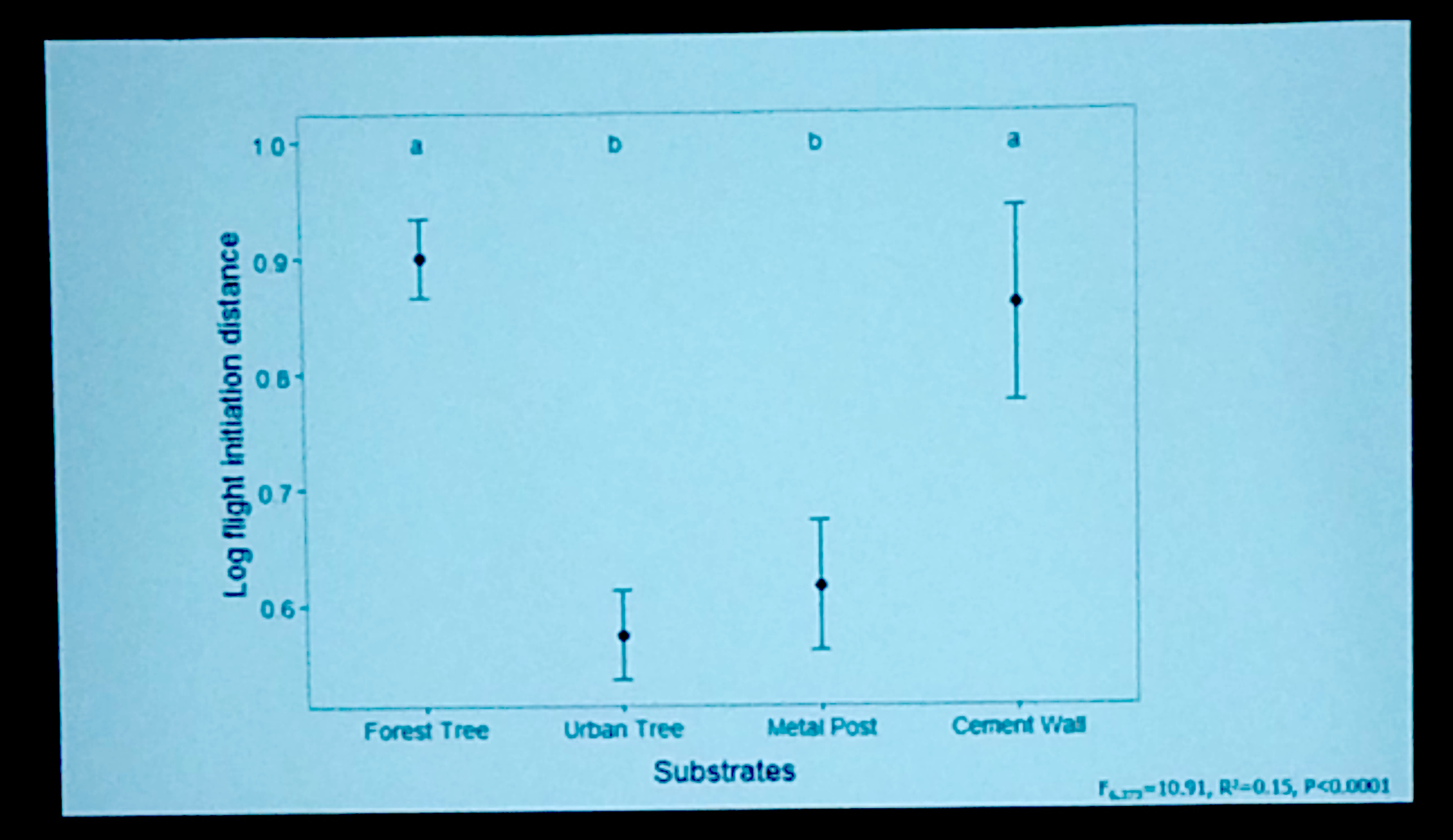
Kevin wanted to know how Anolis cristatellus from San Juan, Puerto Rico and South Miami behaved in urban habitats compared to forest habitats when perceiving a predation threat. Although there are obvious costs of not escaping a predator successfully, there are also costs of fleeing when not necessary in terms of lost feeding opportunities and disrupted social interactions (mating, territory defense). Kevin wanted to know if the urban environment influenced escape behavior decisions. Specifically, he had two objectives: (1) To quantify escape behavior (squirreling, jumping, or sprinting) and how this relates to different types of perches found in urban areas. (2) To measure flight-initiation distance (FID), or how close one can approach an animal before it flees, to see if there are differences between forest lizards and urban lizards.

2016-07-10 09.07.18Kevin found that as perch diameter increases, the probability that a lizard will squirrel around a perch or sprint up the perch increased and the probability of jumping decreased. Interestingly, when he also looked at perch use, he found that the majority of lizards were using perches of thinner diameter where the probability of jumping was highest. Urban lizards also tended to use more isolated perches, which he defined as the number of nearby potential perches within 1 meter. When nearby perch density was lower, lizards tended to jump less – perhaps not all that surprising since they have fewer places to jump to. Kevin also found that escape strategy differed based on the type of perch used. In urban habitats, on trees and on metal posts lizards squirreled more frequently than they did in forest habitats. Interestingly, on cement walls (e.g. buildings) lizards did not jump at all and mainly sprinted to escape. 2016-07-10 09.10.05Kevin offered a few possible explanations for this trend. For one, building perches tend to be more isolated than trees and so it may simply be that lizards on these substrates have nowhere to jump to. A second possibility is that the lizards have trouble jumping from these perches since they are more vertical than the optimal angle for jumping (39-42°, Toro et al. 2003).

In his final analysis, Kevin found that flight initiation distance (how close you can get to the animal before it flees) was very short for animals perched on urban trees and metal posts. In fact, he commented that on some occasions he was able to get close enough to touch the lizard before it fled! This difference was significantly shorter than for animals perched on trees in the forest and for animals perched on painted concrete walls in the city.

JMIH 2016: Anolis conspersus Color variation and Habitat Use

Bright and early this morning, Christopher Peterson kicked off the anole talks of the day on the topic “Intraspecific color and habitat use variation in Anolis conspersus.” Christopher noted that on Grand Cayman there appear to be three color morphs for A. conspersus: brown, blue, and green and asked if color morph was correlated with habitat use. Christopher captured 309 lizards across the island, photographed them for color analysis, and took a large number of habitat measurements plus basic morphology of the lizards (mass, SVL). When analyzing the color data, however, he noticed that the picture was not so clear: many of the lizards had both blue and green coloration. Since these were not discrete groups, instead he analyzed body pattern, which appeared to be more discrete and showed the same geographical variation. In general, lizards on the East of the island were brown and spotted while the lizards on the West of the island were green/blue with vermiculated pattern.

2016-07-10 08.34.27

Using a complex logistic regression, Christopher analyzed the discretized character state with his habitat and morphological measurements. Disappointingly, he found no associations between morphology or habitat use with body patterns. He concluded that the variation in pattern and coloration is probably best explained by geographic location alone and that future genetic analyses may help clear up if this is a geographical cline with isolation by distance.

2016-07-10 08.37.45

JMIH 2016: Phylogeography and Population structure of Anolis cristatellus

Quynh Quach presenting her Master's thesis work at JMIH.

Quynh Quach presenting her Master’s thesis work at JMIH.

Quynh Quach, a master’s student from the Revell Lab at U. Mass. Boston, presented her thesis research on “Phylogeography and Population Structure of Anolis cristatellus on the island of Vieques.” Before Quynh joined the Revell lab, former  post-doc Graham Reynolds and former Losos lab undergraduate Tanner Strickland looked at the phylogeography of Anolis cristatellus across Puerto Rico and the Virgin Islands using mitochondrial DNA (in review). Tanner’s work revealed that there was a mitochondrial break on the island of Vieques, just off the coast of Puerto Rico. The mitochondrial data suggested that there were two genetically different groups of A. cristatellus, one on the East and one on the West of Vieques. The only problem was, as we know, mtDNA patterns are not always supported by nuclear whole-genome DNA patterns. In addition, Tanner’s dataset only consisted of 9 samples from Vieques.

When Quynh joined the lab, she wanted to know more about this pattern. Would this division be supported by nuclear genome analyses? Were these lineages anthropogenically introduced? If not, what was the origin of these groups – historical allopatry followed by secondary contact or isolation by distance? So she set out to answer these questions by collecting 300 tail tips from across the island of Vieques, extracting and sequencing both mtDNA and nuclear DNA.

The mtDNA variation shows a strong geographic pattern.

The mtDNA variation shows a strong geographic pattern.

Quynh first constructed a mitochondrial phylogeny to verify the pattern observed by Tanner and Graham. The mtDNA analysis confirmed that there are 2 mtDNA clades on Vieques with strong geographic patterns. The island-wide pattern of mtDNA variation was not what we would expect if anthropogenic introduction were the cause since this would be unlikely to show such a clear East-West pattern with the small contact zone in the middle. So then how did this pattern arise?

2016-07-08 13.39.15

Analysis with K=2 shows two clear groups associated with the East and West.

To answer that question, Quynh next looked at nuclear DNA using RADseq. She sequenced 48 individuals: 5 from Virgin Islands, 6 from Puerto Rico, and 37 from Vieques, then de novo assembled the genome and called 16,808 SNP’s. She ran STRUCTURE and DAPC analyses on this data and found that the Virgin Island samples form 1 cluster and Puerto Rico and Vieques form a second cluster with 4.1% divergence between the groups. But she wondered, what if we look at just Vieques and specify K=2? When she did this with DAPC and saw a clear geographic pattern similar to what she found with the mtDNA. Finally, she tested whether this represented isolation by distance. She found that there was significantly reduced gene flow between geographically distant individuals, supporting this hypothesis as the most likely cause of the variation.

Lastly, Quynh emphasized that it is important to consider multiple genetic markers and not just rely on mtDNA results. Had the group stopped at their original mitochondrial analysis, they would have reached a very different conclusion.

Australian Cryptoblepharus: Convergence across a Continent

When it comes to adaptive radiations, the diversification of Anolis is one of the most striking examples. While Anolis is therefore a well-known rock stars in the league of adaptive radiations, in this blog post I would like to introduce you to one of the mere mortal examples; skinks from the genus Cryptoblepharus.

Cryptoblepharus skinks (“Cryptos”) are small diurnal lizards that have rapidly diversified and are known for their widespread distribution with species present in the Malagasy region, on the Australian continent and on many island archipelagoes in the Indo- and wider Pacific. Furthermore, species that occur on similar substrates are notoriously difficult to identify based on morphological characteristics and a more accurate estimate of species diversity has only recently been accomplished using a widespread genetic screen with allozyme markers (Horner & Adams, 2007).

Distribution of Australian Cryptoblepharus and the three habitat specialists. (a) Topographic map of Australia with the mean point of each species’ distribution plotted and coloured according to habitat type (for complete distribution maps, see Horner & Adams (2007). In situ photographs of (b) arboreal, (c) littoral, and (d) rock specialists (green, blue, and red dots on the topographic map, respectively).

Distribution of Australian Cryptoblepharus and the three habitat specialists. (a) Topographic map of Australia with the mean point of each species’
distribution plotted and coloured according to habitat type (for complete distribution maps, see Horner & Adams (2007)). In situ photographs of (b) arboreal, (c) littoral, and
(d) rock specialists (green, blue, and red dots on the topographic map, respectively).

Whereas species within the same habitat are highly cryptic, species that occur on different substrates (‘rock’, ‘trees’ or ‘beaches’) are relatively easy to distinguish. Rock Cryptos for example, traverse the red sandstone escarpments that are iconic for the Australian outback (think ‘Uluru like’ in terms of color and rock type) and they look very different from Cryptos that occur in a more mesic or coastal habitat. In a recent paper (Blom et al., 2016) we focused on the Australian radiation and explored whether habitat specialization explains current patterns of phenotypic variation in ecologically relevant traits. Using a comparative approach, we quantified the presence of distinct adaptive peaks, the frequency of shifts between such peaks and ultimately discuss the role of ecology in promoting continental radiation.

Page 19 of 67

Powered by WordPress & Theme by Anders Norén