
Category: Anole Photographs Page 1 of 9

Ecuador’s Eccentric Anoles

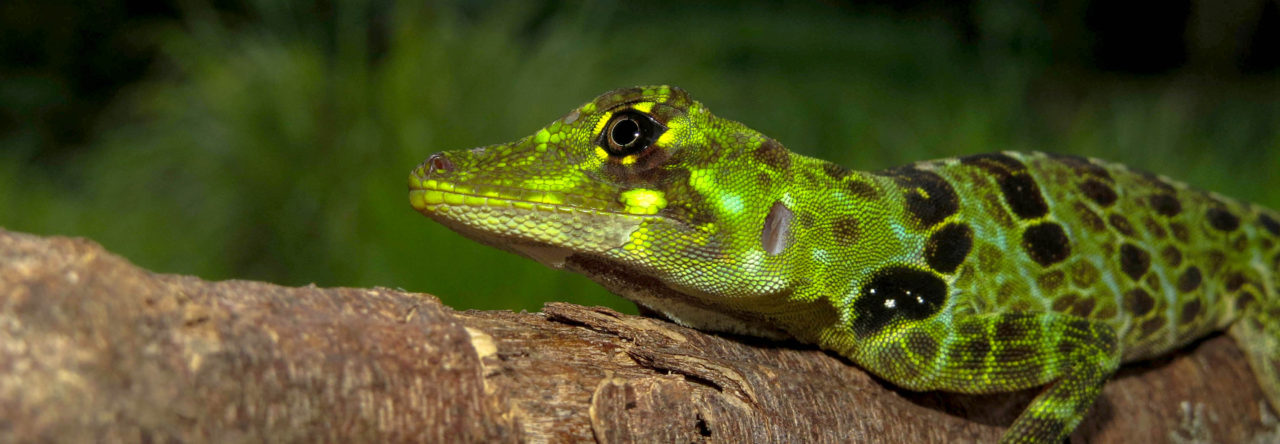
Male Anolis proboscis. Photo by Sam Schenker.

Ecuador is one of the most biodiversity-rich and unique locations in the world – especially for herps. Currently, there are 207 species of lizards there, 41 of which are some of the most spectacular anole species around (Arteaga 2025). As a herp wildlife photographer and an employee of the Khamai Foundation, I have had many chances to encounter and document some of these incredible animals. In this post I will offer some photos, stories, and natural history information about the anole species I witnessed on a ~10 day trip to Ecuador in 2022. The locations we visited included Mindo, at the Septimo Paraiso Lodge; the Choco, at Parque Bosque La Perla; and the Amazon lowlands, at the Yasuni Scientific Station and Yarina Lodge.

Mindo

Observed species: Anolis poei, Anolis fraseri, Anolis proboscis, Anolis aequatorialis

The Mindo Cloud Forest is a very unique ecosystem in the Ecuadorian Andes. While it is famous in the birding community, it also supports a variety of colorful and strange anoles. Mindo’s hallmark anole species is, of course, the Pinocchio anole (Peters and Orces, 1956), famously discussed on AA numerous times. The Pinocchio anole’s trademark nose is actually just flesh and scales – it bends when touched, and would clearly be useless in a jousting battle. Some observations of these lizards show that they can actually raise/lower their horn at will – to move it out of the way to eat, for example – despite the seeming lack of muscle. This species is extremely cryptic, as most herpetologists have found after returning disappointed from Mindo, and very little is known about their life cycle and behavior. This can be attributed to the fact that these lizards tend to prefer the canopy of the cloud forest (the individual we found was knocked down from a two-story tree!) and they move at a snail’s pace during the day. Like many other anole species, A. proboscis can turn from bright greens and black to muddy brown colors when stressed. After a stunning photo shoot, the male individual we found was returned to a safe location away from the owls near the lodge

Male Hippie Anoles (Anolis fraseri) have some of the most stunning colors in the nighttime cloud forest. Most males have bright red heads, as this old individual did, with some also having blue and purple colors down their backs – very 70’s indeed! These diurnal lizards are actually uncommon to see, since they perch higher in the forest than most common lizards. We were lucky to see two individuals, a male and a juvenile, who both offered their best poses.

Juvenile Anolis fraseri. Photo by Sam Schenker.

Adult male Anolis fraseri. Photo by Sam Schenker.


Chocó

Observed species: Anolis granuliceps, Anolis gracilipes, Anolis fasciatus

The Alluring Anoles of Alto Velo

Alto Velo Island. Photo by R. Graham Reynolds.

Although I have not been a prolific poster on AA, I have enjoyed contributing articles about the obscure and rarely seen anoles of the Greater Antilles and Lucayan archipelagos, such as Anolis ernestwilliamsi, Anolis fairchildi (1,2,3), and Anolis scripts (1,2,3,4,5).

Here is another post in that series, focused on Anolis altavelensis, the Alto Velo anole. First, a bit of background. I am currently collaborating with Joe Burgess of the National Park Service (USA), Brad Keitt of the American Bird Conservancy (USA), and Jorge Brocca of SOH Conservación (Dominican Republic) on a multi-year project focused on the ecological restoration of Alto Velo Island. This project includes detailed surveys of terrestrial fauna, followed by the removal of invasive species and recovery monitoring.

Alto Velo Island is located about 30 km off the coast of southern Hispaniola, south of the town of Pedernales, Dominican Republic. Part of Jaragua National Park, the island is separated from Isla Beata, and the mainland of Hispaniola, by a deep-water channel. This means that the island contains some endemic reptile species, including A. altavelensis, as well as endemic Leiocephalus and Sphaerodactylus. It also means that not many scientists have visited, as the island is very challenging to reach without either a large boat or a very skilled panga captain. The crossing is dangerous at the best of times, with winds regularly reaching 15–25 kts and waves 1.5–2 m, conditions that are challenging, if not reckless, for open vessels. There are no landing beaches, and a rocky coast surrounded by reefs await those who cross the Beata Channel. As I can now personally attest, this island is not for the faint of heart.

But what awaits is spectacular! Alto Velo Island is very tall, much taller than you might perceive from a satellite view, with a peak of 150 m and a series of dramatic hills that fall precipitously down to the blue sea. A wide, flat plain graces the north end, although a mixture of invasive grasses and African milkweed mars the landscape. The island has historically been heavily impacted by guano mining, an extractive industry that has left numerous islands and islets in the Caribbean in ecologically degraded states, as well as probably contributed to the extinction of some reptile species (such as on Navassa Island). Nevertheless, some endemic reptiles remain on Alto Velo, including the anole.

Anolis altavelensis. Photo by Joseph Burgess.

And what an anole is found there! Anolis altavelensis is dramatically beautiful, even among a superlative group of the bark anoles (distichus series) that are renowned for their variety and beauty. This species is electric orange, meaning that a sweep of a flashlight over a bush at night resembles a Christmas tree with small orange jeweled ornaments dotting the green leaves. Spectacular!

Happily, the species is relatively common on the island, despite an extremely damaging history of guano mining, burning for goat grazing, and infestation with cats, rats, and many invasive plants. Some native vegetation remains, particularly on the steep slopes, but a goal of the restoration project is to restore the native vegetation as well. Stay tuned for updates on this project as we hope to see Alto Velo restored to its ecological vibrancy and remote beauty.

Cases of Interspecific Hybridization within Anolis of the bimaculatus Group Produced in a Private Breeding Facility


Fig.1) Left: Anolis bimaculatus male (top) and A. leachii male (below) for comparison. Right: adult male A. leachii x A. bimaculatus hybrid.

We all know examples of interspecific hybrids in animals such as the Liger, the Zhorse or the Calico Chuckwalla or even intergeneric hybrids in plants such as orchids. Even within Anolis, there are well known examples of interspecific hybrids such as Anolis aenus x Anolis trinitatis on Trinidad.

I was able to produce fertile hybrids of different members of the bimaculatus group in my breeding facility which I want to show you in this post.

I am a private reptile keeper and breeder and have been working with Lesser Antillean Anolis, mainly  in the sense of keeping and breeding, for 20 years. About three years ago, a good friend of mine told me his A. oculatus and A. terraealtae, which he kept together in a small greenhouse, had interbred and produced offspring. This was amazing to me, as I thought they were genetically too far apart. Shortly after that, out of interest and curiosity, I paired up some different species of my collection with the aim to produce hybrids. I was interested if it is possible to interbreed them in general, and also I wanted to see what the hybrids would look like. So in 2020, I paired up …

1) a male A. marmoratus marmoratus with a female A. ferreus

2) a male A. leachii with a female A. bimaculatus

In both cases, I used a large adult male and a young adult female that was raised single and had never been with any other Anolis before. I introduced the female into the male‘s enclosure and in both cases the male started courting the female immediately and mated with her. After the copulation, I separated the female again and collected the eggs over the course oft he next months. Long story short: I was able to obtain viable hybrids, raise some of them to maturity, paired this F1 generation again and produce viable F2 hybrids.

To describe the hybrids, I would say that they are generally very much intermediate in size and color regarding their parent species, both in males and females. But just look at some of the results (above and below):

Fig.2) Left: Anolis bimaculatus female (top) and A. leachii female (below) for comparison. Right: adult female A. leachii x A. bimaculatus hybrid.

Fig.3) Left: Anolis marmoratus marmoratus male (top) and A. ferreus male (below) for comparison. Right: adult male A. m. marmoratus x A. ferreus hybrid.

Now, I have some thoughts about this. We know that genomes diverge in isolation until the accumulated differences result in “speciation“ and/or reproductive isolation, as it is the case with the Anolis in the Lesser Antilles. With the use of molecular clocks such as the cytochrome b mitochondrial gene and geological dates, we can measure the genetic distance and estimate the timespan of separation of these taxa and project their phylogenetic relationships.

But how genetically distant or how long or over how many generations do two species have to be isolated to be genetically incompatible in the sense of not only being recognized as separate species by us, but also not being able to reproduce? Could Anolis be used as a model group for a question like that in general? Which would be the most distantly related Anolis species that would possibly be able to reproduce? Is there any specific pairing that would be of special interest?

Short disclaimer: None of the hybrids will return into nature. They live a healthy and fulfilled captive life like any other captive Anolis. They are just fine and healthy. Please do not blame me for this project.

The Anole in the Hole

Anolis cristatellus emerging from tree hole

A male Anolis cristatellus emerging from an abandoned woodpecker hole.

Greetings, anole lovers! I wanted to share some recent observations from my Miami backyard. I’ve got a male Anolis cristatellus who’s made his home in an abandoned woodpecker cavity.

Red-bellied Woodpecker excavating tree hole

A Red-bellied Woodpecker excavating a nest cavity in a royal palm tree.

He started using the cavity a few months ago, but the story begins earlier than that. This spring, a pair of red-bellied woodpeckers (Melanerpes carolinus) excavated two cavities in a dead royal palm tree in my yard. When the upper cavity (~4-5m above the ground) attracted the interest of a pair of red-masked parakeets (Psittacara [formerly Aratingaerythrogenys), the woodpeckers shifted their attention to the lower cavity (~2.5m above the ground).

Red-masked Parakeet at tree hole

A Red-masked Parakeet at the entrance of a red-bellied woodpecker nest cavity.

Ultimately the parakeets moved into the upper cavity and it became clear to me that two cavities were actually connected inside the tree, because a parakeet would occasionally enter the upper cavity (which the parakeets had enlarged enough to enter) and, seconds later, peek its head out of the lower cavity (which was too small for the parakeets to enter or exit). The woodpeckers abandoned the site shortly after the parakeets took interest in it, and despite my hopes that *someone* might nest successfully in the cavity, a few weeks later the parakeets abandoned it too.

Gray squirrel peeking out of tree hole

A gray squirrel peeking out of an abandoned woodpecker cavity.

In the late summer / early fall, well after the birds abandoned the cavities, I began seeing a male A. cristatellus around the lower cavity and I wondered if he spent any time inside. The first time I saw him actually emerge from inside the cavity was after a heavy afternoon rain. Subsequently, I saw him close to the cavity entrance at dawn and dusk several times, and I saw him emerge from the cavity early in the morning on at least one occasion. He seems to enter and exit the cavity throughout the day (he can frequently be seen hanging out near the cavity, even during fair weather), but I get the sense that he’s mostly using it as a shelter during the night and during storms.

Over the last several weeks, I’ve also seen a gray squirrel (Sciurus carolinensis) spending time in the same cavity, but surprisingly this hasn’t deterred the anole, who still frequents the cavity as well. Earlier in the fall (during the period when the anole was also using the cavity), I also observed a gecko (Hemidactylus sp.) emerge from the cavity at dusk one night… so the hole is definitely a busy spot, even after being abandoned by its original makers!

I haven’t heard of anoles using nest holes in trees as shelters or night roosts. That being said, whenever I’ve looked for anoles at night, I’ve always looked for more exposed sleeping sites. Have others observed anoles using tree holes for sleeping or for daytime shelters?

Anolis cristatellus perched outside tree hole

A male Anolis cristatellus perched outside an abandoned woodpecker hole.

Photo Contest 2019 – Time to Vote!

The Finalists Are In!

Thanks to all who submitted photos for the Anole Annals calendar contest–we received lots of great submissions! We’ve narrowed it down to the top 27, and now it’s time for you to vote! Here’s a slideshow of the finalists:


This slideshow requires JavaScript.


Vote Now!

Choose your 6 favorites in the poll below. You can click on the thumbnail to view full-size images in the poll, check the box next to your picks. You have 10 days to vote – poll closes next Sunday at 11:59pm (12/1). Spread the word!

Anolis cusuco as Prey of a Praying Mantis

Predation event between a Praying Mantis (Mantodea: sp.) and a sub-adult female of Anolis cusuco. Photo Credit – George Lonsdale

A natural history note published September 2019 in the journal SAURIA details an unusual observation of anolivory by a Praying Mantis. Specifically, it discusses an event involving the predation of a sub-adult female Anolis (Norops) cusuco.

Anolis cusuco owes its name to its type locality in the cloud-forest of Cusuco National Park, Honduras, and is a species endemic to the country. Few publications exist regarding the natural history of this species and much regarding its ecology, including its potential predators, remain unknown. While a small contribution, this observation describes the first, albeit somewhat unsuspecting predator for Anolis cusuco.

The Beauty of Cuban Anoles

Anolis bartschi.  Pinar Del Rio Cliff Anole (Viñales, PR).

Cuba is the largest island in the Caribbean and has the highest diversity of Anolis lizards with 64 currently known species. Here I share few anole photographs taken in the wild with a Canon EOS D80 during some expeditions to the island.

Anolis bartschi  Pinar Del Rio Cliff Anole (Viñales, PR) 
Anolis quadriocellifer  Cuban Eyespot Anole (Guanahacabibes, PR)
Anolis allisoni Cuban Blue Anole (Delta del Cauto Fauna Refuge, Las Tunas)


What Colombian Anole Species Could These Two Be?

I found these two specimens in my farm located in the municipality of Santa Sofia, department of Boyacá, Colombia. The living specimen was found near a stream in a wet area, while the dead specimen was found in the house of the farm. The farm is located in an Andean forest at about 2300 meters above sea level where plants such as oaks and eucalyptus trees predominate, among others.

Three in The Bed: a Curious Case of a Shared Sleeping Perch in a Neotropical Anole

Opposite views of a communal sleeping event (1 male, 2 females) of Anolis cusuco at Parque Nacional Cusuco, Departamento Cortes, Honduras (Brown & Arrivillaga, 2018)

Let’s be honest: anoles are fascinating! These charismatic and well-adapted lizards are always a pleasure to watch and document. Better yet, no matter how well you think you know a species, they’re still always full of surprises.

The sleeping behavior of anoline lizards is a fascinating aspect of their natural history, and a growing amount of literature has detailed species-specific sleeping activities.  Typically, anoles are considered solitary sleepers owing to their territorial nature,  but ‘behind closed doors,’ this may not always be the case!

For those curious,  a recent  ‘behavioral oddity’ published in Mesoamerican Herpetology  by Brown & Arrivillaga (2018), reported an example of three individual Anolis (Norops) cusuco sleeping together on a perch! The individuals were so close that portions of their bodies overlapped! Strange, indeed; this observation contrasts the typical view of anole sleeping ecology, territoriality and indeed that what is known for this species (Clause & Brown, 2017).  In over 5 years of visiting Cusuco NP (observing countless solitary sleeping A. cusuco), imagine the surprise in finding these anoles having a sneaky snuggle!!

As we wrote: “Although a conclusive explanation is not available, we suggest that because the sleeping group consisted of one male and two females, that the shared perch might have been breeding-related. This situation might be associated with the overlap of male and female territories, or by the anoles awakening close to necessary resources. Conceivably, however, courtship might have been interrupted by nightfall, and the orientation of the sleeping male ensured that courting would continue the following morning.”


The Dreaded Sand Fly: Not Even Anoles Can Escape Lutzomyia!

Blook sucking Sand Flies present on Anolis bicaorum; a species endemic to Utila Island, Honduras.

Sand Flies (Lutzomyia)! For those of you fortunate enough to have worked in the Neotropics, you may well remember these relentless, miniature biting definitions of annoyance and discomfort! Well, it seems it isn’t just biologists that fall victim to torment, but unfortunately our anole friends, too!

While in the field conducting ‘Anole Patrol’ (Visual Encounter Surveys) at Kanahau Utila Research & Conservation Facility  on Utila Island, Honduras,  we often encounter individuals of Anolis (Norops) bicaorum tolerating ectoparasitism by Sand flies (Lutzomyia).  Regretfully, we have yet to extensively research into anole ectoparasitic/host relationships, though a quick online search brings up a surprising pool of prior literature.

While my knowledge on this topic is still somewhat lacking, I figured that this little observation proves interesting and its documentation may spur a discussion of such!


A male Anolis bicaorum encountered in-situ with numerous ectoparasitic Sand Flies (Lutzomyia) on its body.

Extra species information:

Anolis (Norops) bicaorum is endemic to Utila Island, Honduras; a small  (41km sq)  Caribbean island part of the Isla de la Bahia/ Bay Island group.  Research in 2017 (funded by the Mohammed bin Zayed Species Conservation Fund (MBZ) , resulted in the publication of new information regarding Anolis (Norops) bicaorum distribution, natural history and ecology, as well as the first records of sympatric  occurrence with its endemic congener Anolis (Norops) utilensis The presented results also suggested that both endemic anole species are substantially threatened owing to loss of their core primary habitats.

An additional future threat includes the unfortunate establishment and spread of the admirably successful, yet deplorably invasive, Anolis sagrei , an adaptable, competitive and ironically ‘loathsome lizard’ previously associated with declines of native herpetofauna (a species that i am sure requires little introduction on Anole Annals!!).


Page 1 of 9

Powered by WordPress & Theme by Anders Norén