
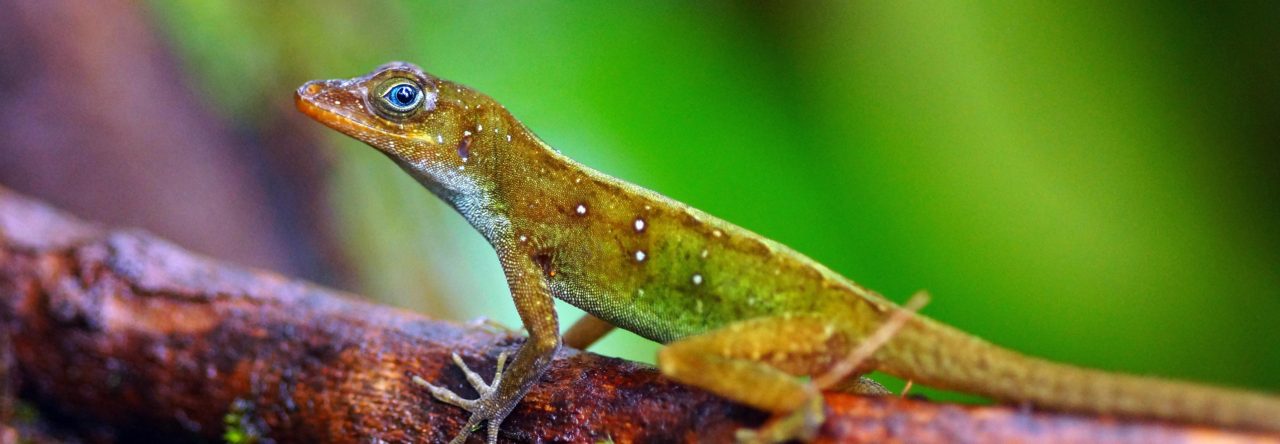

Anolis sagrei. Photo by: Thayna Medeiros de Andrade
Anolis sagrei (brown anole, Figure 1) is a small species, native from Cuba, that invaded Florida around 1800. Me, I am from Brazil, and this is the story of how I made some interesting discoveries about the brown anoles during my brief invasion to the US.
My journey in the herp world began by studying the South American lizard genus Tropidurus (Figure 2). They are basically the Anoles of the south. Widespread, a lot of species, habitat-specific morphotypes. By studying these amazing lizards, I got a scholarship and

Tropidurus imbituba. Photo by: Thayna Medeiros de Andrade
had the opportunity to choose any place in the world to do a short internship. So I chose… Alabama.
The tricky thing about studying live animals is that, no matter what you do, unpredictable things can always happen. And they did. When I first started talking to Dan Warner, our idea was to study whether inland and island females of brown anoles showed any preference between substrate mixed with salt or fresh water for egg laying, and after egg laying, compare water uptake between eggs incubated in a substrate mixed with fresh or salt water. But, as I mentioned, unpredictable things happened.
For a starter, our first question was: Do females preferably nest in substrate mixed with saltwater or freshwater? And, from the 123 eggs found, 37 (around 30%) were found on the ground. It felt like they were mocking me. Eggs found on the ground shriveled, so we were not able to incubate them. Secondly, even though we maintained the lizards under the same conditions, for some unknown reason, females from the island laid far fewer eggs than females from the inland. Lastly, all eggs died. But we will get to that later. Even with all the bumps along the way, we found some interesting stuff.
Females were captured in two locations. Inland females were captured in a residential area in Fort Walton, Florida. The microhabitat occupied by females were a mix of concrete and the gardens of the constructions. The island females were captured in an estuarine area, on a small island (Figure 3) in the Halifax River, Ormond Beach, Florida. These small islands are frequently inundated by seawater when the tides are high and, during major storms, can even be submerged.

Figure 3. Spoil island submerged in the Halifax river. Photo by: Thayna Medeiros de Andrade
Due to these conditions, we hypothesized that island females would have developed mechanisms to recognize salt in the soil. But inland females, which are naive to saline soils, would not be able to recognize this cue. And that is what we found! Females from the island avoided nesting in substrate mixed with saltwater, while inland females showed no preference (Figure 4). This indicates that there might be some local adaptation in maternal effects.

Figure 4. Difference in nest site choice by island and inland females of brown anoles. Black bars indicate the percentage of eggs found in substrate mixed with freshwater; grey bars indicate the percentage of eggs found in substrate mixed with saltwater. The number above the bars indicates the actual number of eggs found in each type of substrate, for each population.
But this got me thinking: what happens when the island is inundated during reproductive season? Do females retain the eggs until better conditions are restored? Do the eggs develop under a certain threshold of salinity? There is an open field to investigate.
Some insights of what happens come from the second part of my work. Since females from the island laid fewer eggs, we were unable to do a proper comparison of what happens to eggs incubated in substrate mixed with fresh or saltwater depending on female population. But one thing was common between them: eggs incubated under saltwater conditions barely survived a week (Figure 6). Eggs found in the saltwater pot were already lighter than eggs found in the freshwater pot, independently of female population (Figure 5a). This probably reflects an immediate water loss in saline environments rather than females actively laying lighter eggs in saline nest sites. Moreover, after a week, eggs incubated in substrate mixed with freshwater gained mass, while eggs incubated in saltwater substrate were either not growing or losing mass (water) (Figure 5b).

Figure 5. a) Mass of the eggs on the day they were found, according to the type of pot they were laid in (substrate mixed with freshwater or saltwater). b) Change in egg mass after a week (day 7 – day 0). The dashed line indicates no change in egg mass after a week of incubation; points above this line gained mass, while points under this line lost mass. Yellow triangles indicate observations for the island population, and black triangles indicate observations for the inland population.
So my guess is that during inundation, if no other type of substrate were available, females from the island would retain their eggs. Since inundations are so frequent, I also think it is a possibility that they lay fewer, heavier eggs, with a higher proportion of water, that can withstand the higher water loss rates imposed by saline environments. As for the inland females, they do not seem to recognize salt in the substrate. Even though the eggs incubated in saltwater died, they did not avoid laying eggs in substrate mixed with saltwater. So an inundation would probably affect reproductive success of this population.
Lastly, from the 31 eggs incubated in substrate mixed with fresh or saltwater, only one hatched (Figure 6). The ones incubated in freshwater substrate lasted longer, some developed until the 28th day after egg laying or more, when anole eggs usually hatch. They grew, one hit 0.8g. But, for some unknown reason, they failed to hatch. This still bugs me. If you have any ideas why, let me know.

Figure 6. Survival rates of eggs from inland females (dashed line) or island females (solid line) incubated in freshwater substrate (black line) or saltwater substrate (grey line).
In conclusion, I had an amazing time in the US, visited Disney, the Statue of Liberty, and learned a little bit more about the anoles. As for my work, it is established that brown anole females recognize environmental cues ideal for egg laying, and we found out that salinity can be one of these cues. But, since urban areas are rarely, if ever, inundated by sea water, brown anole females might not have developed the sensory ability to detect this specific cue. Or they recognize salt only above some threshold that we did not measure. In any case, there is geographic variation in nesting behavior that should be more thoroughly investigated. Moreover, we found that constant exposure to saltwater can be detrimental to embryo development. But we do not know if there is a level of salinity that allows embryo development.
I think we left a lot of interesting open questions to be answered by other anole enthusiasts, and I would love to see more research investigating this topic.
If you found the work interesting, check our article: Maternal nest-site choice in response to saline substrates differs between island and inland populations of lizards