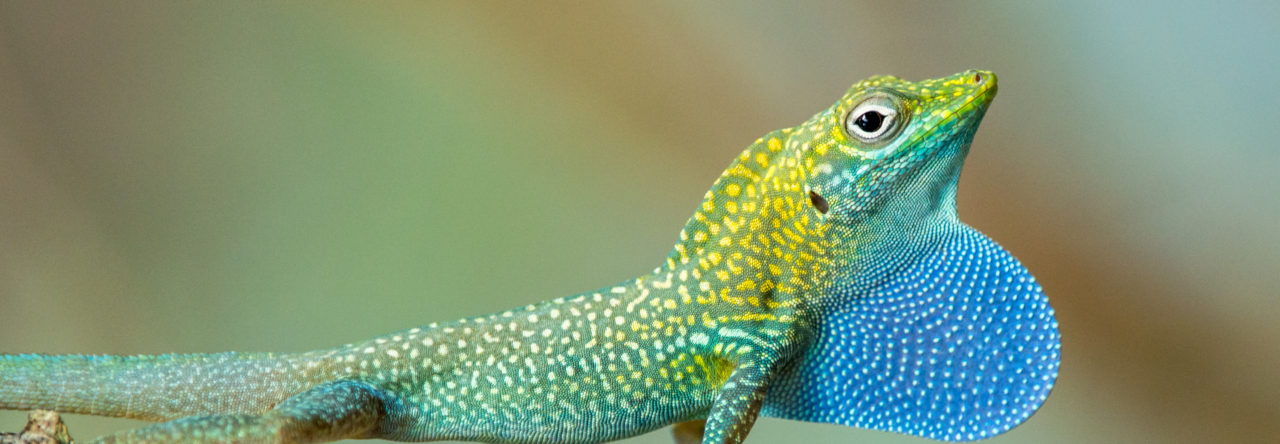

Anolis equestris during one of our Miami surveys
There truly is never a dull moment in South Florida, especially for those of us who love herps. South Florida is a herper’s paradise with at least 63 exotic herps recorded in the state in addition to some unique and endemic native species. In fact, South Florida is the global hotspot for non-native herps, and the world’s most invaded continental ecoregion. While almost all the herps we see while walking around Miami are non-native, we are also almost always in heavily human-modified habitat. This led us to wonder if we would see more native species if we were at sites where native habitat was preserved. Back in 2017, we set out to answer this question, comparing herp communities between 15 parks with natural habitats and 15 parks with primarily anthropogenic features (think playgrounds, baseball fields, and dog parks). Spoiler alert: Non-native species dominated the herp communities in all of the parks, natural and anthropogenic alike. Non-natives made up a whopping 90.6% of all individuals we identified. Perhaps unsurprisingly for those who have grown accustomed to the small lizards scurrying along their sidewalks and fences, 86% of everything we saw was from the genus Anolis.
Fast forward to 5 years later. It’s 2022 and all of us herpetologists in Miami are constantly being asked by anyone who learns of our lizard expertise, “What’s this big new lizard I keep seeing?! It’s got an orange head and tail and a blue body,” or “I keep seeing these lizards with curly tails hanging out around my house – what are they?” These two large predatory lizards, agamas and curlytails, are clearly spreading around the county, to the point where even non-lizard-people are taking note. As we look around, we can’t help but wonder if there could be a change in the composition of our already very exotic herp community in Miami in just the 5 years that have passed since our former study. So, we set out to answer that question.
Several months later we’d completed the same surveys at the same 30 parks, with a fantastic team of researchers, exactly five years after our first study. What did we find? Well, despite both the incredibly short time span and South Florida already being the most invaded herpetofauna community in the world, we found that non-native herps were still increasing in both richness and abundance, in amounts that were measurable in just a 5-year period! Non-native herp abundance increased significantly by 32.7%, while native abundance did not change significantly (only a 6% increase). This time around, 92.3% of our observations were non-native herps. Once again, most of our observed individuals were anoles (82%), and brown anoles and green anoles were our most commonly observed species, both being found at 97% of all sites surveyed. It is worth mentioning, however, that even the 7.7% of observations that were classified as “native” have a caveat: Most of these observations were Anolis carolinensis. As readers of Anole Annals likely know, there is now evidence that most Anolis carolinensis in Miami are hybrids with the non-native Anolis porcatus. If these are reclassified as non-native, our native count is down to just ~1%.

Figure caption: Bar graphs showing the difference in mean (a) abundance and (b) richness (±95% Confidence intervals) by year. Total abundance (p = 0.043) and richness (p = 0.001), as well as non-native abundance (p = 0.032) and richness (p = 0.0012), increased significantly from 2017 to 2022, whereas native abundance and richness did not (p > 0.4).
While Anolis spp. make up most of our observations, it was really the agamas and curlytails that stole the show this time around.