
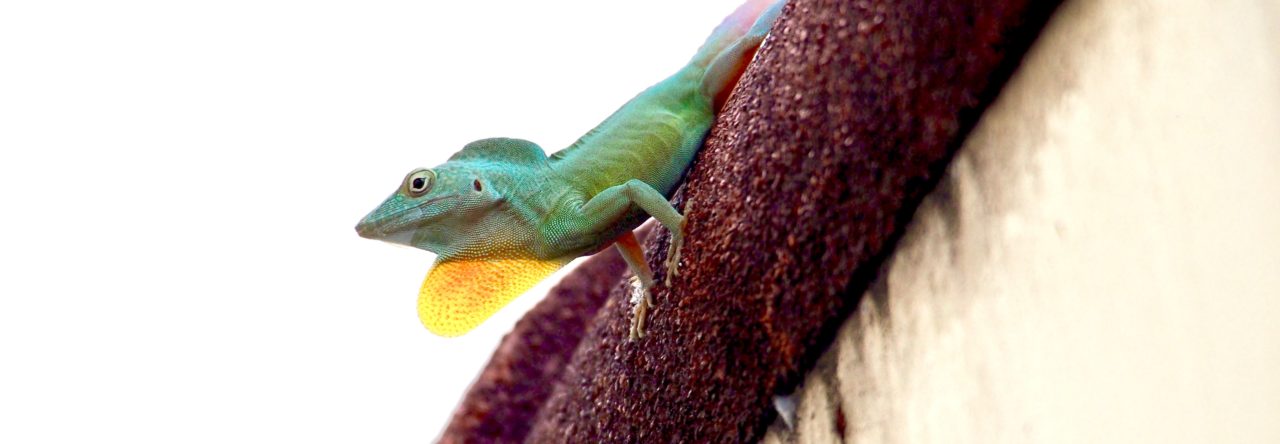
Over the past several years, semi-aquatic anoles experienced a bit of viral fame for “scuba diving,” a nickname for their ability to rebreathe a bubble of air over their nostrils while diving underwater. Rebreathing allows anoles to remain underwater for a long time and theoretically escape their terrestrial or aerial predators. My collaborators and I have clocked rebreathing semi-aquatic anole dive times of about 20 minutes, though — who knows – it may even be longer! Chris Boccia and Luke Mahler led a collaborative study a few years ago in which we found that these rebreathed bubbles do decrease in oxygen over a dive, which tipped us off that anoles are actually using bubbles in respiration.

Water anole (Anolis aquaticus) rebreathing a bubble of air. Photo by: L. Swierk
But aside from being just a mind-boggling behavior to watch and a nerdy party factoid, the existence and function of rebreathing immediately hatches dozens of ecological, evolutionary, and physiological questions. One of the most fun and puzzling of these is: how are anoles actually able to stay underwater so long just by using the oxygen in their old, exhaled breath? We were puzzled by this too since, despite the relatively low oxygen demand expected of a lizard in cool stream water, we already knew that there was something funny going on with oxygen availability in these rebreathed bubbles toward the ends of dives. Instead of decreasing linearly like you would expect, the oxygen decrease in bubbles actually slowed over time. Could this mean that – when oxygen was needed most — the rebreathed bubbles were picking up oxygen from the water surrounding them?
That air-breathing animals extract oxygen from water via bubbles is certainly not a new idea. There is solid evidence of so-called “physical gills” in many air-breathing invertebrate species, including beetles, water bugs, spiders, and even scorpions! These species maintain bubbles on or near their bodies, and they get enough oxygen from the diffusion of dissolved oxygen from the water into their air bubbles to respire and remain underwater for long durations (sometimes indefinitely!).
Given the relatively small size of these invertebrates, versus the larger sizes and greater oxygen demands of semi-aquatic anoles, we thought it extremely unlikely anoles would be able to entirely rely on physical gills for indefinite respiration. But… perhaps oxygen diffusing into their bubbles could at least extend their dives? Even only a small increase in dive time could offer a benefit when it comes to predator avoidance.
My then-PhD student, Dr. Alexandra Martin, an NSF REU student, Diane Cordero-De La Cruz, and I decided to design an experiment to begin to test this idea, using our lab’s favorite (don’t tell!) semi-aquatic anole: Anolis aquaticus. In controlled lab conditions, we altered the levels of dissolved oxygen in tanks, predicting that if lizards were able to use their bubbles as physical gills then they would be able to stay submerged longest in the most highly oxygenated tanks. We were surprised and intrigued to find exactly this – A. aquaticus dive durations increased significantly when dissolved oxygen in the water was highest, and dives were shortest when dissolved oxygen was lowest. Anoles also rebreathed fewer bubbles as dissolved oxygen increased. These patterns suggest that rebreathing bubbles may be more than just an oxygen “tank”… bubbles may also be functioning as a physical gill, replenishing the air bubble with oxygen from the surrounding water. Use of a physical gill would be a first for any known air-breathing vertebrate.

Dive duration and numbers of rebreathed bubbles (shown as estimated marginal means; EMM) of water anoles diving in low, medium, and high dissolved oxygen (DO) tanks. Figure from Martin et al. 2025, Journal of Experimental Biology
There are many next steps to confirm the mechanism and adaptive function of our results, one of which is to directly measure oxygen diffusion into the bubble. But we are fascinated by the story that these findings are beginning to tell: that anoles may be pushing the envelope of vertebrate respiration in ways we’re only beginning to appreciate. As always, anoles find a way.
You can read more about our findings in our new paper in the Journal of Experimental Biology: “High dissolved oxygen extends dive duration and suggests physical gill use in a vertebrate.”

Water anole perched on a streamside boulder. Photo by L. Swierk


