
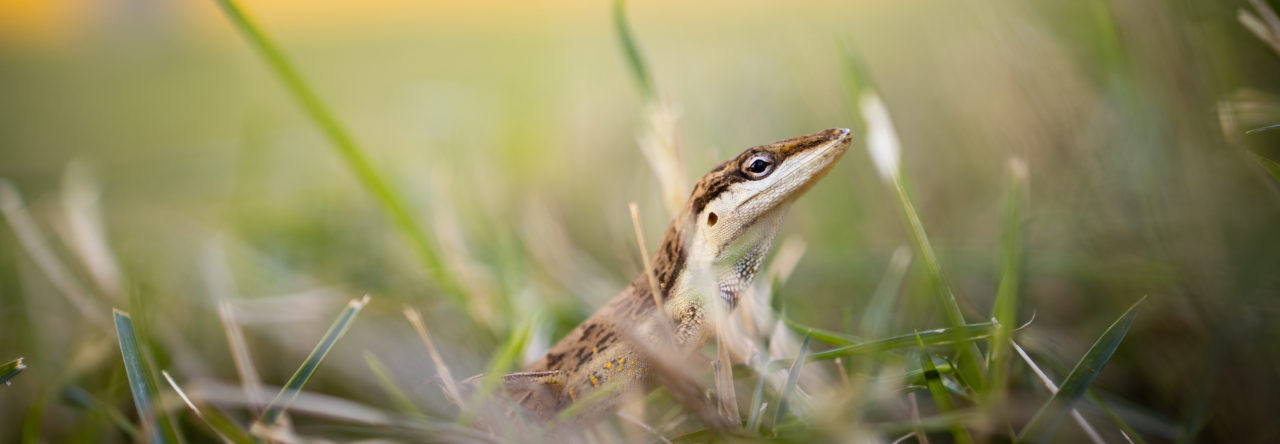
 Across the Anolis genus, color and color change are used in a variety of ways, from camouflage to signaling. While many studies have focused on male coloration, few have explored the more subtle females and the role that their coloration may play. We sought to continue to understand the role of rapid color change in Anolis aquaticus (the water anole). Previous work within the species has discovered that color change is used as camouflage and that males are more consistent at matching their background coloration than females. However, whether color change could also be used as a social signal had yet to be tested. Therefore, we wanted to further test if color change may also be used as a social signal, specifically in females.
In the lab, we exposed female lizards to a dark enclosed tank to darken their coloration (these lizards experience rapid-color lightening) and then immediately placed them in an arena with a male conspecific. We repeated this with an empty tank as well for each lizard to compare both a social and isolated color change. To determine the extent of color change, we photographed their coloration before and after each trial. Using MicaToolbox in ImageJ, we created a visual model based on the brown anole visual system to get a better look into what these anoles look like to each other.
We discovered that while color did change during each trial, there was not a significant difference between social and isolated trials. However, we did find that females that had better body condition had bluer and less green coloration as compared to those with lower condition. We propose a few directions toward which these results may be pointing . First, this shift away from green and toward blue seems to be a less camouflaged color and therefore may indicate that greater body conditioned individuals don’t camouflage as much as smaller lizards. This would also coincide with previous findings that females are more conspicuous in the field than males. These findings may also lead to the idea that females are using this coloration to signal quality to potential mates and that coloration is indicative of health in the species.


Ultimately, our study shows the importance of continuing to explore drivers of color change in the genus, and to broaden our studies to include or highlight female coloration in not only Anolis but across taxa.
Check out more details of our findings in our paper out now in Biological Journal of the Linnean Society.