
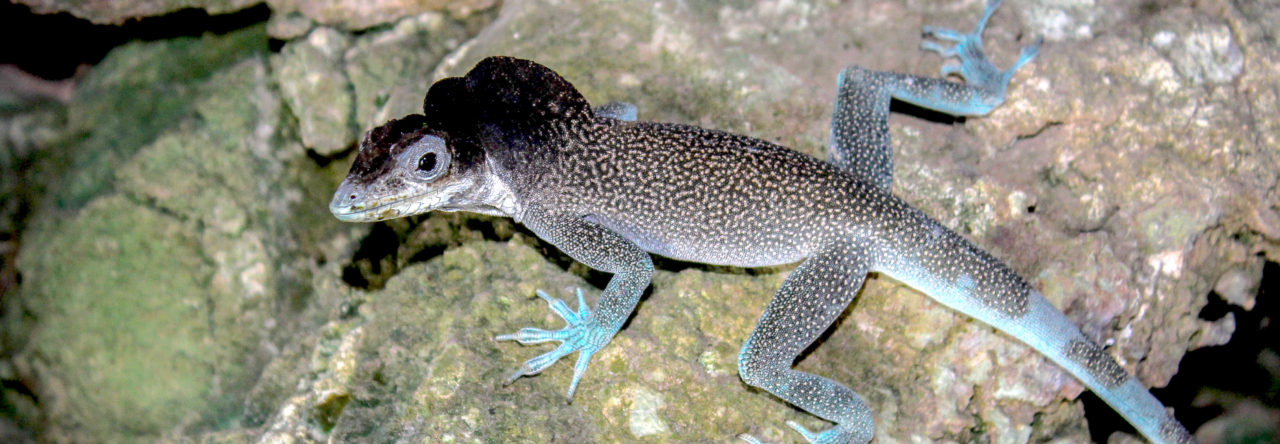

Color in life of Anolis laevis. Dewlap of adult male (A), lateral head of adult male (B), lateral body of adult male (C), ventral body of adult male (D), lateral head of adult male stressed (E), lateral body of adult male stressed (F), mouth of adult male (G), dewlap of adult female (H), lateral body of adult female (I), ventral body of adult female (J), lateral head of adult female stressed (K), lateral body of adult female stressed (L).
The rediscovery of Anolis laevis is one of those stories that seem written to remind us why biological exploration remains indispensable. Described in 1876 from a single specimen, holotype ANSP 11368, and then lost to science for a century and a half, this small anole with a strange proboscis on its snout became a myth of the montane forests of northeastern Peru. For more than a decade, herpetologist Pablo Venegas conducted repeated and systematic surveys throughout the region, from 2003 to 2018, intensively searching the same montane forests without finding a single trace of the elusive Swordsman anole, reinforcing its reputation as a species that might have vanished forever.

Holotype of Anolis laevis ANSP 11368 (SVL = 60.0 mm). Head in dorsal (A), lateral (B), and ventral (C) views. Body in dorsal (D), and ventral (E) views. Tail in ventral (F) view.
The work reported in our recent paper began quietly in 2008, when two adult females were collected in Laguna Negra, in the department of San Martín, Peru, without anyone knowing at the time that they held the key to solving a historical enigma. Ten years later, in 2018, two adult males appeared in Posic and Nuevo Chirimoto, confirming that the “swordsman anole” was still alive. It was at that moment that a systematic investigation began which, after years of comparing morphology, reviewing historical collections, and documenting living individuals, succeeded in bringing to light a species that had remained in the shadows for generations.
The process was as captivating as it was rigorous. Researchers compared every detail of the new specimens with the 19th-century holotype, a specimen that is deteriorated but still retains the diagnostic characteristics that define the species. The male’s small rostral proboscis and dorsal crest formed by triangular scales are still visible, features that match precisely with the rediscovered animals, dispelling fears that this was a different cryptic species. The study also revealed a surprising sexual dimorphism: the females, unknown until now, completely lack a proboscis but have a black gular fold with white scales, while the males have a pink gular fold with a bluish border. This revelation not only completed the portrait of A. laevis, but also provided an essential piece of the puzzle for understanding how sexual selection and visual signaling operate in these Andean anoles.

Sexual dimorphism in Anolis laevis.
The work condenses decades of uncertainty into a powerful visual sequence. The holotype allows us to observe, from dorsal, lateral, and ventral views, that even after 150 years of preservation, the key features are still there, anchoring the species’ identity to the present. The photographs reveal a lichen-colored lizard, almost camouflaged among moss and damp leaves, and show the female with her dark dewlap deployed for the first time. Comparison with other proboscis anoles, such as A. phyllorhinus from Brazil and A. proboscis from Ecuador, highlights a fascinating evolutionary truth: although these “big-nosed” lizards look alike, they belong to different lineages.