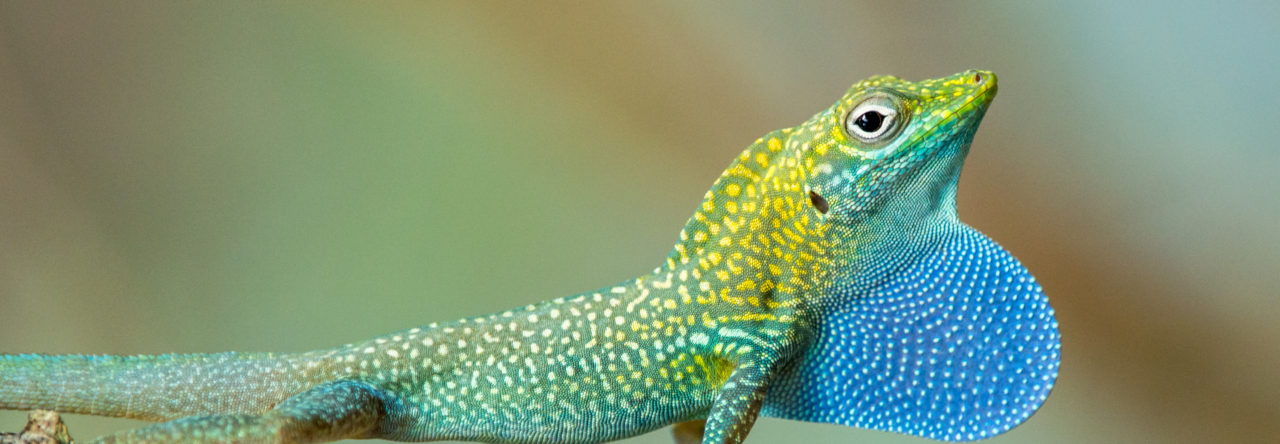

Sexual dichromatism in anole dewlaps. Anolis insignis above, Anolis transversalis below. Males on left, females on right. Photos appeared in Lizards in an Evolutionary Tree, photographed by Steve Poe (insignis), Arthur Georges (male transversalis) and Alexis Harrison (female transversalis).
Dewlaps—the extensible throat ornaments of anoles—are classically viewed as male secondary sexual traits used in mate attraction and rival assessment. However, many species exhibit fully developed female dewlaps, and in numerous cases, male and female dewlaps differ in coloration (see some great photos and info in past Anole Annals posts here, here, here, and here! The last post actually inspired Dr. Michael Yuan, senior author on this paper, to work on female dewlaps). What drives this sexual dichromatism?
To address this, we assembled a comparative dataset encompassing 292 Anolis species, documenting dewlap colors in both sexes from the literature, field guides, and community science sources including Anole Annals, iNaturalist, and AnoleKey. We classified dewlap colors based on pigment content, focusing on carotenoids and pterins, which produce red, orange, and yellow hues and often serve as condition-dependent signals. Species were classified as dichromatic if males and females did not share color elements. We integrated these data with measures of body size, sexual size dimorphism, and species co-occurrence, mapped onto the anole phylogeny.

Figure 1. Evolutionary patterns of pigment presence in Anolis dewlaps. (A) Ancestral reconstructions showing how carotenoid- and pterin-based coloration evolved in females (left) and males (right). Pie charts indicate the probability of each pigment state at every node, with tip states shown at the ends of the tree. (B) Proportion of species with each pigment type, separated by dewlap dichromatism categories: female-dewlap absent, monochromatic, and dichromatic.
Our analyses indicate that dewlap coloration is highly evolutionarily labile, with frequent gains, losses, and reversals across the phylogeny. Male and female colors are phylogenetically correlated, suggesting some evolutionary constraint. Crucially, sexual dichromatism appears largely driven by female-specific loss of costly pigments, rather than male pigment evolution. This pattern implies that female dewlap coloration evolves under selective pressures distinct from males, rather than merely reflecting a correlated response to male traits.
We also found evidence consistent with signal partitioning: females were less likely to share dewlap colors or costly pigments with sympatric species, particularly in species-rich communities. In contrast, sexual size dimorphism did not predict dichromatism, suggesting that pleiotropic or androgen-mediated constraints are insufficient to explain female color divergence.
In summary, male dewlap coloration remains relatively constrained, likely due to sexual selection, whereas female dewlaps exhibit greater evolutionary flexibility, often losing costly pigments or diverging in hue to reduce signal interference. These results underscore the role of female-driven evolutionary dynamics in shaping ornamental traits and highlight the importance of considering female signaling in studies of sexual dimorphism.
Future work should investigate the behavioral function of female dewlaps and examine UV reflectance, which is currently poorly characterized but perceptible to anoles. Understanding these components will be critical for elucidating the selective pressures driving dewlap evolution and sexual dichromatism.
You can check out the paper here:
Erin P Westeen, Guinevere O U Wogan, Ian J Wang, Michael L Yuan, Loss of pigments in females is associated with sexual dichromatism in an ornamental trait, Evolution, Volume 79, Issue 7, 1 July 2025, Pages 1299–1309, https://doi.org/10.1093/evolut/qpaf075
And a nice digest written about the article here:
Madelynn M Sinclair, Digest: Sexual dimorphism and signs of selection in the dewlaps of female Anolis lizards, Evolution, Volume 79, Issue 8, August 2025, Pages 1690–1691, https://doi.org/10.1093/evolut/qpaf122