
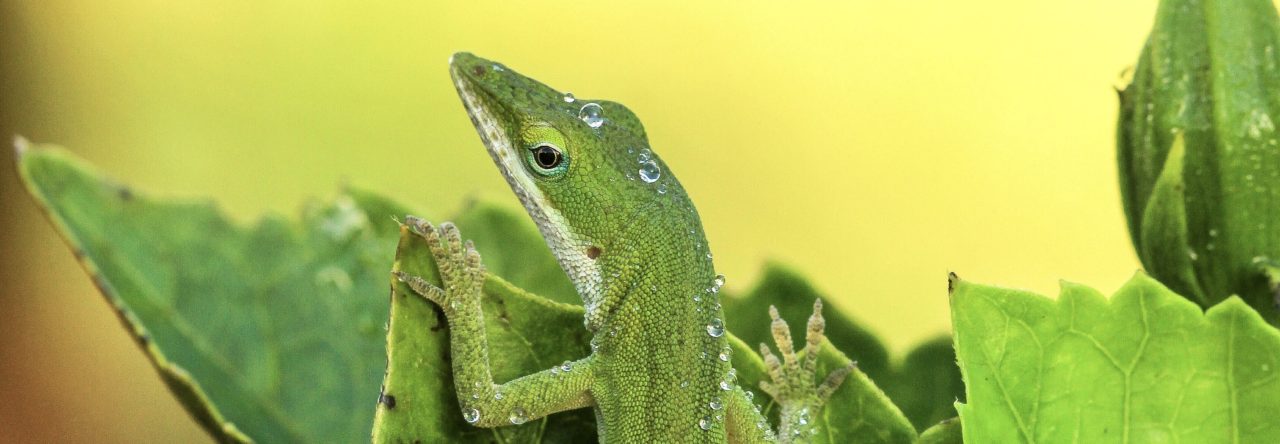

Figure 1. Sleeping green anoles on leaves (Photographs by Osamu Sakai).
Sleep is one of the most fundamental states for animals, including humans and wildlife. When people travel to unfamiliar places, one of their first concerns is often where they will sleep that night — at least it is for me. Lizards may face a similar challenge.
Like other diurnal Anolis lizard species, green anoles (Anolis carolinensis) are active during the day and rest at night. Sleeping on vegetation is thought to be a common strategy among arboreal anoles, likely reducing the risk of attacks from ground-dwelling predators. But, how do they sleep in the wild when living in an unfamiliar, non-native environment? Which plant species do they use for beds? Do males and females differ in their choices, or do sleeping habits change across life stages? To address these questions, we investigated the night-time microhabitat use of free-ranging green anoles.
Our focal population is A. carolinensis on the Ogasawara Islands, Japan, located about 1,000 km south of Tokyo. This population originated in North America (the Gulf/Atlantic clade) and has been established on these subtropical islands since the 1960s. During night-time surveys, we observed the green anoles perched on leaves with their eyes closed (Fig. 1). They showed no reaction to flashlight illumination and only a weak response, if any, to gentle tactile stimulation. In short, they appeared to be fast asleep!!
Our survey revealed no sexual differences in sleeping sites with respect to perch height (Mean: males = 256.2 cm; females = 261.7 cm) or the plant species used for beds. In contrast, juveniles slept on much lower vegetation (Mean = 103.0 cm) and used different plant species to adults (Fig. 2).

Figure 2. Ontogenetic niche shifts in the sleeping sites of green anoles. Adults and juveniles used different beds in terms of perch height and variety of plant species. The similarity of the plant species was assessed using Pianka’s niche overlap index
We also found that the characteristics of their sleeping sites were influenced by habitat type. Comparisons between natural forests and human-modified areas suggest that local vegetation has a strong influence on the types of leaves that the green anoles sleep on (Fig. 3). In human-modified habitats, the green anoles were frequently found sleeping on two palm species: the Formosa palm and the golden cane palm. However, at natural forest sites where these palms are absent, the green anoles did NOT rely on particular plant species for their beds.

Figure 3. Comparison of the plant species used by adult lizards in (a) natural vegetation (n = 25) and (b) human-modified environment (n = 98). An asterisk (*) after the plant name represents non-native species on the Ogasawara Islands.
Together, our findings provide a natural history note on A. carolinensis. Notably, the green anoles exhibit an ontogenetic niche shift in sleeping site: as they grow, they change both the perch height of the plants and the species they use for sleeping. Is this niche shift also observed in native green anole populations? Does this pattern have adaptive significance? Further research would be valuable in answering these questions.
Finally, we’d like to discuss the implications for invasion biology. On the Ogasawara Islands, the introduced A. carolinensis has caused severe declines in the native insect fauna, including many endemic species. Improving our understanding of the basic natural history of these animals (i.e., sleep ecology) could contribute to more effective management and control. If you’d like to learn more, the full open-access paper is available in Herpetological Conservation and Biology 20(3): 519–527.

- Where Do Green Anoles Go to Sleep? Night Life in the Ogasawara Islands - January 8, 2026
Leave a Reply