
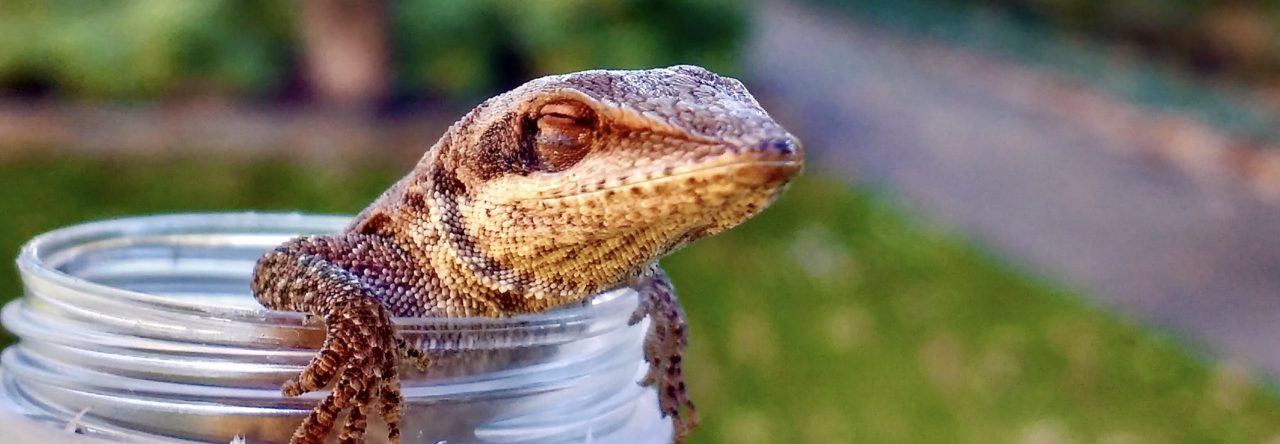
 Ok, who recognizes this one? And does it look it’s a member of any of the ecomorph categories? You make the call!

Professor of Biology and Director of the Living Earth Collaborative at Washington University in Saint Louis. I've spent my entire professional career studying anoles and have discovered that the more I learn about anoles, the more I realize I don't know.
Latest posts by Jonathan Losos (see all)
- New Article on Anolis roosevelti and the Question of Its Survival - March 16, 2024
- Lizard Diving Champions: Trading Heat For Safety Underwater - March 15, 2024
- Do Large Brown Anoles Get the Most Mating Opportunities? - January 6, 2024
Hispanioland
Neat! Twig Anole? Not a west indian species, right? The limbs and tail seem slightly longer than in typical greater antillean twig dwarves…
Ludovic Deutsch
Looks like twig anole yes.
Peter Mudde
Hmm I does look like a mainland Dactyloa-species with connections to A.punctatus
Levi Gray
Looks like a Phenac to me. Is it orcesi?
Robert Powell
Considering your recent itinerary, could it be A. utilensis?
Todd Jackman
I’m going to go out on a limb – one that is almost certainly wrong – and say Anolis pumilis. If I recall, it was A. pumilis that we were looking for in Cuba at night when armed locals came and Jonathan suddenly became nearly fluent in spanish – A. pumilis doesn’t fit nicely as it is a bush anole that sort of acts like a twig anole, if I recall correctly.
Jonathan Losos
It’s funny how having a colonial era musket pointed at you can help with your foreign language proficiency.
Steven Poe
It looks like williamsmittermeierorum, but there are a few South American phenac/tigrinus group things that look similar. If it is from Peru or Southern Ecuador, then williamsmittermeierorum. If it is from Venezuela, then tigrinus.
Editor’s note: this comment was posted yesterday, but for some reason ended up in the spam folder!
Jonathan Losos
Good work everyone. Most of you were on the right track. And kudos to Steve Poe, who in email correctly identified this as none other than Venezuela’s Anolis tigrinus. The photo was taken recently by Anthony Herrel, who remarked that in all aspects, it appears similar to a West Indian twig ecomorph, a point recently made in a paper by Gabriel Ugueto.
Fernando Ayala
It is a male (tigrinus-male-herrel). The title of the photo was saying this when you download.