
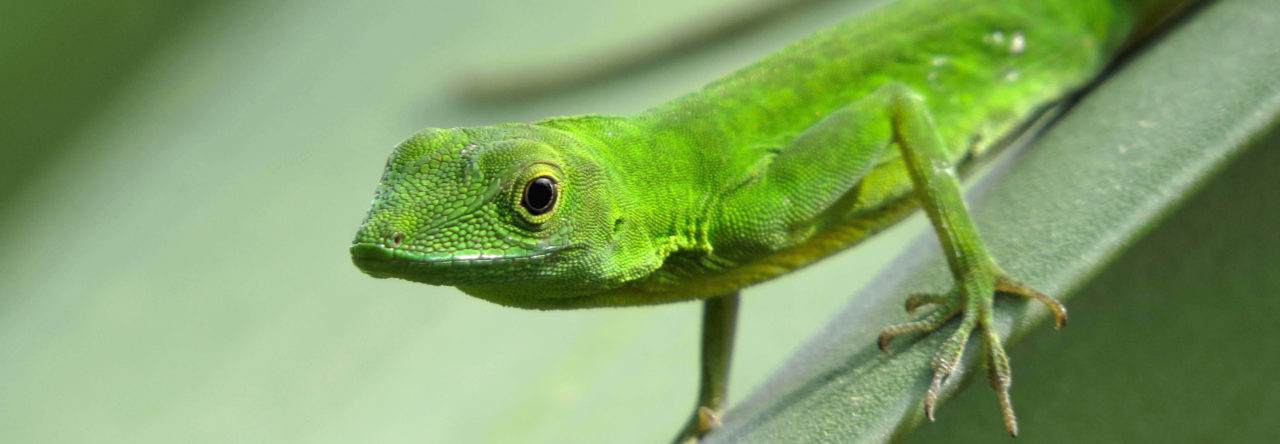
 All things 8-bit are making a comeback. The worlds of art, technology, fashion and music all have (re)embraced the format, and I, for one, don’t want anoles to be left behind. Here’s my 8-bit take on a member of the disticus clade (bonus points on guessing which one). Drawn in Adobe Illustrator following these instructions, you can also roll your own with a free webapp here.

I am an Assistant Professor at Rutgers University-Camden. I use a variety of evolutionary genetic approaches to ask questions about gene flow, adaptation and speciation.
Latest posts by Anthony J Geneva (see all)
- John David Curlis - March 1, 2022
- Joe Macedonia - January 31, 2022
- Lindsey Swierk - January 27, 2022
Martha Munoz
My guess is A. distichus vinosus.
This makes me miss Amstrad like whoah.
geneva
Wow, an Amstrad! I never had the pleasure. I cut my teeth on an Atari 2600.
Good guess on the animal, but not the one I used. For those wanting a cheat sheet, the specimen I used for a model is in this image.
Martha Munoz
So, any reason for choosing A. d. ignigularis??? Vinosus is still my favorite. We have a formidable stock of them in the herp collections here.
geneva
You are right, its an ignigularis. My dissertation work revolves around the divergence of ignigularis and ravitergum, so it had to be one of those and frankly I think ignigularis are the prettier of the two, and have the cooler latin etymology – “fire throated” always beats “grey backed” in my book. I agree that vinosus are stunning, although I still haven’t seen ocior or altavelensis, which may give them a run for their money.
Martha Munoz
So I see! Well ocior may only be a painting, but it doesn’t even look like distichus anymore to me. It hits the Grass-Bush ecomorph in my mind with that lateral stripe. If you’ll be in the DR this summer we should catch up!